Quick Take
- Narration: Kristin Barkhurst reads with the patient warmth the material requires, each story gets room to breathe without feeling slow
- Themes: Memory, connection, dignity in later life, intergenerational storytelling
- Mood: Gentle and nostalgic, designed for shared listening rather than solitary immersion
- Verdict: A distinctive and genuinely useful audiobook that serves a specific audience, seniors with dementia or isolation, and the families and caregivers trying to reach them, with more skill and dignity than the genre usually manages.
I came to Inspiring Short Stories for Seniors through a conversation with a reader who had purchased it for her father, who had vascular dementia. She told me they’d started working through the stories a week in and that her father loved the questions at the end of each one, that they prompted him to remember things she hadn’t known about him. She’d learned things, she said. Beautiful things. That’s a particular and powerful use case for an audiobook, and it’s one that the genre almost never designs for deliberately.
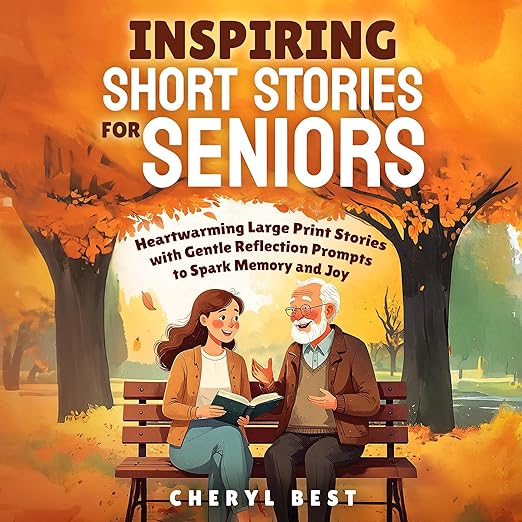
Cheryl Best’s collection of thirty short stories, narrated by Kristin Barkhurst, does something unusual in the audiobook landscape: it is explicitly designed as a relational listening experience rather than a solo one. Each story runs approximately ten minutes, and each includes memory-sharing prompts intended to generate conversation between the listener and whoever is with them, a daughter, a son, a caregiver, a friend. The prompts are not adjuncts to the stories; they are load-bearing structural elements. This is not a book you listen to on your commute. It is a book you listen to with someone you want to reconnect with.
The Ten-Minute Story as a Format Choice
The decision to constrain each story to roughly ten minutes is more deliberate than it initially appears. For seniors experiencing cognitive decline, fatigue, or reduced concentration spans, a short and complete narrative arc provides satisfaction without demanding sustained attention. Best describes the prose as written in clear, flowing language that makes listening comfortable and fatigue-free, and Barkhurst’s narration honors that design, she reads at a measured pace that doesn’t rush through emotional beats or compress the warmth out of scene-setting.
The stories themselves cover a range of domestic and social situations from the mid-twentieth century onward: a widowed teacher facing Valentine’s Day alone until her students surprise her, two girls running a detective agency in 1959 suburbia, a prom date that turns into a dance lesson from Grandpa, a reluctant new resident at assisted living discovering what home can still mean, a bowling league that becomes a lifeline for women in retirement. The settings and characters are recognizable to the likely audience without being condescending, Best is writing about the world these listeners lived in, not a sanitized fantasy of it.
The Memory Prompts and What They’re Actually For
The memory-sharing prompts at the end of each story are where this audiobook does something genuinely original. Rather than functioning as comprehension questions or discussion points in the conventional sense, they are designed to activate autobiographical memory, to invite the listener to locate the story’s events in their own experience. For seniors with dementia, this is a specific therapeutic application. The prompts give the listener a pathway into their own history that doesn’t require them to retrieve information on demand (which dementia disrupts) but rather to recognize and respond to a frame (which is a different cognitive process that often remains more intact). A reviewer who used the book with her father noted that conversations generated by the prompts revealed memories she had not known about, which is a description of the prompts doing exactly what they were designed to do.
Barkhurst’s narration is consistent across the full collection, with a warmth that doesn’t tip into sentimentality. She voices the various characters with light differentiation rather than theatrical range, keeping the focus on the story rather than the performance.
Who Should Listen and Who Should Skip
This audiobook has a specific and underserved audience, and it serves that audience exceptionally well. It is the right choice for families and caregivers listening alongside a senior, particularly one experiencing early to moderate cognitive decline or social isolation, who want a structured, low-pressure format for conversation and connection. It also works for senior listeners who simply enjoy short, complete stories from recognizable mid-century settings.
Skip if you’re looking for a single-listener audiobook for your own entertainment, the relational design is so central to the product that it functions less well without a second person present. Also skip if you’re looking for contemporary or plot-driven fiction; these are quiet, character-centered stories designed for recognition rather than surprise.
Frequently Asked Questions
Can Inspiring Short Stories for Seniors be used with a family member who has dementia?
Yes, and this is explicitly one of the use cases it was designed for. Multiple reviewers, including one whose father has vascular dementia, report that the memory-sharing prompts at the end of each story successfully activate autobiographical memory, prompting conversations about personal history that wouldn’t otherwise occur. The ten-minute story length also suits reduced concentration spans associated with cognitive decline.
Is this intended as solo listening or shared listening with a senior family member?
Shared listening is central to the design. The memory-sharing prompts are structured as conversation starters for a listener and a family member, caregiver, or friend. The book can be listened to alone, but a significant part of its value is in generating the conversations the prompts are designed to initiate.
Are the stories set in any particular historical period, or do they span different eras?
The stories are primarily set in recognizable mid-twentieth-century American settings, suburbia in 1959, dance halls, bowling leagues, assisted living. They are designed to be recognizable to the generation most likely to be listening, which means they locate nostalgia in the specific texture of that world rather than in a generic past.
How does Kristin Barkhurst’s narration handle the different characters and stories across thirty entries?
Barkhurst maintains a consistent warmth and measured pacing across the collection without resorting to theatrical character voices that would feel out of place in this material. The narration is designed to feel like an intimate reading rather than a performance, which serves the relational listening context better than a more dramatic approach would.