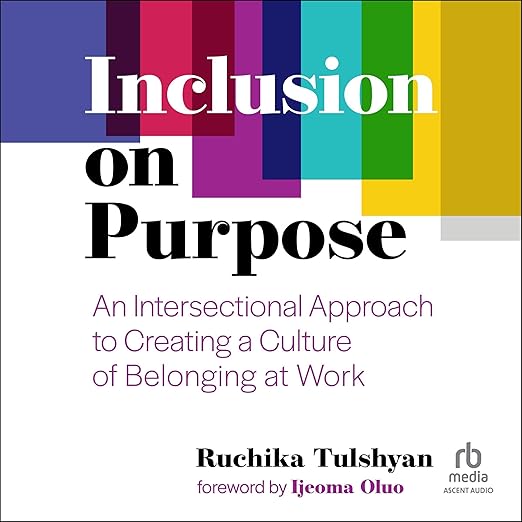
Ruchika Tulshyan's central argument in this audiobook is not that inclusion is a nice idea but that most organizations perform inclusion rather than practice it, and the gap between those two things lands hardest on women of color. Narrated by Tulshyan herself and running just under nine hours, Inclusion on Purpose is one of the clearest and most practically oriented books in the DEI space precisely because it refuses to let leaders off the hook with good intentions. The opening sections establish the problem with enough rigor that even skeptical listeners will find the evidence difficult to dismiss, and the framing is organizational rather than moral from the beginning.
Culture Add Replaces Culture Fit as a Test
The phrase "level playing field" has done enormous damage in corporate culture, and Tulshyan wastes no time in dismantling it. Her argument is structural: bias is not primarily a matter of individual bad actors but of systems that were designed around a default employee who was never a woman of color. The practical effect is that the burden of navigating those systems falls on the people who can least afford to absorb the cost. Tulshyan's framing of "culture add" over "culture fit" is one of the book's most actionable contributions. It reframes a hiring criterion that has functioned as a soft veto into something interrogatable and specific: add to what, exactly, and for whose benefit?
The book's structure is deliberate and intelligent. Tulshyan moves from diagnosing the landscape, through the specific dynamics of intersectionality where racial and gender bias compound rather than simply stack, to concrete strategies that leaders can implement without waiting for institutional permission. She is direct that "leaning in" has always placed the burden of systemic reform on the people most harmed by the system, and she presents a compelling case for why dismantling structural barriers, not coaching individuals to tolerate them better, is where organizational energy belongs. This is not a peripheral argument in the book; it is the organizing principle, and it shapes the format and sequence of every chapter that follows.
A Performance That Is Actually Recalled Experience
Tulshyan's decision to narrate this herself is the correct one. Her voice carries a specificity of experience that a professional narrator would have to approximate. When she describes the experience of being the only woman of color in a leadership meeting, or the particular exhaustion of code-switching across multiple registers of identity, the performance is not performed. It is recalled. That distinction matters for a book whose central claim is that lived experience constitutes a form of expertise that institutions routinely discount. The listener receives both the argument and its embodiment in a single, coherent audio experience.
Listeners in the management space have consistently noted that the actionability of the advice stands apart from comparable titles. Where many DEI books end at diagnosis, Tulshyan provides concrete step-by-step changes to HR practices, meeting facilitation, feedback structures, and sponsorship patterns. Reviewer Amy Gallo cited the practical specificity as the distinguishing quality, and reviewer Theo identified how even small procedural changes, such as who opens meetings and who receives credit for ideas, compound over time into either inclusion or its absence. The 8-hour-42-minute runtime is well-paced for the material; the evidence-building sections in the middle third are the ones most likely to convert a skeptical manager, and they need room to unfold rather than being compressed into conclusions.
Mentorship Gives Advice, Sponsorship Uses Organizational Capital
The section on psychological safety is worth particular attention from anyone in a leadership role. Tulshyan frames it not as a team-building exercise but as a precondition for inclusion: if employees cannot predict whether speaking up will cost them something, they rationally choose silence. The book traces exactly how that silence becomes institutionalized, and how organizations can create conditions where people know their employer has their back as structural reality rather than slogan. The argument builds from multiple directions simultaneously, drawing on research into retention, performance, and innovation alongside the more familiar equity framework.
The chapters on sponsorship versus mentorship are among the most practically consequential in the audiobook. Tulshyan makes a precise and useful distinction: mentorship gives advice; sponsorship uses organizational capital on someone's behalf. Women of color, she argues, are over-mentored and under-sponsored, and the difference in career trajectory is measurable. Reviewer Alice C. noted the depth of the research and the way intersectionality is handled not as an addendum but as a central organizing lens throughout, which distinguishes the book from titles that treat gender and race as parallel but separate categories. This is the kind of specific, research-backed insight that makes the audiobook worth returning to in sections rather than treating as a single-pass listen.
An Uncomfortable Precision for Women of Color
This audiobook is most valuable for people with hiring or promotion authority who want to move from stated values to auditable practices. HR professionals, team leads, and anyone responsible for performance reviews will find specific, implementable strategies here. Listeners who are women of color will recognize the workplace dynamics Tulshyan describes with an uncomfortable precision that multiple reviewers have noted. Those looking for a broad introduction to DEI thinking without hands-on application may find the detail more granular than they expected, but that granularity is exactly what makes it useful. The book's real offer is a working set of tools, not a diagnosis alone, and that distinction is audible from the first chapter and sustained through the final one.
In Brief
- Performance: Ruchika Tulshyan narrates her own work with the measured authority of someone who has given this material as a keynote dozens of times, confident and occasionally impassioned in ways that print cannot replicate.
- What it covers: Workplace equity, intersectionality of race and gender, structural bias versus individual effort
- Feel: Urgent and practical, grounded in research
- Our call: Managers who want to move from stated values to auditable practices will find this audiobook changes the specific questions they ask in every meeting going forward.