Quick Take
- Narration: Ron Butler reads the investigative journalism with the controlled urgency of a documentary narrator, keeping the procedural complexity from becoming tedious.
- Themes: Military-industrial corruption, the cost of institutional arrogance, civilian inventors confronting a bureaucratic monolith
- Mood: Propulsive and quietly outraged, with the pacing of a thriller built from documented fact
- Verdict: Charles Barber turns a largely unknown story of medical corruption and bureaucratic obstruction into one of the most compelling pieces of narrative nonfiction in the military-medicine space.
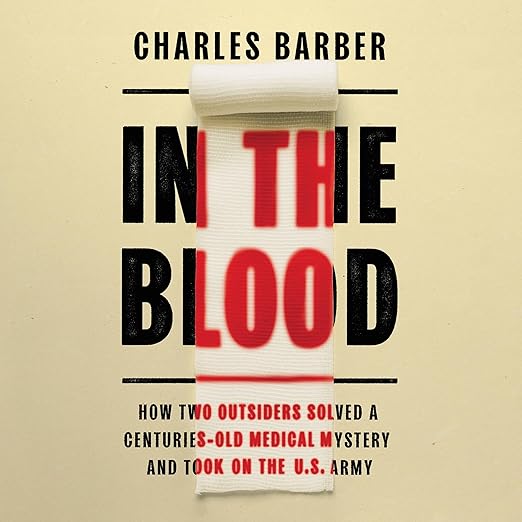
I came to In the Blood knowing only the broad outline: QuikClot, the blood-clotting agent that became standard issue in Iraq and Afghanistan, is now credited with saving thousands of lives. I did not know it took six years of fighting the US Army to get there, or that the Army had its own competing products, one of which was causing heart attacks and strokes in the soldiers it was supposed to protect. By the time Ron Butler had walked me through the first hour of this audiobook, I understood why Charles Barber calls this a David and Goliath story, and I was angry in the way that good investigative journalism makes you angry: not at individual villains but at systems that protect themselves at the expense of the people they exist to serve.
Barber is a historian of psychiatry and a clinical instructor at Yale, which is not the most obvious background for a book about military trauma medicine and Army procurement corruption. But his skill is as a researcher and a storyteller, and both are evident here. He spent years on this material, and the result has the texture of deep reporting: specific dates, documented internal communications, named sources, and a narrative that respects the reader’s intelligence by not oversimplifying the institutional dynamics that made this story possible.
Frank Hursey, Bart Gullong, and the Accidental Discovery
The origin story of QuikClot is improbable in the way that genuinely accidental discoveries often are. Frank Hursey was an absent-minded chemist with no military or medical background who discovered that zeolite, a cheap mineral used in water purification and cat litter, had significant blood-clotting properties. Bart Gullong was a salesman who recognized that the military had an acute unmet need following the 1993 Battle of Mogadishu, where soldiers who survived the initial engagement died from blood loss before they could reach surgical care. Their collaboration was not polished or institutional. It was two outsiders who believed they had found something useful and tried to tell people who had no interest in listening.
Barber renders both men with specificity and genuine affection without turning them into cardboard heroes. Hursey’s unworldliness is both charming and occasionally maddening in the account. Gullong’s sales instincts, which turn out to be more useful than any formal military procurement knowledge, are depicted with the same clear-eyed accuracy. Their partnership works because their limitations are complementary, and Barber trusts the reader to see that without having it explained.
The Army’s Campaign Against a Lifesaving Product
The book’s central antagonist is Colonel John Holcomb, the Army surgeon who championed two competing hemostatic products and led what Barber documents as a sustained campaign to undermine QuikClot’s reputation. One of those competing products, Factor Seven, had known side effects including heart attacks and strokes, a complication that was not disclosed transparently and that, in Barber’s account, was actively suppressed. The Army had invested tens of millions of dollars in its own solutions and was not prepared to acknowledge that two civilians with no military background had found something better and cheaper.
This section of the book is where Barber’s investigative journalism is most impressive. The whistleblower inside the Army who eventually triggered the Department of Justice investigation is handled with the care that a source who took real professional and personal risks deserves. The financial ties between Holcomb’s research institute and the pharmaceutical company that produced Factor Seven are documented specifically enough to withstand scrutiny. Barber does not editorialize beyond what the evidence supports, which makes the documented facts more damning than any editorial flourish could.
Ron Butler and the Weight of Seven Hours and Fifty Minutes
Butler’s narration is precise and controlled, maintaining the investigative register that a story about institutional corruption requires. He handles the technical sections on hemostasis accessibly without condescending, and the dramatic turns in the litigation narrative with appropriate gravity. The audiobook format suits this material particularly well because Barber’s writing is built around narrative tension rather than data tables or visual evidence. You do not miss anything by listening rather than reading.
Who Should Listen and Who Should Skip
In the Blood is essential listening for anyone interested in military medicine, procurement corruption, or how institutions protect themselves at the expense of mission. Veterans and military medical personnel will find the subject matter directly relevant. General readers drawn to narrative nonfiction about institutional arrogance will find this accessible and compelling. Those who prefer their nonfiction without legal and bureaucratic procedural detail will find the middle section demanding.
Frequently Asked Questions
Does the book explain what QuikClot is and how it works without requiring a medical background?
Yes. Barber explains the science of hemostasis and what makes zeolite effective at controlling blood loss in terms accessible to general readers. The focus is on the story rather than the biochemistry, and the technical explanations serve the narrative rather than interrupt it.
How does Barber handle the legal proceedings around Factor Seven and the Department of Justice lawsuit?
He covers the whistleblower’s role, the DOJ investigation, and the resulting focus on financial ties between Holcomb’s institute and the pharmaceutical company in meaningful but not exhausting procedural depth. The legal proceedings function as confirmation of what the earlier investigative reporting had documented.
Is Colonel Holcomb presented as a villain, or does Barber maintain journalistic balance?
Barber documents Holcomb’s actions thoroughly and the evidence he presents is damning, but he maintains the discipline of sticking to documented fact rather than assigning psychological motives. The institutional context that made Holcomb’s campaign possible is treated with as much attention as the individual conduct.
How does this audiobook compare to other military medicine narratives about combat surgery in Iraq or Afghanistan?
In the Blood is more institutional and investigative than first-person surgical narratives. It is less about what combat medicine looks like on the ground and more about how decisions made in offices and research institutes determined what tools soldiers had available. Readers who want the ground-level perspective should pair it with accounts from combat surgeons embedded in theater.