The Short Version
- Narrator: Jennifer McCollum narrates her own book, and the decision pays off, her voice carries the weight of a practitioner who has lived this research, lending authority to every statistic and story she shares.
- Subjects: Women's leadership advancement, inner critic and self-advocacy, negotiating for yourself in male-dominated spaces
- Tone: Warm and candid, with the directness of a mentor who has seen the data and still believes change is possible
- Bottom line: A data-backed, story-driven guide for women at any career stage who want to move from competence to recognized leadership.
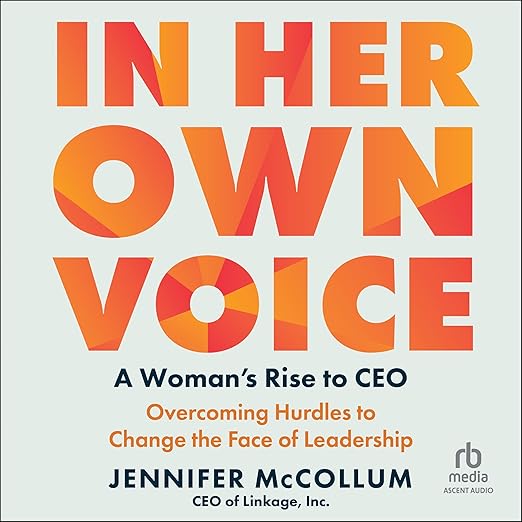
Jennifer McCollum's audiobook on women's leadership begins with a fact that should make any executive uncomfortable: fewer than ten percent of Fortune 500 CEOs are women, and the pace of change has not accelerated in the years since that statistic started making headlines. McCollum, whose organization Linkage spent twenty-five years tracking the hurdles facing women in the corporate pipeline, does not spend time lamenting this reality. She builds a map through it instead. Listening to her narrate her own research felt less like consuming a business book and more like sitting across from someone who had been keeping receipts on a system that wasn't working and had finally decided to show them to us. The combination of data precision and personal conviction is rare in this genre, and it shows from the first chapter.
McCollum's Cadence Carries Pauses of Lived Knowledge
The title is doing real work here. McCollum self-narrates, and that choice shapes the entire listening experience. Her cadence is measured and assured, the kind of delivery you get from someone who has given the keynote speech version of this material many times but has not grown tired of the ideas. Reviewer Lisa Nirell noted that McCollum weaves personal experience into research effectively, and in audio that texture is amplified, you hear the pauses that suggest lived knowledge, not just cited data. The twenty-five years of research behind this book are not worn lightly, but they never tip into academic density. The concepts land cleanly, and the through-line from data point to practical action step is consistently drawn.
One reviewer with executive-team experience pointed out that some of the advice is pitched at an earlier career stage. That is an honest caveat worth holding onto. The core frameworks, understanding your inner critic, learning to negotiate for yourself rather than simply working harder and hoping to be noticed, are universal in their logic, but the examples and scenarios skew toward women still climbing rather than those already at the top. If you are already in a C-suite role, you may find sections that resonate alongside sections that feel like a refresher you didn't need. For everyone on the way up, the match is closer.
Proving Value Requires Visibility as Much as Effort
McCollum structures the book around what she calls key competencies, specific skills and mindsets that research consistently links to women's advancement. That framework gives the listening experience a satisfying architecture. Rather than a loose collection of advice, each section builds on the last, and by the time you reach the chapters on negotiation and navigating workplace bias, the groundwork has been laid. The real-world stories are well-chosen: specific enough to feel authentic, not so insider-coded that they exclude anyone outside a particular industry.
The inner critic material is the section that will land hardest for most listeners. McCollum's argument, supported by her organization's data, is that many women internalize limits that were externally imposed, and then mistake those limits for personal truths. The work of overcoming that is psychological as much as strategic, and she handles both dimensions. Reviewer Elizabeth Hemphill-Burns singled out this section as among the most valuable in the entire book, and it is easy to hear why. The section on proving value through visibility rather than effort alone challenges one of the most deeply embedded professional myths that women in particular are socialized to believe. The argument is made without condescension, and that matters, the audience for this book is accomplished women, not beginners who need to be told the basics.
The negotiation chapters build directly on the inner critic work. McCollum's research shows that women consistently undervalue themselves when entering salary conversations and often prepare less thoroughly for self-advocacy situations than they would for any other high-stakes professional interaction. The reasons for this are cultural and psychological, and she addresses both layers. This combination, research context plus practical response, is where the book earns its place among the stronger entries in the women's leadership genre.
Linkage's Pool Reflects Mid-to-Large Corporate Environments
McCollum's data comes largely from Linkage's research pool, which means it reflects the organizations and leaders that engaged with that program. That is a meaningful sample, but it is not the full spectrum of working women's experiences, and listeners whose workplaces or industries sit far outside that world may occasionally find the scenarios feel slightly distant. The book is strongest for those in mid-to-large corporate environments; the frameworks translate to smaller organizations and nonprofits, but some extrapolation is required.
The negotiation chapters are solid but not the most granular treatment of the subject available. If salary negotiation or contract strategy is your primary need, you would be better served pairing this book with a dedicated resource on that topic. What McCollum offers is the broader architecture of why women often arrive at negotiating tables under-prepared and under-confident, which is arguably more important than tactical scripts, but worth naming as the book's scope.
In Her Own Voice, on Her Own Terms
This audiobook is well-suited for women in early-to-mid career phases who feel the ceiling but haven't been given language for what's holding them back. It is also genuinely useful for managers, of any gender, who want to understand the systemic and psychological forces their direct reports are navigating. Human resources professionals and people in talent development roles will find the research framing particularly useful. Those who prefer their professional development to come through story rather than framework-first instruction will respond well to McCollum's approach. Senior executives who have already worked through material on inner critics and negotiation may find less that is new, but the narration alone makes for an efficient listen at just over eight hours. The self-narrated format is itself an argument for the book's subject: a woman speaking authoritatively about her own research, in her own voice, on her own terms.