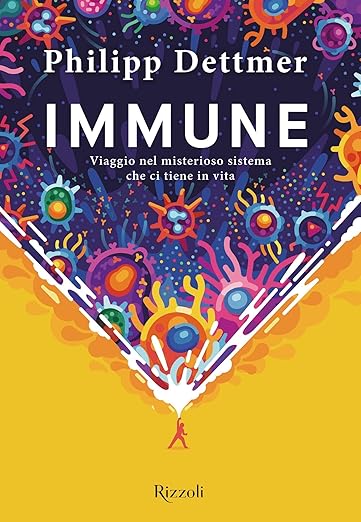
The Short Version
- Read by: One credited voice, Steve Taylor, sitting inside a listing whose other fields all describe an Italian print edition.
- At its heart: Immune system as inhabited architecture, popular science that refuses to talk down, illustration-led explanation.
- Vibe: Patient, curious, quietly alarming.
- Short version: Outstanding on its subject, but settle the language and edition question before paying.
This listing appears to stack two editions on top of each other, and separating them is the first job facing anyone who wants the Immune audiobook. The narrator field names Steve Taylor and the runtime reads ten hours and twenty-eight minutes, which describes a recording. Every other field describes a printed book: a publisher entry naming an Italian house, a language entry reading Italian, an ISBN, and a page count of 429. The description is written entirely in Italian, and among the five written notices attached, four are in Italian and one in German. Confirm with the seller which language this recording is in before weighing anything else.
What sits underneath the metadata is worth the trouble. Philipp Dettmer is described in the publisher's own copy as the mind behind the most popular science-communication channel on YouTube, which one reviewer names as Kurzgesagt, and Immune is his book about the system keeping you alive without asking permission. The copy opens with a blurb credited to John Green, listed there as the author of Colpa delle stelle, praising the book for explaining an immense subject through surprising analogies. The pitch that follows is deliberately domestic: you wake with a burning throat, your head hurts, and under your skin millions are fighting and dying so you can get out the door.
Our Take on Immune
Dettmer's method is announced in the description itself, which invites the reader to visit the fortress of their own body and its defenses. That framing is not decoration. The immune system arrives as an inhabited place with an architecture you can be walked through, rather than as a list of cell types to memorize, and the copy backs the ambition by calling it second in complexity only to the human brain and one of the crucial elements making life on Earth possible. A book making that claim then has to hold a general listener for a very long stretch without retreating into jargon, and the responses suggest it largely manages.
Register is what reviewers keep returning to. Matteo Morreale, who recommends it from the position of someone drawn to infectious disease, settles the balance in four words: 'Divulgativo ma non stupido', popular science that is not stupid about being popular. Marco makes the same point at more length, noting that the explanation goes reasonably deep without reaching an academic or professional level, that it stays comfortably ahead of what an average person would know, and that the 'grafiche curate e bellissime' are part of why it works. Holding that narrow band across ten and a half hours is the actual craft achievement, and it is harder than either dumbing down or showing off.
More than ten hours spent on a single bodily system is an unusual proposition, and it helps to be clear about what the length buys. This is not a survey of human biology with one chapter on immunity. It is one subject taken slowly, which means the payoff arrives late, once concepts introduced in the early hours begin combining into something that behaves like a working model. Listeners who dip in and out across three weeks will lose that accumulation entirely. The structure rewards someone who stays with it, which makes this a poor candidate for background listening while you do something else.
Why Listen to Immune
The audience this book already has is its strongest recommendation. el_dambro followed the YouTube channel for years, bought the book the moment it appeared in Italy, and calls it 'Capolavoro', a masterpiece, praising it for being written simply and accessibly while handing over a genuine understanding of how our own defenses operate. That is a reader arriving with expectations formed elsewhere and finding them met, which is a considerably harder test to pass than a newcomer's enthusiasm. Repeat audiences are the least forgiving ones, because they already know what the good version sounds like.
The second reason is something the format is genuinely good at. Immunology's difficulty for a general audience is not vocabulary, it is holding many simultaneous actors in mind at once, and a continuous narrated explanation forces you to assemble that picture in sequence instead of skipping ahead to a summary box. Marion W., writing from Germany, read the book in German and gave it as a gift in Italian, reporting that the recipient was delighted. A book that survives being handed between languages and still lands is usually one whose clarity lives in the structure rather than in any single turn of phrase.
What to Watch For in Immune
One caveat outranks the others, and it comes from the only response here that is not five stars. Emanuele calls it one of the best works of science popularization in that reviewer's own reading, then registers a precise complaint about the Italian edition: unlike the English one it is not printed on 'carta lucida', glossy paper, with the result that the illustrations, described in that notice as numerous, reproduce badly and are hard to make out. A complaint of that shape only makes sense about a book where the pictures carry meaning, and no recording carries a single one of them.
That matters more here than it would for most nonfiction, because in a book carrying the visual style of the channel Dettmer built, pictures are not ornament, they are half the explanation. A listener receives the analogies and loses the schematics, which leaves the prose holding a diagram on its own. Steve Taylor is the credited voice, and no written response on this listing describes the reading, in any language. What the material asks of a reader is unusual: long chains of named cells acting upon each other, where losing one actor collapses the paragraph. Sample a few minutes from the middle rather than the opening.
Who Should Listen to Immune
Anyone who follows the channel and wants the long-form version of what it does is the obvious audience, and so is a listener who has been told to sleep more and eat better without ever being told what the machinery underneath is actually doing. It suits people who prefer one subject examined thoroughly to a tour across many. Students heading into biology will find a friendly on-ramp here, and readers who bounced off textbook immunology because it arrived as terminology rather than as a story have the best chance of finishing this one.
The illustrations are the strongest reason to hesitate, since none of that layer survives into audio and two separate responses treat the visual work as central to the experience. It will also disappoint anyone after practical health advice, because explaining a system is a different job from telling you what to do about yours. Treat the language question as a purchase blocker rather than a detail: with an Italian description, an Italian publisher field, and notices written in Italian and German, an English-only buyer should get written confirmation about this specific recording first.
Questions Listeners Ask
Is the Immune audiobook in English or in Italian?
The listing does not settle it. The publisher, language, ISBN and page-count fields all point to an Italian print edition, while the narrator credit and runtime point to a recording. The description is in Italian and the reviews are in Italian and German. Ask the seller to confirm the language before buying.
Do the print edition's illustrations matter for the audiobook?
They do. Two reviewers treat the visual work as central, one praising the graphics outright and another complaining that the Italian printing renders them poorly on non-glossy paper. None of that layer exists in a recording, so the spoken analogies have to carry explanations that were designed to share the load with pictures.
Do I need a science background to follow Immune?
No. One reviewer sums the register up as popular science that is not stupid, and another notes it goes reasonably deep while stopping short of an academic or professional level. It assumes curiosity rather than training, though it does assume you will stay with one subject for a long stretch.