A Room for Every Period Iggy Dreamed Of
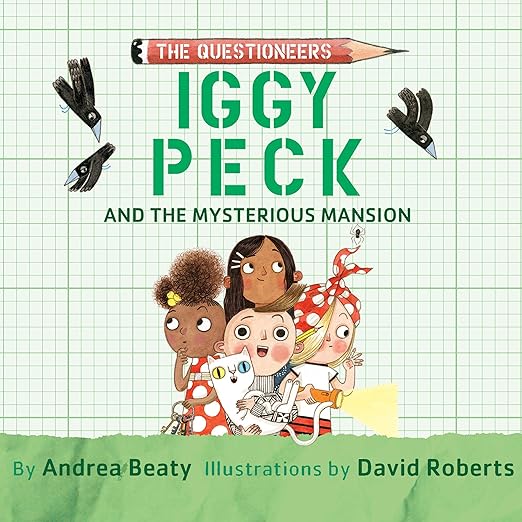
Andrea Beaty's Iggy Peck and the Mysterious Mansion, the third chapter-book audiobook in The Questioneers series narrated by Joel Froomkin, takes an architect who builds houses out of food and puts him inside a house that has a room for every architectural period he has ever dreamed about. The book runs one hour and forty-one minutes, which is right for its target audience of early independent readers and for the kind of shared family listening experience that makes chapter-book audiobooks work best. Froomkin's narration is the right temperature throughout: engaged but not manic, making the mystery feel genuinely suspenseful without escalating to a level that younger listeners would find distressing.
The premise is a good one. Iggy Peck, whose love of architecture has defined him since the picture books, encounters a mansion that is essentially a playground for everything he loves. Ada Twist's Aunt Bernice has inherited a property from ice cream mogul Herbert Sherbert that moves through countless rooms representing different architectural periods. For Iggy, this is paradise. For the plot, it is a mystery: priceless antiques have gone missing, and without those antiques to fund the upkeep, Aunt Bernice could lose the house entirely. The full Questioneers team, including Rosie Revere, Ada Twist, and Sofia Valdez, must solve the mystery before the house is gone.
Iggy's Eager Precision Has Catalogued Every Building
Reviewer lotuz books identified this as the household favorite of all the Questioneers chapter-book entries for both adults and children, including children as young as three and a half. That cross-age appeal is a genuine achievement in chapter-book writing, and it comes from Beaty's decision to build the mystery around something concretely interesting rather than generically spooky. Architectural history, as a subject for a children's audiobook, turns out to be surprisingly good fuel for a haunted-house story. The house itself is a character, full of periods and styles that the children identify and name, and that educational content is embedded in the investigation rather than delivered as a lesson.
Joel Froomkin's narration handles the ensemble well. The Questioneers are four distinct characters, and keeping them distinct across a chapter-book audiobook requires differentiating enough without caricaturing. Froomkin gives Iggy the eager precision of someone who has catalogued every building in his memory, gives Ada the methodical curiosity that defined her picture-book origin, and keeps the supporting cast readable across the mystery's progression. Reviewer B&C Always noted that a second grader receiving the first three books as a birthday gift was able to read along independently and remained highly engaged in the plot; the audiobook format would serve the same child as either a companion to independent reading or as a standalone listening experience.
The short chapter structure, designed for the attention span of early readers, makes the audiobook unusually well paced for shared family listening. Each chapter advances the mystery enough to feel productive without leaving children at a frustrating stopping point, and Froomkin's narration observes those natural pauses in a way that makes the listening experience feel navigable. For parents who read aloud to children and find that chapter books often run too long before natural stopping points, the audiobook version of Iggy Peck and the Mysterious Mansion solves that problem by design.
Architecture Knowledge Functional Rather Than Decorative
The book is specifically the third entry in the Questioneers chapter-book series, and while Beaty writes each mystery to stand on its own, young listeners who have met Iggy, Ada, Rosie, and Sofia in the earlier books will have established affection for the characters that sharpens their engagement with the new plot. The architectural content, which is genuinely informative without being a lesson, will be most vivid for children who have had some exposure to the concept of architectural styles, even informally. The mystery's solution involves Iggy's specific knowledge of architecture in a way that makes the genre knowledge functional rather than decorative.
At one hour and forty-one minutes, this audiobook is short even by chapter-book standards. For adults listening alongside children, the brevity is a feature: the book commits to its mystery, resolves it satisfyingly, and ends without padding. For listeners who prefer longer listens, the Questioneers series as a whole offers the option to move immediately to the next installment, and the audiobook format makes that transition straightforward.
Froomkin Keeps the Ensemble Feeling Like a Team
This audiobook is for families with children between roughly five and nine years old, with the sweet spot being the six-to-eight range that matches the early-independent-reader chapter-book audience. It works especially well as a shared listening experience for parents and young children who enjoy solving mysteries together. Children who love architecture, building, or the Ada Twist and Rosie Revere picture books will find Iggy's chapter-book adventures a natural progression. Adults looking to introduce their children to audiobooks as a format will find this one a reliable first experience; it is short enough to complete in a single sitting and engaging enough that the first one is likely to prompt requests for the others in the series. The Questioneers books are also notable for presenting a diverse ensemble of young scientists and engineers as main characters in an adventure story, and the audiobook format lets children hear those characters as fully realized people rather than concept illustrations. Froomkin's narration ensures the ensemble feels like a genuine team rather than a vehicle for any one character's lesson.
Questions Listeners Ask
Does this audiobook work as a standalone, or do children need to know the Questioneers picture books first?
It works as a standalone chapter-book mystery. Beaty introduces all four Questioneers within the story, and knowledge of the picture books is not required. That said, children who already love Ada Twist or Rosie Revere from the picture books will have established emotional investment in the characters that enhances their engagement with the longer format.
Does this audiobook include any educational content about architecture?
Yes, and it is integrated into the mystery rather than presented as instruction. Iggy's architectural knowledge is the tool that solves the central mystery, and along the way the book introduces children to the concept of different architectural periods through the mansion's rooms. The learning is embedded in the story naturally enough that children will absorb it without registering it as educational content.
How does Joel Froomkin's narration handle the four different Questioneers characters in this audiobook?
Froomkin differentiates the four characters clearly enough for young listeners to track the ensemble without relying on the text. He gives each character a consistent vocal quality: Iggy's precise enthusiasm, Ada's methodical curiosity, and the supporting dynamics of Rosie and Sofia. The differentiation is child-appropriate rather than dramatically exaggerated, which keeps the narration feeling natural across the full runtime.