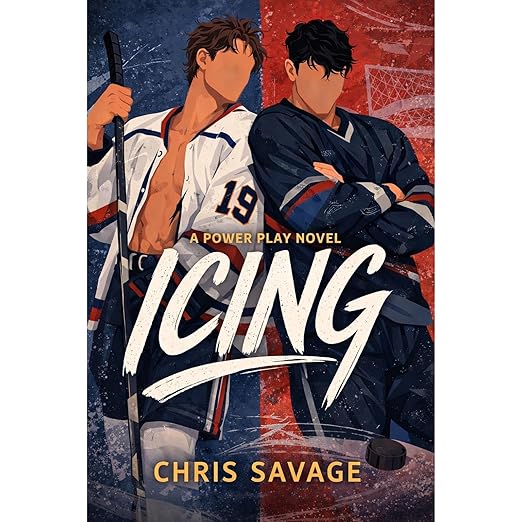
Chris Savage's construction of Cole Briggs in this audiobook deserves attention before anything else: Cole is the NHL's most publicly out player, which means Savage has chosen to begin an enemies-to-lovers hockey romance not at the moment of coming out but at the moment of what comes after. Cole has already done the hardest thing, paid the professional price for it when Chicago traded him, and arrived at the Atlanta Reapers expansion franchise as someone who has already survived disclosure. This is an unusual and smart structural choice, because it means the emotional territory the novel occupies is not 'will he come out' but 'what does it cost to ask someone else to.'
Mikhail Volkov is Savage's second protagonist, and the contrast is doing a lot of narrative work. Where Cole has lived his sexuality publicly and built an identity around visibility, Mik has spent his career behind a mask of granite silence and emotional unavailability. The forced proximity mechanics of the shared training camp hotel room are familiar romance scaffolding, but Savage uses them to force a conversation between two people with fundamentally opposed relationships to being known. The enemies-to-lovers tension functions as a surface layer over a deeper conflict about what it means to ask a closeted man to be visible in the way Cole requires.
The Virtual Voice narration is AI-generated, which introduces limitations worth naming honestly. AI synthesis has improved considerably in recent years, but it still struggles with the kind of tonal microvariation that distinguishes a scene's emotional register in real time. The hockey locker room banter requires different vocal texture than the slow burn of a shared hotel room, and a human narrator would modulate that transition instinctively. The Virtual Voice production delivers the text clearly and at a functional pace, but it does not perform the dual POV structure with the kind of character-specific vocal differentiation that Cole and Mik's contrasting personalities would ideally receive.
Cole and Mik Carry Equal, Opposite Costs
Savage's dual POV structure is one of the book's genuine assets. Cole's chapters carry the energy of someone who has already paid a price and is watching another person decide whether the same price is worth it. Mik's chapters carry the claustrophobia of a life organized entirely around concealment. Both perspectives are written with enough internal logic that the antagonism between them feels specific to these two people rather than a generic conflict of genre tropes.
The hockey world is rendered with enough specificity to feel inhabited rather than decorative. The Atlanta Reapers as an expansion franchise built from castoffs and second chances is a premise that resonates with both characters' situations, and Savage uses it to give the setting thematic weight beyond sports scene-setting. An expansion team is, structurally, a collection of people who did not make it somewhere else, and both Cole and Mik carry that history in different ways.
The emotional stakes of the central conflict, what it costs Mik to go public, and what it costs Cole to stay secret, are handled without easy resolution. Savage commits to both positions having genuine costs, which makes the eventual HEA feel earned rather than inevitable.
The expansion franchise premise is doing more structural work than hockey romance plots typically ask of their settings. Atlanta, as a city building an NHL team from players who did not make it elsewhere, maps precisely onto the emotional situation of both protagonists. Cole was good enough to be Chicago's golden boy and was still traded when he came out. Mik is good enough to have survived in the league but has organized his entire career around not being fully seen. Neither of them belongs to the narrative that NHL culture prefers to tell about itself, and the Reapers as a franchise are, structurally, a collection of the same kind of surplus. Savage uses this coherence between setting and character to give the enemies-to-lovers arc stakes that feel genuinely specific to these two men rather than generically genre-shaped.
The dual POV structure, which the Virtual Voice narration struggles to differentiate vocally, is one of the book's most consistently effective textual choices. Savage uses Cole's chapters to establish what public visibility costs and Mik's chapters to establish what concealment costs, and neither position is moralized. Cole is not heroic for being out; Mik is not cowardly for being closeted. The conflict between them is genuinely difficult rather than simply dramatic, because both men are protecting something real. That moral seriousness is what distinguishes ICING within its genre category.
A word on the series position: ICING is the first book in The Power Play Series, and Savage has designed it as an entry point with a complete HEA and no cliffhanger. Listeners who want to know whether they are committing to an open-ended serial or a complete reading experience can approach this audiobook with confidence that the central story resolves. The Power Play Series presumably continues with other players on the Atlanta Reapers roster, and the world-building investment Savage makes in this first installment establishes a franchise with room for multiple relationships to develop across the series.
Virtual Voice Struggles Most in Mik's Head
The Virtual Voice narration limitation is most noticeable during the scenes that require the most emotional range. The confrontational sequences between Cole and Mik work reasonably well because the conflict is externalized in dialogue. The internal scenes, particularly Mik's chapters where his emotional processing is primary, are where the AI narration's flatness works most against the material. Listeners who find AI narration disruptive to their immersion should factor this in before committing to nearly five hours with the format.
The romance moves quickly once the emotional dam breaks, which is appropriate to the genre conventions of enemies-to-lovers but may feel slightly abrupt for listeners who have been invested in the slower build. The snowstorm and single-room forced proximity sequence is where Savage accelerates the relationship, and the pacing shift is noticeable.
No listener reviews were available for this title, so this assessment is based entirely on the text and production as encountered.
Real Stakes Beneath Genre Sports Romance Scaffolding
ICING is well-suited for listeners who enjoy MM sports romance with genuine emotional stakes beneath the genre scaffolding. Readers who want hockey romance that treats the coming out narrative seriously rather than treating it as a quick plot device will find this audiobook more substantive than most in the category. Listeners who have enjoyed Josh Lanyon's work or Annabeth Albert's military romance series, which share the combination of genre conventions and emotional specificity, will find Savage operating in compatible territory. Those who find AI narration a significant barrier to immersion should know the Virtual Voice limitation before starting. Listeners who are primarily interested in the enemies-to-lovers and forced proximity mechanics rather than the deeper visibility-and-disclosure conflict will still find the romance beats delivered competently within those expectations.
Quick Take
- Voice: Virtual Voice AI synthesis delivers the text clearly but struggles with the tonal differentiation that Cole and Mik's contrasting personalities ideally require.
- Big ideas: enemies-to-lovers, coming out costs, forced proximity, MM hockey romance
- Atmosphere: tense and slow-burning, with the hockey world as genuinely inhabited backdrop rather than decoration
- Worth it?: A structurally smart MM hockey romance that puts real emotional stakes at the center of its tropes, limited by Virtual Voice narration that cannot fully perform the dual POV differentiation the story deserves.
Is ICING part of a series and do I need to read anything before this audiobook?
ICING is the first book in The Power Play Series and is designed as an entry point. No prior reading is required. The book delivers a complete HEA with no cliffhanger.
How does the Virtual Voice narration affect the listening experience of ICING?
The AI narration delivers the text clearly and at a functional pace, but it lacks the tonal microvariation a human narrator would bring to the emotional range of the dual POV structure. Scenes requiring internal emotional nuance, particularly Mik's chapters, are where the limitation is most apparent.
How explicit is the content in this audiobook?
ICING is an MM romance described as having scorching heat. The explicit content is present and significant, consistent with tropes like only one bed and forced proximity. Listeners seeking a lower heat level should know this is categorized as explicit within the genre.
What makes ICING different from other MM hockey romance audiobooks in terms of its handling of coming out?
Savage sets Cole's coming out before the story begins rather than making it the central plot event. The conflict instead focuses on what it costs Cole to ask Mik to become visible, and what it costs Mik to remain concealed. This shifts the emotional territory from disclosure drama to the more specific question of visibility within a relationship.