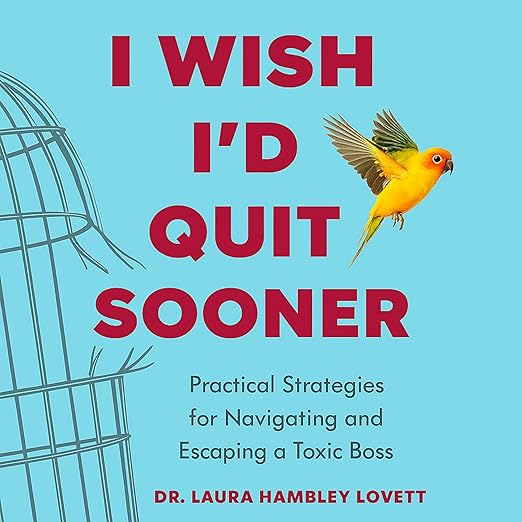
A gaslighting boss rarely announces himself in the first meeting, and that slow-dawning realization is exactly the mechanism Dr. Laura Hambley Lovett spends six hours unpacking in this audiobook. I Wish I'd Quit Sooner names eight distinct toxic-boss personas, from the Self-Serving Egomaniac to the Gaslighter, and builds a practical exit-and-recovery framework around twenty-five years of organizational psychology practice plus her own recent North American research. This isn't a memoir about one bad boss. It's a working diagnostic manual, narrated by the researcher who built it, aimed squarely at listeners currently inside a workplace dynamic they haven't fully named yet.
Toxic Bosses, From the Boardroom to the Zoom Room
What separates this from the general shelf of toxic-workplace books is how specific the eight personas get. The Control Freak and the Dishonest Manipulator require different exit strategies, and Hambley Lovett treats that distinction as the whole point rather than a marketing hook. Reviewer D. Finlay's review, titled 'Not a single research participant regretted leaving their toxic boss,' cites research suggesting '87% of professionals have experienced at least one toxic boss in the workplace,' and adds plainly, 'If that's the case, then a lot of people need to read this book.'
The synopsis's own phrase, toxic bosses thriving 'from the boardroom to the Zoom room,' is doing real work beyond just sounding catchy. It signals that Hambley Lovett isn't writing about a dynamic confined to traditional office hierarchies; remote and hybrid work created new avenues for the same controlling, manipulative, or gaslighting behaviors to operate with even less oversight, since a bad manager on a video call has fewer witnesses and fewer informal checks than one in a shared office. That expanded scope is part of why the book reads as current rather than a retread of decades-old management-book advice.
The book's own four-stage framing, helping listeners 'navigate, escape, recover, and take back control of their career,' is worth reading as a deliberate structural progression rather than four interchangeable buzzwords. Navigating comes first because most listeners start here still employed and still trying to make the situation work; escape and recovery are treated as later, distinct phases rather than a single event, which acknowledges something a lot of toxic-workplace advice glosses over: leaving a bad job doesn't automatically undo the damage it did, and recovery is its own separate stage of the work.
Lovett Reads Like a Psychologist Trained Not to React
Hambley Lovett narrates her own material, and the register she brings to it is worth naming specifically: calm, clinically steady, without performative outrage or motivational uplift layered on top. She reads like a psychologist trained not to visibly react to difficult disclosures, which turns out to be exactly right for a book asking listeners to recognize abusive patterns in their own working lives without being talked into a catharsis they haven't actually earned yet. A hired narrator reading this same script would risk either over-dramatizing the personas into cartoon villains or under-selling the real damage being described; Hambley Lovett's own clinical experience keeps the tone anchored in professional steadiness throughout.
Reviewer Elizabeth Hamilton-Guarino credits the book with 'compassion and clarity to a subject many people struggle to name,' and that naming function is where the eight-persona structure earns its keep. It gives listeners actual vocabulary, not just validation, for behaviors they may have spent years explaining away as a personality clash or their own oversensitivity. TL Blackburn's review points to Hambley Lovett's decades of experience as an organizational psychologist as the source of the book's practical grounding, distinguishing it from advice built purely on anecdote.
Building an eight-persona taxonomy rather than describing toxic behavior in the abstract is a meaningfully different kind of practical guide, and it's worth naming why that structural choice matters. A vague sense that your boss is just difficult is hard to act on; a specific label, the Dishonest Manipulator versus the Control Freak versus the Gaslighter, gives a listener language to use in a conversation with HR, a therapist, or their own internal decision-making about whether to stay or go. Twenty-five years of applied organizational psychology practice sits behind that taxonomy, which is a meaningfully different foundation than a book built purely from personal anecdote or a single consulting engagement.
Validating and Unsettling in the Same Sitting
This is squarely a practical guide, not a narrative memoir, so listeners expecting a story-driven structure with a clear beginning, middle, and end should recalibrate. The eight personas function more like reference chapters, useful to revisit individually depending on which boss type a listener is currently dealing with, which is a slightly different listening experience than a book meant to be consumed start to finish in one sitting. The accompanying PDF, included with the audiobook purchase, appears to carry supporting worksheets and frameworks that reinforce the audio content, and listeners who skip it may miss some of the practical implementation tools referenced throughout.
The subject matter itself is heavy by design, since the book is explicitly built around workplace abuse, gaslighting, and manipulation, and Hambley Lovett doesn't soften that reality for the sake of a lighter listen. Anyone currently in an acutely difficult work situation should know going in that recognizing your own boss across these eight personas can be validating and unsettling in the same sitting. The six-hour runtime moves briskly for the amount of ground covered, eight distinct personas plus recovery strategy, which means some listeners may want to revisit specific chapters rather than absorb everything in one pass.
The synopsis pitches this at 'the millions of employees worldwide' currently enduring unhealthy workplace dynamics, a genuinely global framing rather than one narrow to a single country's corporate culture, and it's worth weighing against Hambley Lovett's specifically North American research base; the underlying persona patterns likely travel well across borders, but listeners outside North America should expect the specific cited research to skew toward that region.
More Field Guide Than Personal Memoir
Anyone currently working under a boss they can't quite name what's wrong with is the clearest audience for this one, especially listeners who have already tried to explain the dynamic to friends or family and come up short on vocabulary. It's also a strong pick for HR professionals, career coaches, or team leads who want a shared framework for discussing workplace dysfunction with more precision than a generic difficult-manager complaint usually offers. The self-narration adds real credibility here, since Hambley Lovett isn't just summarizing research, she built it.
Readers hoping for a warm, story-driven memoir about surviving one specific bad boss will want a different kind of book here; this one reads more like a field guide than a personal narrative, prioritizing pattern recognition across eight distinct persona types over one detailed personal arc. The runtime is also efficient rather than expansive, so anyone hoping for extended case studies or long-form anecdotes per persona may find the six hours move faster than the depth of the subject matter might suggest.
Before You Press Play
- Narrator: Dr. Laura Hambley Lovett narrates her own research with calm, clinical steadiness, never performative outrage or forced uplift.
- Subjects: toxic leadership recognition, workplace psychology, exit and recovery strategy
- Tone: Measured and validating, more diagnostic than dramatic
- Bottom line: A precise, research-backed audiobook for anyone trying to put a name to a bad boss dynamic, though it functions more as a reference tool than a single continuous narrative.
Does this audiobook name specific types of toxic bosses, or just describe toxic behavior generally?
It names eight specific personas, including the Self-Serving Egomaniac, the Control Freak, the Dishonest Manipulator, the Great Divider, the Unethical Corrupter, the Abusive A-Hole, Disordered Personalities such as the Narcissist and Sociopath, and the Gaslighter, giving listeners specific vocabulary rather than general complaints.
Do I need to already be in a toxic work situation for this audiobook to be useful?
No, though it's most immediately useful for listeners currently navigating one. HR professionals, team leads, and anyone who has previously struggled to explain a past difficult boss will also find the eight-persona framework genuinely useful.