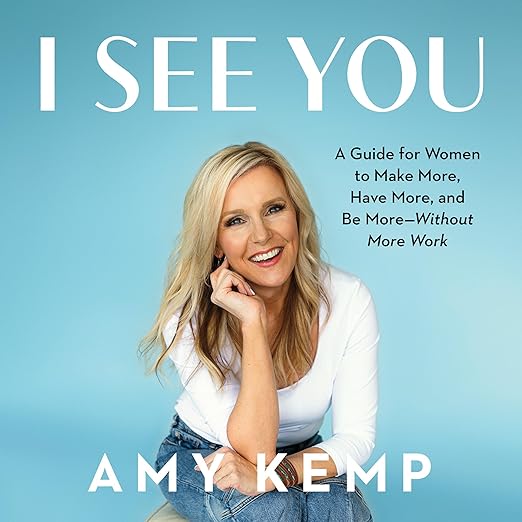
Amy Kemp opens I See You the way she's opened thousands of coaching calls over twenty years running her own business: by naming the exhaustion first. This audiobook, narrated by Kemp herself, is built for the working woman who is giving everything to her job and her household and still ending most days feeling like she's failing at both. Kemp draws on two decades of building her own company and coaching thousands of women through the same bind, and her core promise is a specific one: you can grow your income, influence, and impact while working fewer hours, not more, if you're willing to change how you spend your energy rather than simply adding more effort on top of an already full plate.
The Six Things List Kemp Built for Herself
What makes this audiobook land differently than a typical business self-help title is the intimacy of Kemp's approach, and hearing her narrate her own material only sharpens that effect. Reviewer wendy wardlaw put it directly: Amy Kemp has a way with words, and specifically praised implementing what Kemp calls her "6 things list," a practical tool for staying focused on priorities rather than getting pulled into every unpaid task that lands on a working woman's plate. Reviewer Awallace echoed that specificity, calling the book especially relatable for working mothers juggling more roles than any one person should reasonably carry at once.
Kemp structures the book with end-of-chapter exercises, meaning this isn't purely a listen-and-absorb experience; it's designed to be worked through, ideally with a notebook nearby to actually complete the reflection prompts rather than just nod along. Reviewer Kindle Customer described going through the book twice for exactly that reason, reading quickly the first time because they couldn't put it down, then returning more slowly to complete the exercises and apply the principles, and reported that doing so genuinely shifted how they ran their own business.
Kemp's own twenty-year business background gives the book's more ambitious claims real weight rather than motivational-speaker abstraction. She isn't writing from theory or secondhand research alone; the specific tools she teaches, the six things list, the boundary-setting scripts, are ones she describes using in her own company before turning them into a coaching curriculum for other women to adopt in their own careers.
Leveraging What Kemp Calls Your Natural Genius
The audiobook format suits Kemp's coaching-session framing better than you might expect from a book built around written exercises. Her pacing, warm but direct, mimics the actual rhythm of a one-on-one coaching call: she names a problem, tells a relatable story about a client or her own experience, then offers a specific, actionable reframe. That structure works well in audio because it doesn't require staring at a page to follow the logic; you can absorb the story and the takeaway in one pass and return to the written exercises later when you're ready to sit down with them properly.
Self-narration matters here in a very specific way. Kemp isn't performing empathy for an audience; she's speaking as someone who has personally coached thousands of women through this exact bind and built her own successful business while doing it. That lived authority is audible in small choices, where she slows down, where she lets a harder truth land without softening it, in a way that a professional narrator reading a script secondhand would likely flatten into something more generic.
One of the book's more distinctive ideas is what Kemp calls leveraging your natural genius, essentially identifying the specific work you do better and more easily than almost anyone else, then restructuring your role or business around doing more of exactly that instead of spreading yourself evenly across every task that technically falls under your job description. It's a reframe of delegation that feels less like a productivity hack and more like permission, which is very much the emotional register Kemp is going for throughout the entire book rather than a checklist of hacks.
Kemp structures her argument around three specific outcomes, influence, impact, and income, treating them as related but distinct goals rather than assuming growth in one automatically produces growth in the others. That distinction matters practically: a listener might already have plenty of impact within an organization but see none of it reflected in compensation, or plenty of income but no real influence over decisions that affect their daily work. Kemp addresses each separately with its own specific strategies, rather than offering one generic formula for career advancement that treats all three as interchangeable.
Itemizing the Invisible Labor of Running a Home
This is explicitly a book for women in professional or business roles, and the framing throughout, boundaries, income growth, redistributing unpaid domestic labor, assumes a listener juggling both a career and a disproportionate share of work at home. Listeners outside that specific situation, including men looking for general career advice, will find plenty of the underlying principles about boundaries and leverage transferable, but the examples and language are pointed squarely at women balancing professional ambition with home responsibilities, not written as gender-neutral advice with the specifics filed off.
Because the book leans so heavily on exercises and reflection prompts, listeners who prefer to passively absorb an audiobook during a commute or workout may get less out of it than those willing to pause, actually think through Kemp's questions, and revisit sections later with a notebook. The audio format doesn't include the printed exercises directly, so you may want a notes app or journal open alongside it for full effect.
The chapters on redistributing unpaid work at home are among the more pointed material in the book, asking listeners to actually itemize the invisible labor, scheduling, remembering, emotional management, that tends to fall disproportionately on women in dual-career households. Kemp doesn't pretend this conversation is easy or conflict-free, and the book's advice here leans practical rather than aspirational: specific scripts and specific renegotiations rather than a vague call to simply communicate better with a partner.
A Coaching Voice for Business Owners Who Want Homework
Working women, and especially working mothers, who feel like they're maxed out on effort but not seeing proportional results in income or advancement are the exact audience Kemp is speaking to throughout. Business owners and career-driven professionals looking for a coaching voice rather than a dry productivity framework will find Kemp's intimate, story-driven style a welcome change of pace from more clinical business audiobooks on the same shelf.
Readers allergic to workbook-style prompts and homework at the end of each chapter might find the coaching format more demanding than a straight business text, since Kemp genuinely wants you doing the exercises, not just listening past them on the way to the next chapter's story.
- Voice: Amy Kemp narrates her own material with the warmth and direct address of an actual coaching session.
- Big ideas: burnout and boundaries, unpaid domestic labor, income growth for working women
- Atmosphere: Intimate and encouraging, occasionally confrontational
- Worth it?: Recommended for working women who want a coach's voice in their ear, not just another productivity checklist to skim.