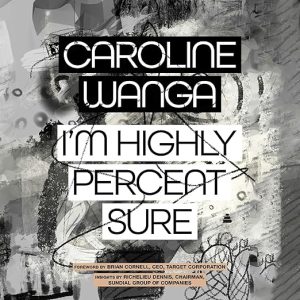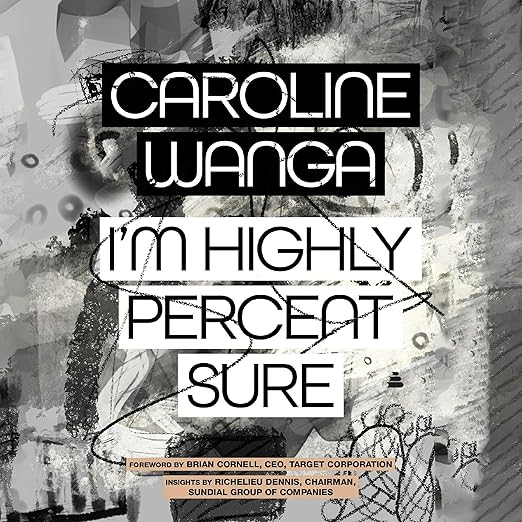
Caroline A. Wanga's phrase for what she is after in I'm Highly Percent Sure is instigational inspiration, and the audiobook delivers on that slightly unusual combination from the first chapter. This memoir, narrated by Wanga herself at 5 hours and 22 minutes, covers her own ongoing negotiation between intuition and inner saboteur: the lifelong conversation between knowing what you are supposed to do and the voice that tells you that you will not be able to do it. Wanga's credentials, Co-Founder of WangaWoman LLC, President and CEO of Essence Ventures, and a career that has included significant executive roles, give those concepts practical weight rather than reducing them to motivational abstraction.
The self-narration is not incidental to the book's argument or its reception as an audiobook. Wanga's whole case is about authenticity, the idea that purpose is delivered through a genuine self rather than a performed one, and a book making that argument in someone else's voice would undermine itself immediately. Her delivery is warm without being soft, witty without sacrificing directness. She reads her own material the way someone reads to a room they have already won over: with the confidence of knowing the audience wants to be there and the awareness that keeping them engaged is still her responsibility.
Highly Percent Sure Names the Space Before Certainty
The title is itself a kind of provocation and a key to the book's framework. I'm Highly Percent Sure is Wanga's phrase for operating in the space between certainty and doubt: not fully convinced of every step, but committed enough to move forward with intention. That framing gives the memoir its intellectual backbone and distinguishes it from the more binary success narratives that populate the genre. This is not a book about having all the answers. It is a book about developing enough of a relationship with your intuition that you can function productively in their absence.
One reviewer described the book as super inspiring and noted that Wanga opens up about her struggles with the inner critic, the nagging internal voice that most people who read professional memoirs share, and how it has shaped her path. That candor is real and consistent across the audiobook. Wanga is not presenting a polished retrospective of her journey with the rough edges sanded down for palatability. She is sharing the version that includes the moments where she did not follow her intuition and paid for it, which distinguishes the memoir from the genre of professional self-help that typically presents success as clean and linear even when it was not.
Her Voice Carries What the Content Requires
Self-narration in memoir is a gamble that Wanga wins decisively. Her voice carries the credibility that the content requires, and her timing reflects someone who speaks to rooms regularly for professional purposes: she knows where the weight falls in a sentence, and she knows when a pause does work that additional words cannot. The audiobook format is particularly well-suited to this kind of memoir because the personal voice is not just the vehicle for the argument but the argument itself. Wanga's phrase, It Ain't Math, it's MISSION powered by INTUITION, becomes a different kind of statement when you hear it in her voice rather than encountering it on a printed page.
At just over 5 hours, the runtime is compact for a professional memoir. That compactness is not a limitation but a reflection of Wanga's approach: she writes with specificity rather than padding, and the 5 hours carry more actual argument and personal observation than many longer books in the genre. The hashtag framing that appears in the synopsis, the IYKYK and the TakeNotesDoItBetter, reads as slightly self-promotional in text but lands differently in audio: in Wanga's voice, it sounds like someone inviting you into an ongoing conversation about what it means to live according to your actual values rather than the values you perform for institutional approval.
An Endocrine Metaphor Replaces the Career Arc
The book's unconventional structure, built around the endocrine system metaphor for intuition and the concept of the inner saboteur as a specific psychological phenomenon, will work better for some readers than others. Wanga is not writing a chronological career biography or a business framework book organized around strategies and case studies. She is writing something closer to a philosophical reflection on the relationship between selfhood and professional life, using her own experience as evidence rather than as linear narrative. Readers expecting a conventional memoir arc will need to adjust their expectations before they get too far in.
The book carries a clear orientation toward purpose and authenticity in a specifically professional register. The audience Wanga is writing for is people who are ambitious and working and experiencing the gap between what they know they are meant to do and what they are actually doing on a daily basis. Readers looking for something more broadly spiritual or more explicitly political in its engagement with the structures of professional life will find some of what they need here but not all of it.
The Exhaustion of Fighting Your Own Saboteur
Women in professional environments who are navigating the tension between institutional expectations and their own sense of authentic direction will find this audiobook particularly resonant. The business memoir genre often offers success stories without friction; Wanga offers something harder and ultimately more useful. Listeners who are already familiar with Wanga's public presence through her work at Essence Ventures or her earlier career will bring context that enriches the book's specific references, but the memoir does not require prior familiarity to deliver its argument clearly. Anyone who has felt the specific exhaustion of fighting their own inner saboteur in a professional context will recognize what Wanga is describing and find the 5-hour investment well returned.
Does Caroline A. Wanga self-narrating this audiobook strengthen or weaken the listening experience?
Strengthens it significantly. A book arguing for authenticity over performance loses credibility the moment it is handed to a neutral professional voice. Wanga's narration is the argument in action: her timing, her warmth, and her directness are exactly what the memoir describes.
Is this audiobook accessible to new listeners unfamiliar with Caroline Wanga's professional background?
Yes, though prior awareness of her work at Essence Ventures adds context. The memoir is self-contained enough to work without background knowledge of her specific career history, and Wanga provides what the listener needs to follow the argument.
Is I'm Highly Percent Sure a business strategy audiobook, a memoir, or something else entirely?
It occupies the space between memoir and professional philosophy without fully belonging to either category. It is organized around Wanga's personal experience, shaped by a specific argument about intuition and purpose, and directed at professional listeners. The closest label is memoir-driven professional reflection.