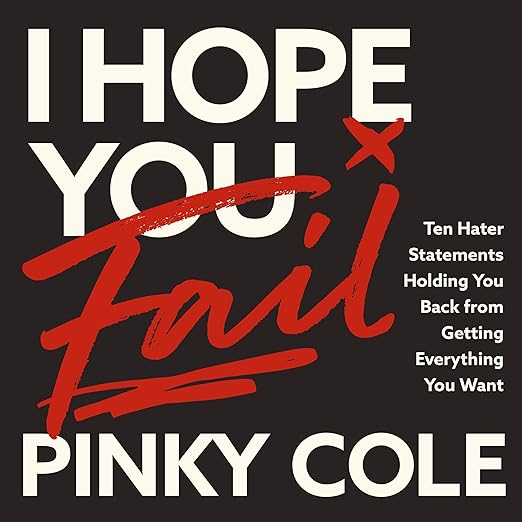
Pinky Cole's I Hope You Fail audiobook comes with an advantage that most entrepreneurship titles cannot manufacture: the author reads it herself, and Cole's voice carries the specific credibility of someone who has built Slutty Vegan from a fire-gutted New York City restaurant to a nationally recognized brand that attracted top-tier investors. That credibility is not assumed or signaled through endorsement. It is earned sentence by sentence across five hours of narrative that refuses the redemptive arc of most founder memoirs and replaces it with something harder and more useful: a systematic reexamination of the moments that felt like defeat and an argument for why each one was necessary rather than merely survivable.
The structural engine of this audiobook is ten counter-intuitive hopes that Cole presents as chapter frameworks. I hope you don't believe in yourself. I hope you don't get that raise. I hope the customers don't show up. Each one inverts the standard motivational premise and then unpacks why the conventional aspiration obscures something more important about how growth actually works. This is a genuinely risky rhetorical strategy because it requires Cole to deliver on the reversal rather than simply assert it, and she does. The chapter on not getting the raise is not a meditation on patience. It is a specific argument about how underpayment reveals your actual market value and creates the conditions for a decision you might not otherwise make.
Ten Hopes, Uneven but Honestly So
Cole's backstory, including the fire that destroyed her first restaurant after she had invested everything she had in building it, is not used as inspirational decoration. She returns to specific decisions made in the immediate aftermath of that loss and examines them with an honesty about her own panic and resourcefulness that is rare in a genre that tends to compress difficulty into a montage before arriving at triumph. Reviewer laquanda baker noted that the book reads like a conversation with the author herself, and the audiobook version intensifies that quality considerably. When Cole describes working for someone else's dream after losing her own, the frustration in her delivery is not performed. It is simply present.
The ten hopes are not equally strong. The chapter on not believing in yourself is the most philosophically interesting and the most developed, drawing a careful distinction between self-confidence and self-knowledge and arguing that the former is often a substitute for the work required to build the latter. Some of the later chapters on operational specifics of building Slutty Vegan move at a different level of abstraction, and listeners expecting the personal intensity of the early chapters to sustain through the entire book will find some unevenness. But the unevenness is honest. Cole is not pretending that all ten lessons carry equal emotional weight, and the variation in register keeps the audiobook from the uniform inspirational tone that makes so many comparable titles feel processed.
A Third-Party Narrator Could Not Produce This Pain
The self-narration is the primary reason to choose the audiobook over the print edition. Cole's delivery in the section about losing the New York City restaurant has a specificity of pain that could not be produced by a third-party narrator working from the text. She knows exactly where in each sentence the emotional weight falls, and she places it there without theatrical emphasis. That restraint is what makes the passages about failure convincing rather than instructional. You are not being told what failure felt like. You are hearing it from the person who felt it.
The book also performs a function that is not explicitly stated in its marketing: it is a document about what Black women entrepreneurs face in a business environment that systematically undervalues and overscrutinizes them. Cole does not write a polemic on this subject, but her specific anecdotes about investor meetings, about how her restaurant's name was received, and about who was and was not willing to back her at various stages of Slutty Vegan's growth, collectively construct a picture of those conditions without ever reducing the book to a grievance narrative. That dimension makes it worth the time for listeners far outside the target demographic of new entrepreneurs.
20 Minutes for a Hope That Could Anchor More
Listeners expecting a comprehensive business methodology will find this book does not deliver one. Cole's ten hopes are principles and reframes, not operational blueprints, and the practical advice within each chapter is illustrative rather than prescriptive. The book works best as a recalibration of attitude toward failure and setback rather than a step-by-step entrepreneurial guide. Those looking for specific frameworks around fundraising, hiring, or scaling should supplement with more operationally focused titles.
The five-hour runtime means that some of the ten chapters receive relatively brief treatment, and a few of the counter-intuitive hopes feel like they could sustain significantly more development. The hope about customers not showing up, for instance, makes a genuinely interesting argument about feedback loops and market research, but Cole moves through it in under 20 minutes when the underlying insight could anchor an entire chapter in a longer treatment. The book is punchy and the brevity is a choice, but listeners who want depth on every topic may find some of the later chapters glancing.
Specific Conditions Facing Black Women Entrepreneurs
Entrepreneurs at the early-to-mid stage of building something who have experienced specific setbacks and are working out how to interpret them will find this audiobook most directly useful. Cole's ten reframes are sharp enough to shift perspective on failures that feel permanent, and her self-narration makes the medicine go down without the condescension that some motivational business books carry. The book is also worth listening to for anyone interested in the specific conditions facing Black women building businesses in the United States, delivered by a practitioner with specific, unsentimentalized experience rather than an advocate or researcher. First-time listeners who have never encountered Pinky Cole or Slutty Vegan will find this a fully functional introduction.
Questions Listeners Ask
Does Pinky Cole narrating I Hope You Fail herself make the audiobook worth choosing over the print edition?
It makes a significant difference, particularly in the sections about losing her New York City restaurant and the early days of building Slutty Vegan. Cole knows exactly where the emotional weight falls in her own sentences, and her restraint in those passages carries a conviction that a third-party narrator working from text could not reproduce.
What are the ten counter-intuitive hopes in the I Hope You Fail audiobook?
Cole structures each chapter around a hope that inverts standard motivational advice, including hopes that you don't believe in yourself, don't get that raise, and that customers don't show up. Each chapter then makes a specific argument for why the conventional aspiration obscures a more important truth about growth and self-knowledge.
How does I Hope You Fail compare to other women-in-business audiobooks in terms of honesty about failure?
Cole is more specific about her own losses and panic than most comparable titles. She does not compress difficulty into a brief montage before arriving at triumph. The fire that destroyed her first New York City restaurant is examined through the specific decisions made immediately afterward, with a frankness about fear and resourcefulness that the genre rarely sustains past the opening chapter.