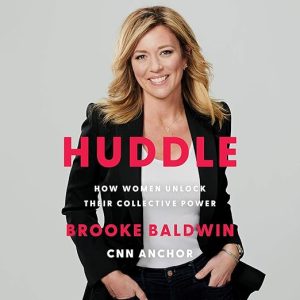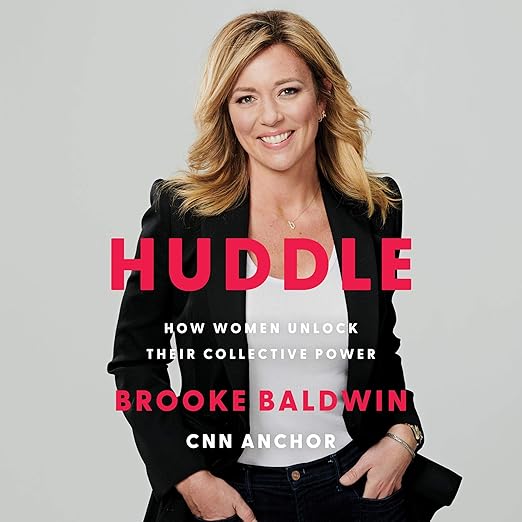
Karlie Kloss's Kode with Klossy and Reese Witherspoon's Filmmaker Lab for Girls open this audiobook's exploration of what CNN anchor Brooke Baldwin calls 'huddling,' the specific pattern of women banding together across politics, Hollywood, activism, sports, and ordinary friendship to solve problems and build each other up. Baldwin narrates her own reporting here, and the Wall Street Journal bestseller status suggests the concept struck a chord well beyond a niche business-book audience.
From Steinem and King to Abrams and DuVernay
The reporting range is genuinely wide. Baldwin embeds with groups as different as US military veterans turned Democratic Congresswomen, African-American judges in Harris County, Texas, and an all-female Hollywood writers room, tracing a common thread through settings that share almost nothing else in common. She interviews figures from Gloria Steinem and Billie Jean King to contemporary names like Stacey Abrams and Ava DuVernay, giving the book a generational sweep that connects second-wave feminist icons directly to current organizers.
What keeps Huddle from reading as a simple celebrity-name-drop exercise is Baldwin's own throughline: her own path from growing up in the South to climbing a male-dominated broadcast-news ladder, encountering what she calls 'sharp elbows' along the way. That personal thread runs underneath the reported chapters, and reviewers respond specifically to the mix; one calls it 'stories of how powerful women can be for each other,' built on real journalistic access rather than secondhand research.
Baldwin's reporting extends into celebrity and professional spheres too: chef Dominique Crenn and sports agent Lindsay Colas both appear as examples of women using established success specifically to amplify other women in their fields, a different register from the grassroots organizing chapters but part of the same underlying argument. On the athletic side specifically, Baldwin covers Megan Rapinoe, Hilary Knight, and Sue Bird organizing around equal pay, tying professional sports directly into the same huddle framework she applies to politics and Hollywood.
Framing BLM's Founding as a Women's Story
One phrase from Baldwin's own framing is worth sitting with directly: she describes periods of 'huddle droughts' in American history, stretches where this kind of organized women's mutual support receded, set against her parallel argument that Black women specifically have been huddling for centuries, predating the concept's more recent cultural visibility. That distinction matters to the book's actual argument; huddling isn't presented as a new invention of the social-media era, but as a recurring pattern that sometimes gets obscured and sometimes gets rediscovered.
A different register of huddle gets equal weight alongside the more overtly political chapters: women who survived sexual abuse healing together, through communities like The Class and GirlTrek specifically named in the book, and military wives supporting each other through long separations and uncertain deployments. Baldwin treats trauma-recovery huddles and headline-grabbing activist huddles as versions of the exact same underlying mechanism, which is one of the book's more quietly persuasive structural choices.
The book also traces huddles inside institutions not usually associated with organized women's solidarity: teachers rallying to improve working conditions, and the founders of Black Lives Matter organizing as women specifically within a movement often discussed in broader terms. Naming that specific detail, that BLM's founding is framed here as a women's organizing story, is a useful preview for readers who might otherwise expect the book to stay within more conventionally 'women's issues' territory.
Maintaining a Huddle Is the Harder Half
Baldwin narrates with what one might expect from a career news anchor: controlled, authoritative delivery that stays composed even through emotionally charged material. The interesting texture shows up specifically in the personal passages, where her own career history carries more warmth and specificity than the more reported, journalism-style sections, a natural enough gap but one worth knowing about going in.
At over nine hours, the audiobook has real room to cover the ground the subtitle promises, from well-known headline moments (the Women's March, MeToo, Time's Up) through much less publicized huddles: Indigenous women's environmental organizing, the mothers behind gun-law advocacy, nurses supporting each other through the isolation of the pandemic. That range needs the runtime it's given; a shorter treatment would have to cut entire categories of huddle Baldwin clearly wanted to include.
A third reviewer's short but pointed note captures the book's intended takeaway well, describing real depth on every page about why a huddle matters and observing that maintaining one is the harder, more crucial half of the equation. That distinction between building and sustaining support networks runs through Baldwin's later chapters specifically, past the initial formation stories into what keeps a huddle functioning over years rather than a single galvanizing moment.
Baldwin writes as a journalist rather than a sociologist, and that distinction shapes the whole book's register: scenes and direct quotes carry the argument more than data tables or academic citation would, which keeps a nine-hour nonfiction audiobook moving at a magazine-feature pace rather than a textbook one. Readers who want the more academic, citation-heavy version of this same subject should look elsewhere; Baldwin's approach trades some scholarly rigor for genuine narrative momentum and readability.
Interview-driven nonfiction translates unevenly to audio depending on how a book handles quoted material, and Baldwin's approach favors close paraphrase and scene-setting over long block quotations, which suits her own narration well; a book built around lengthy direct quotations read aloud by a single narrator can start to blur together, and Huddle mostly avoids that trap by keeping quoted material short and embedded within her own reporting voice.
Rewarding Listeners Who Stick Past Familiar Chapters
Structurally, this reads as journalism organized by theme rather than a single continuous argument, which means individual chapters can be sampled somewhat independently if a specific huddle interests you more than others. Listeners wanting a tight, single-thesis business book should recalibrate; this is closer to a reported anthology unified by Baldwin's own voice and framing than a traditional structured argument with a beginning, middle, and conclusion.
One reviewer specifically praised how 'Brooke shares some examples of some amazing huddles,' and that word, examples, is accurate: this is a book of illustrative cases more than a step-by-step framework readers can apply directly. Anyone wanting a practical how-to guide for building their own huddle should expect inspiration and pattern-recognition over an explicit action plan.
Some chapters lean more heavily on well-documented public movements (the Women's March, MeToo) that readers may already know well from news coverage, while others cover genuinely under-the-radar organizing most listeners won't have encountered before. The balance tilts toward the less-covered material as the book progresses, which rewards listeners who stick with it past the more familiar opening chapters.
Named Sources and Direct Interviews Throughout
Women navigating male-dominated industries, or anyone curious how organized women's support networks actually function behind well-known headline movements, will find real substance here. Baldwin's own journalism background means the access is real: named sources, specific scenes, direct interviews rather than secondhand summary.
Skip it if you want a structured, actionable playbook rather than a reported survey of real huddles across politics, sports, and the arts; the value here is pattern recognition and inspiration built from genuine reporting, not a numbered framework you can apply chapter by chapter.
The Short Version
- Read by: Brooke Baldwin narrates with composed anchor authority, warmest in her own personal passages.
- At its heart: Women supporting women, grassroots organizing, career adversity
- Vibe: Reported and wide-ranging, personal at the edges
- Short version: A well-reported survey of real women's networks, stronger as inspiration than as a step-by-step guide.
A Few Questions About Huddle
Does Brooke Baldwin narrate this audiobook herself?
Yes, and her career-anchor composure carries through most of the reporting, with the personal chapters about her own career path showing noticeably more warmth than the more journalistic sections.
How long is the Huddle audiobook, and does it need to be listened to in order?
It runs over nine hours and is organized thematically rather than as a single linear argument, so individual chapters covering specific huddles can reasonably be sampled out of sequence.
Which real-world women's movements does this audiobook cover in depth?
It covers the Women's March, MeToo, and Time's Up alongside less publicized organizing: Indigenous environmental activists, gun-law reform mothers, all-female writers' rooms, and networks of judges, veterans, and nurses.