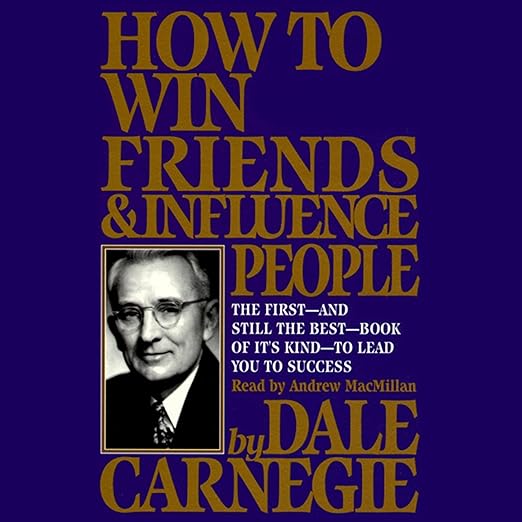
Dale Carnegie wrote How to Win Friends & Influence People in 1936, and the title has been putting people off ever since. Reviewer MISS MARIE opened her assessment by calling it "incredibly off-putting," and she is not wrong that the framing sounds manipulative to modern ears trained to be suspicious of influence. But Carnegie's actual argument, which Andrew MacMillan narrates across 7 hours and 15 minutes with consistent warmth, is essentially the opposite of manipulation: that genuine curiosity about other people, the willingness to listen rather than perform, and the discipline to make others feel understood rather than managed are the foundation of any lasting professional or personal relationship. The book was developed from a series of lectures Carnegie delivered to businesspeople in New York, and the audiobook format restores something of that original spoken character; it was always meant to be heard, argued with, and applied, rather than studied quietly from a page.
What Carnegie Prized Got Rarer in the Digital Age
The book organizes its argument into specific numbered principles: the six ways to make people like you, the twelve ways to win people to your way of thinking, the nine ways to change people without arousing resentment. This sounds like a self-help checklist and is actually a structural device for making concrete what might otherwise remain abstract good intentions. Carnegie illustrates each principle with anecdotes drawn from the business and public life of the 1930s, which is where the audiobook most transparently shows its age. The examples reference figures that contemporary listeners may not recognize, and the social dynamics of workplace and family life reflect assumptions that have shifted considerably in ninety years. Reviewer Andreas Aristidou raised precisely this tension, whether this is an "outdated classic or a contemporary gem," and the honest answer is that it is both simultaneously, in layers that are worth separating.
The principles themselves have held because they are grounded in attention and acknowledgment rather than in the specific social scripts of any particular era. Carnegie's core observation is that most people spend most conversations waiting to talk rather than genuinely listening, and that the person who actually pays attention has an immediate and substantial advantage in any relationship. That observation is not less true now than it was in 1936. If anything, the conditions of contemporary digital communication, the competition for attention, the speed of exchange, the premium on brevity, have made genuine sustained attention rarer and therefore more valuable than Carnegie's original audience could have imagined.
MacMillan Steers Clear of Two Failure Modes
Andrew MacMillan is a sensible narrator choice for this material. He avoids the two failure modes that afflict many business-book narrations: either delivering the content with the flat enthusiasm of a corporate training video, or overcooking it into motivational-speaker energy. MacMillan reads as if he is explaining something he finds genuinely interesting to a listener he respects, which is the register Carnegie himself aimed for in his lectures. The audiobook format benefits this particular book because Carnegie's prose is inherently conversational; the lecture origin is audible in the rhythm of the sentences, in the way illustrations follow principles with the pacing of a speaker checking for comprehension, and MacMillan's narration respects that rhythm rather than flattening it.
Reviewer Pedro H. noted that the book makes you think about how you communicate with a specificity that general communication advice usually avoids. Reviewer MISS MARIE, despite her initial resistance to the title, concluded that the book is not a self-help manual for people who want to make friends but something more practical and more demanding than that. The audiobook's 7-hour and 15-minute runtime is comfortable for its content, long enough to develop each principle with concrete examples but short enough that the accumulation does not become oppressive. The structure of named principles followed by illustrations is easy to follow in audio without reference to a table of contents, which matters for listeners engaging during commutes or while handling other tasks.
The Most Misread Chapter Argues for Agreement First
The most frequently misread chapter is the one on winning people to your way of thinking. Carnegie's counterintuitive argument is that the most effective approach is to find genuine agreement first and build from there rather than to lead with your position and defend it. That observation cuts against the instinct of most professional communication, which tends toward assertion and persuasion as primary tools. The audiobook's continuous delivery makes this argument easier to absorb than the printed version, where readers often skim toward the numbered principles without absorbing the reasoning that makes each one more than a social technique.
The section on changing people without arousing resentment is where the book is most psychologically precise and most frequently underestimated. Carnegie's observation that criticism nearly always hardens resistance rather than producing change is supported by extensive case illustration, and the alternatives he proposes, specific, private, framed as questions rather than pronouncements, require more self-discipline than most people apply to everyday professional feedback. MacMillan delivers these sections with appropriate weight without making them feel like moral lectures, which is the correct approach for principles that need to be practiced rather than admired from a safe distance.
A Useful Re-Engagement for Anyone Who Read the Print
Anyone early in a professional career who has not yet read this book should treat it as foundational rather than optional. The principles apply directly to management, client relationships, negotiation, and any context where sustained cooperation matters more than short-term compliance. Experienced professionals who encountered the book in print in an earlier phase of their career may find the audio format a useful re-engagement; hearing the material rather than reading it tends to surface different passages as primary, and the commute-friendly format makes revisiting Carnegie less of a commitment than it used to be. Those who find the 1930s anecdotal frame a barrier can engage selectively; the principles remain intact regardless of the specific historical examples Carnegie uses to illustrate them. Listeners expecting modern neuroscience-backed frameworks should look elsewhere, but those who want the most consistently recommended interpersonal book in professional development will find the audiobook delivers on its reputation.
- Performance: Andrew MacMillan delivers Carnegie's prose with steady, approachable authority; the tone is conversational rather than preachy, which suits a book whose core argument is that genuine interest in other people is more powerful than any technique.
- What it covers: Human relations and communication, the psychology of persuasion, leadership through empathy
- Feel: Warm and practical, with the patient confidence of someone who has seen these principles work across decades
- Our call: Carnegie's principles have survived ninety years of social change not because they are timeless platitudes but because they are grounded in something specific about how human attention and acknowledgment function.