Quick Take
- Narration: Paige Lewin’s self-narration is not optional here, her own voice delivering her own hair journey, with its specific emotional weight and the intimacy of someone explaining a path she actually walked, is what makes this audiobook more than a care guide.
- Themes: Natural hair care and product literacy, psychological reclamation of Black beauty identity, holistic health and self-acceptance
- Mood: Warm, honest, and ultimately affirming without pretending the journey is easy
- Verdict: Among the most complete holistic natural hair guides available in audio, the self-narration and expert contributor framework make it genuinely distinct from comparable titles.
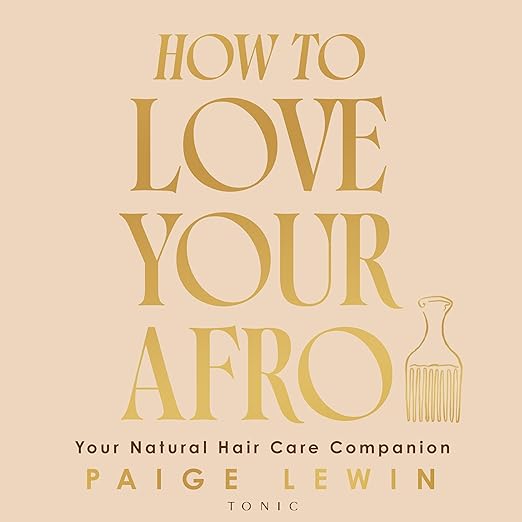
I was halfway through my second cup of coffee on a Saturday morning when I started How to Love Your Afro, and I did not put it down until it was finished. This is not typically how I engage with hair care books. I expected a guide with some personal framing around it, useful tips, probably a few expert quotes, maybe an inspiring journey as context for the practical content. What I got instead was a book that operates simultaneously as memoir, cultural criticism, wellness guide, and hair science primer, and that holds all four of those modes without dropping any of them. Paige Lewin, as both author and narrator, has written something that respects the complexity of what she is actually addressing.
The opening is specific and disarming. Lewin describes being fourteen and begging her mother for her first chemical relaxer, convinced that straight hair was her route to beauty and acceptance. The years that followed, damage, frustration, wigs and weaves and chemical treatments as armor against her own texture, are not framed as tragedy but as understandable responses to a specific cultural environment that told Black women their natural hair was insufficient. The transition from that history to her current position as host of Texture Talks, and to the genuine love for her Afro that she now feels, is the emotional architecture of the book, and Lewin does not rush it or flatten it. Reviewer Amazon Customer, who ordered a hardcover immediately after engaging with the electronic version, noted that the book helped her understand how she viewed her own Afro and what steps she needed to take, which captures precisely the work the book is doing: not prescribing but illuminating.
The Expert Framework That Earns Its Contributors
Many beauty books bring in credentialed contributors as decorative authority rather than substantive expertise. Lewin’s framework avoids this. Integrative psychotherapist Tasha Bailey contributes to the sections on psychological relationship to hair, explaining why hair care in this specific cultural context carries therapeutic rather than merely cosmetic weight. Dermatologist Dr. Yvonne Abimbola brings clinical depth to the scalp and follicle health content. Rio Agor Watts, as a color and curl specialist for Revlon Professional, provides the product-specific technical guidance. These are not token quotes pulled from email interviews, the contributions are integrated into the argument, and each contributor addresses the dimension of the topic their expertise actually qualifies them for. The result is a book that is simultaneously emotionally intelligent and technically rigorous, which is a rare combination in a category where books tend strongly toward one or the other.
What the Product Guidance Actually Does
One of the book’s stated strengths, noted by reviewer Amazon Customer, is that it does not talk about one brand and is not geared toward purchasing specific products. This matters enormously in a category where product recommendations are frequently financially motivated and poorly matched to individual hair needs. Lewin’s approach is to build a framework for evaluating products based on hair porosity, moisture-protein balance, and ingredient literacy rather than brand loyalty. The tools-and-techniques section serves readers across the full range of natural textures, from Type 3 curls to Type 4C coils, and addresses both DIY and professional contexts. Reviewer KJ, who described the book as helping her accept and appreciate her 4C hair, demonstrates the framework’s applicability at the coiliest end of the texture spectrum, the category where product misinformation has historically been most prevalent.
The Cultural and Psychological Dimension
What ultimately distinguishes How to Love Your Afro from excellent but purely technical hair science books is the integration of psychology and cultural analysis. Lewin addresses how Eurocentric beauty standards have been internalized by Black women across generations, how language shapes relationship to hair before a single product is ever applied, and how the act of choosing natural hair is often a psychological reclamation before it is a cosmetic decision. This dimension is not separate from the practical content, it shapes how the practical advice is received and whether readers can actually follow it. Reviewer Amazon Customer’s description of the book as special in connection with the intergenerational hair-care relationships her family shares points to the emotional register the book inhabits: this is ultimately a book about belonging to yourself.
Frequently Asked Questions
Is Paige Lewin’s self-narration what makes this audiobook distinctive, or does it work equally well in print?
Self-narration is a significant part of the audiobook’s value here. Lewin’s delivery of her own fourteen-year-old self asking for that first relaxer, and her transition through damage and hiding toward genuine self-acceptance, carries emotional weight that print can convey but audio amplifies. This is one of the cases where the author’s voice is the correct choice.
Does the book cover all natural hair textures equally, or is it primarily oriented toward one type?
Lewin explicitly covers the full spectrum of Black natural hair textures, with reviewers at the 4C end of the range specifically noting its applicability. The framework is built on texture-agnostic principles, porosity, moisture-protein balance, ingredient literacy, that apply regardless of curl pattern.
How does the expert contributor content integrate with Lewin’s personal narrative?
The contributions from psychotherapist Tasha Bailey, dermatologist Dr. Yvonne Abimbola, and curl specialist Rio Agor Watts are woven into the relevant sections rather than isolated as sidebar content. Each contributor addresses their specific domain, psychological, medical, and technical respectively, creating a genuinely holistic approach.
Is this book appropriate for someone who is not yet on a natural hair journey but is considering one?
Yes. Lewin explicitly addresses readers at any point on their journey, and the book’s psychological framework is particularly useful for people still processing why they have been avoiding or managing away their natural texture. Understanding the cultural context before making practical changes is part of what the book offers.