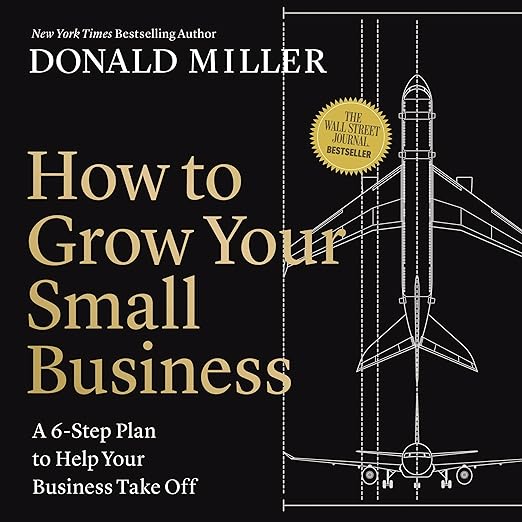
The Short Version
- Performance: Miller reads his own material with the ease of someone who has taught this framework from a stage many times before.
- What it covers: operational systems, cash flow discipline, scaling an already-running business
- Feel: Brisk, practical, low on inspiration-speak
- Our call: A tight, actionable listen for small business owners who already have revenue and want structure, not a pep talk.
Four employees working out of a basement became a fifteen-million-dollar operation in six years, and Donald Miller spends this entire audiobook explaining exactly how, without a single vague chapter about passion or hustle. I've sat through plenty of business audiobooks that promise a system and then deliver anecdotes instead; this one actually hands you the system, structured as what Miller calls a Flight Plan: six concrete steps rather than six motivational stories. The self-narration matters here specifically because Miller sounds like someone who has taught this exact material live, many times, not a hired voice performing enthusiasm about someone else's spreadsheet.
Five Checking Accounts as Cash Flow Discipline
The six steps are genuinely concrete rather than aspirational: cast a vision built around three economic priorities, clarify your marketing message, install a sales framework that makes the customer the hero of the story rather than your company, optimize your actual product offering, run a management and productivity playbook that keeps a team aligned, and use five separate checking accounts to manage cash flow. That last one is the kind of granular, almost boring tactic that separates a book meant to be used from a book meant to be inspiring.
Miller's own operational history gives this more weight than the average founder-turned-author case. Long before StoryBrand, he ran a small Portland-based publishing venture, which means the operational chaos this book addresses, unpredictable revenue, unclear roles, a founder doing too many jobs at once, is chaos he's actually lived through twice, not observed from a consulting distance.
The five-checking-accounts cash flow system deserves particular mention because it's the kind of tactic a listener can implement the same afternoon they finish the chapter, unlike most of what passes for financial advice in business audiobooks, which tends to stay comfortably abstract.
The sales framework specifically borrows the customer-as-hero logic Miller has built his broader consulting career around: instead of a business positioning itself as the hero of its own story, the Flight Plan trains owners to build a sales process where the customer's problem drives every conversation from the first interaction onward. It's a subtle shift in framing that changes concrete behavior, how a sales call opens, what a landing page leads with, what a follow-up email says, and Miller walks through each application with enough specificity that a listener could adapt the exact language to their own business the same afternoon they finish listening.
Pacing That Sounds Delivered From a Stage
Miller narrates his own material with the fluency of someone who has delivered this framework from a stage repeatedly, not someone adapting unfamiliar prose to a microphone for the first time. That fluency shows up as pacing: he moves through dense operational content without the hesitation a professional voice actor might have reading unfamiliar business jargon cold.
Reviewers confirm the practical payoff lands quickly. One small business coach who works with overwhelmed owners called it 'exactly what they need to get back on track,' and another listener with an existing business said the advice had 'immediate impact' on actual growth, not just on how they thought about growth. A third reviewer specifically praised how the book breaks complex operational concepts into steps that are easy to actually follow.
From a Basement to Fifteen Million in Six Years
At just over five hours, this is short enough to finish over a single weekend and dense enough that a listener could realistically start implementing the Flight Plan the following morning, which is a rare combination in a genre that often pads runtime with repetition.
Miller built Business Made Simple, the company behind this book, into a full ecosystem of courses, coaching certification, and consulting built on frameworks like this one, and that infrastructure shows in how tightly organized the six-step system is here. This isn't a first attempt at explaining these ideas; it's a refined version that has already been tested against thousands of business owners working through the company's other programs, which means the rough edges a first-draft framework usually carries have mostly been sanded down already.
The specific number Miller keeps returning to, four employees in a basement growing sixfold to fifteen million dollars in six years, functions as more than a marketing hook throughout the book; he keeps circling back to which exact step of the Flight Plan mattered at which stage of that growth, so the framework arrives with a real timeline attached rather than reading as six equally-weighted, context-free instructions.
An Audiobook That Still Needs a PDF
The audiobook includes a companion PDF of graphics and worksheets for building your own Flight Plan, and that's worth downloading before you start rather than after. The core ideas translate cleanly to audio, but the actual planning exercises need paper or a screen in front of you; a listener who only absorbs the audio will understand the framework without having built their own version of it.
This assumes an existing, revenue-generating business rather than a pre-launch idea. The synopsis itself frames the audience as entrepreneurs whose business already looks different than they imagined, which means someone hoping for startup or fundraising guidance is in the wrong book entirely; this is a scaling manual, not a launch manual.
The first step, casting a vision around three economic priorities, asks owners to articulate numbers many small business founders have genuinely never written down before, a specific revenue target, a specific profit target, and a specific personal income target. Listeners should be ready to pause and actually think through their own figures rather than passively absorbing the chapter, since the exercise only works if you supply your own real numbers rather than following along in the abstract.
Skip It If Your Business Has Not Launched
This is built for small business owners who already have customers and revenue but feel stuck managing the day-to-day, wanting structure rather than another round of motivation. Owners specifically drowning in operational chaos, unclear cash flow, unclear roles, will get the most direct value from the six-step system.
Reviewers who work directly with small business owners as coaches or consultants specifically praised how the book breaks dense operational concepts into steps their own clients could actually follow, which suggests this works nearly as well as a resource advisors hand to clients as it does for an owner working through it solo.
Franchise owners and multi-location operators will find particular value in the management and productivity playbook section, since Miller designed that piece specifically to keep a growing team aligned once a single founder can no longer personally oversee every decision.
Skip this if you're pre-launch and need help validating an idea or raising capital, or if you're looking for deep marketing theory rather than operational execution; Miller's marketing thinking gets a lighter treatment here than the operational and financial material, which is clearly the book's real focus.
Frequently Asked Questions
Is Donald Miller's narration in this audiobook different from a professional voice actor reading his material?
Yes, noticeably. Miller narrates with the fluency of someone who has delivered this exact framework live many times, which shows up as confident pacing through dense operational content rather than a careful first read of unfamiliar material.
Do I need the companion PDF to get value from this audiobook, or does the narration cover everything?
The core six-step framework comes through clearly in audio alone, but the actual planning worksheets for building your own Flight Plan require the PDF; download it before you start listening rather than after.
How does this audiobook's six-step Flight Plan differ from typical small business advice?
It replaces broad motivational advice with concrete mechanics, specific guidance on vision, messaging, sales, product, management, and a five-account cash flow system, each one designed to be implemented immediately rather than absorbed as philosophy.