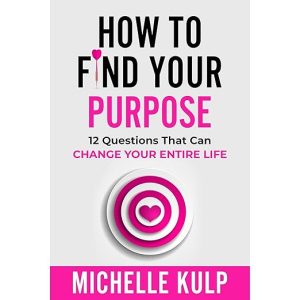
Seventeen years into a legal career, Michelle Kulp describes waking up, hitting snooze a few times, scrolling her phone, and drifting through work, traffic, dinner, and Netflix without a single part of the day feeling like it was actually hers. That monotony is exactly what this fifty-eight-minute audiobook sets out to interrupt, not by handing listeners an answer, but by walking them through twelve questions Kulp insists nobody else can answer for you. How to Find Your Purpose leans hard on a widely circulated Einstein line as its organizing idea: 'If I had an hour to solve a problem and my life depended on the solution, I would spend the first 55 minutes determining the proper question to ask; for once I know the proper question, I could solve the problem in less than five minutes.' Kulp's whole method follows that logic, better questions over faster answers, compressed into a single sitting rather than a sprawling self-help doorstop.
Boymom96 Kept a Google Doc Open While Listening
The book began, per its own framing, as one legal professional's real exit from seventeen years of unfulfilling routine, and that origin gives the twelve questions a lived-in specificity that purely theoretical self-help often lacks. Kulp is explicit that this is not a book that will tell a listener what their purpose is; it is a structured act of self-interrogation instead. Reviewer Boymom96 used it exactly that way, keeping 'a Google doc open' while listening and treating the audiobook 'like a workbook,' which resulted in what she calls 'a concrete plan for my next steps in both my working and personal life,' a genuinely practical outcome for under an hour of listening.
The twelve questions themselves are not listed in the synopsis, which keeps some of the book's structure a surprise, but the framing throughout leans on Kulp's own hard-won distinction between distraction and genuine engagement, noting how social media, television, alcohol, gambling, and video games all function as ways to fill the exact void an absent sense of purpose leaves behind. That is a fairly unflinching list for a fifty-eight-minute self-help audiobook to include right in its own synopsis, and it signals Kulp is more interested in naming the actual coping mechanisms listeners might recognize in themselves than in offering only gentle, abstract encouragement.
AI Narration in Tension With Personal Questions
The narrator on this listing is Virtual Voice, an AI-generated narration rather than a human performer, and that choice sits at real tension with what the book is actually asking a listener to do: sit with hard, personal questions about a monotonous, unfulfilling life and answer them honestly. Self-reflection content like this typically depends on a warm, human, one-on-one register, the sense of someone speaking directly and personally to you, and synthetic narration struggles to deliver that intimacy no matter how technically clear the pronunciation is. None of the three listener reviews mention the narration directly, all three focus entirely on the content and the questions themselves, which may say something about how quickly a fifty-eight-minute listen moves past any single delivery choice, for better or worse.
What survives that narration gap is the content's own structural discipline. One reviewer, posting under the handle An honest man, describes feeling intimidated by the so-called 'blank page' of figuring out life and business direction, calling the book 'a godsend' for laying out 'an easily digestible fashion' toward feeling 'undaunted and forward thinking.' Reviewer Alden M. credits it with helping readers break free from a routine that, in the review's own words, 'often characterizes daily life.' Both reactions point to the same real strength: twelve focused questions, delivered without padding, can genuinely reset a stuck moment faster than a much longer, more meandering self-help title might.
Kulp's own seventeen-year run in the legal field before making this specific pivot gives her twelve questions a credibility that a purely theoretical life coach's framework sometimes lacks; this is someone describing a transition she actually lived through in detail, snooze button and all, rather than a hypothetical case study. That lived specificity is part of why reviewer Alden M. finds real personal resonance in the book rather than treating it as just another entry in an oversaturated self-help category, even at under an hour long.
Pausing After Each Question Is Essentially Mandatory
This audiobook is explicitly built as a companion to writing, not passive listening. The book itself states plainly that ebook buyers need a separate journal or notebook to answer the twelve questions, while the paperback includes lined space directly on the page; the audio edition inherits that same requirement without any built-in workspace of its own. A listener who presses play expecting a complete, self-contained experience will finish the fifty-eight minutes having heard the questions without ever having done the actual work the book is designed around. Pausing after each question to write a real answer, rather than letting the audio run straight through, is essentially mandatory for this format to deliver on its own premise.
The Virtual Voice narration also means no particular vocal warmth softens what is, structurally, a fairly intense set of personal confrontations, seventeen years of unfulfillment, distraction, monotony, laid out directly. Listeners sensitive to synthetic narration in emotionally personal content should sample a short clip first. The genre tag on this listing, Women in Business, and its professional, strategy-focused framing also oversell the content somewhat; this reads much more like personal development and self-reflection than career strategy or workplace case studies, despite where it currently sits filed.
A Sharper Question Beats a Faster Answer
Anyone stuck in Kulp's exact described loop (work, traffic, dinner, distraction, repeat) and ready to actually sit with hard questions rather than scroll past them is the clear audience here. Reviewer Boymom96's approach, treating the audiobook as an active workbook with a notes app open alongside it, is the ideal way to get real value out of fifty-eight minutes; listeners willing to actually pause and write after each question, rather than treating this as a straight one-sitting listen, will get far more out of this than passive listeners will. Anyone specifically drawn to Kulp's Einstein-quote premise, that a sharper question beats a faster answer, will also find the whole structure resonates.
Those who dislike AI-generated narration, or who need real vocal warmth to engage with personal, reflective content, should sample the opening minute before buying, since Virtual Voice's delivery is a genuine departure from a human narrator's presence. Listeners hoping for a longer, more elaborated self-help experience with case studies and extended examples will also find fifty-eight minutes thin by comparison to a typical business or career audiobook. And anyone unwilling to pause and actually write down answers somewhere, a notebook, a phone note, anything, is better off skipping this one, since the entire value of the twelve questions depends on doing that work rather than just hearing them read aloud.
At a Glance
- Voice: Virtual Voice's AI narration is a real mismatch for this kind of intimate, question-by-question self-reflection material.
- Big ideas: purpose and self-discovery, breaking routine, guided self-questioning
- Atmosphere: Intimate, urgent, and workbook-practical
- Worth it?: Twelve genuinely useful questions undercut by synthetic narration and a format that demands a notebook the audio can't provide.