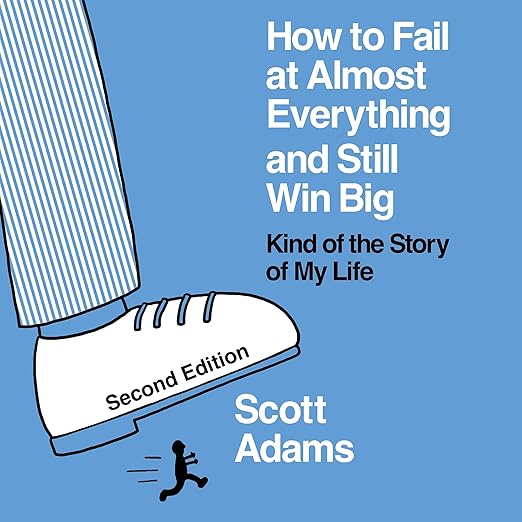
Quick Take
- Narration: Andrew Baldwin reads Adams’s prose with dry intelligence, the timing works well for the material’s blend of self-deprecation and genuine provocation.
- Themes: systems vs. goals, talent stacking, the counterintuitive logic of failure as information
- Mood: Brisk and irreverent, with occasional detours into surprisingly sincere territory
- Verdict: The systems-over-goals framework is genuinely useful and distinct enough from standard productivity advice to earn your eight hours.
I picked this one up on a Sunday afternoon when I was between more serious projects and feeling the particular restlessness of wanting to read something that would give me a new angle on a familiar problem. How you structure ambition. Whether passion is cause or consequence. I’d read the first edition years ago and remembered finding Adams irritating and illuminating in roughly equal measure. The second edition, I was curious to see, felt tighter, the self-congratulation trimmed, the actual argument sharpened.
Scott Adams is the creator of Dilbert, which means he arrives with a specific cultural baggage that some listeners will need to set aside to hear what he’s actually saying. His reputation as a contrarian pundit is not something the book itself foregrounds. What it foregrounds instead is a clear-eyed record of someone who failed repeatedly, used those failures as data, and built a framework for navigating a career that depends more on positioning than on talent alone.
The Systems Argument and Why It Lands
The core distinction Adams draws between systems and goals is the intellectual payload of the whole book, and it’s genuinely good. A goal is a binary outcome, you either achieve it or you don’t, and in either case you stop. A system is an ongoing arrangement that keeps producing upside regardless of specific outcomes. Writing every day is a system. Getting published is a goal. The difference matters because systems keep you in the game even when individual attempts fail, and they tend to produce unexpected opportunities that a goal-focused mentality would miss entirely.
This isn’t a new idea, James Clear’s later Atomic Habits covers related ground with more psychological scaffolding, but Adams arrived earlier and with a different register: wry, personal, willing to look like an idiot in service of making the point. The talent stacking concept, which follows naturally from the systems argument, is similarly practical: instead of trying to be the best in the world at one thing, become very good at several things that, combined, are rare. Adams is a mediocre artist who is also a reasonable writer and also understands business and comedy, and those three competencies combined turned out to be a unique market position. The argument is humble in a specific way that makes it easy to apply.
The Dilbert Creator’s Unconventional Take on Health and Energy
Several chapters deal specifically with energy management rather than time management, and here Adams diverges from the standard productivity literature in useful ways. His argument that personal energy is the true limiting resource, not hours in the day, connects back to the dietary and exercise habits he details from his own life. These sections are less systematically argued than the opening chapters, more anecdotal, but the anecdotes are specific enough to be illustrative rather than decorative.
Listeners expecting a diet book or a wellness guide will find these chapters a detour. But the thread connecting energy to systems to success is more coherent than it might first appear, and Adams earns the broader claim by building it from specifics.
Andrew Baldwin’s Narration and the Adams Tone Problem
Adams has a voice as a writer, dry, quick, aware of his own absurdity, and Baldwin captures the register well without overplaying it. This is not a book that demands theatrical narration; it demands something closer to confident conversational delivery, which Baldwin provides. The humor lands because he doesn’t reach for it. The earnest moments, and there are more of them than you’d expect, land because he doesn’t deflect from them either.
At eight and a half hours, the pacing is comfortable. The second edition’s tightening is genuinely perceptible in the audio format, where bloat costs more than it does in print. You don’t feel the familiar self-help sag around the two-thirds mark where most books of this type run out of ideas and start repeating themselves with different vocabulary.
Who Should Listen and Who Can Skip It
Listen if you’ve been skeptical of standard goal-setting frameworks, if you’ve read James Clear or Cal Newport and want a more idiosyncratic counterpoint, or if you’re in a career transition and need a different way of thinking about what skills are worth developing. The Dilbert creator context is irrelevant to the quality of the argument.
Skip if you’re looking for a methodologically rigorous self-help book with research citations, Adams writes from personal experience and observation, not from systematic study. Also skip if Adams’s cultural profile in recent years makes him difficult to read in good faith; that’s a legitimate response, though the book predates most of that.
Frequently Asked Questions
What’s actually new in the second edition versus the 2013 original?
The second edition is described as a tighter, updated version. Adams trimmed portions that had aged less well and updated references to reflect more recent context. The core frameworks, systems over goals, talent stacking, passion as result rather than cause, remain intact. Listeners who remember the first edition will find it familiar but streamlined.
Is this book really about health and fitness, or is the wellness content incidental?
It’s incidental rather than central. Adams devotes several chapters to energy management, diet, and exercise, but they’re framed as components of the larger productivity and success argument rather than as health guidance. Don’t come to this for a nutrition plan, come for the career and personal development framework.
How does How to Fail compare to Atomic Habits as a systems-thinking listen?
They’re complementary rather than redundant. Adams is more autobiographical and idiosyncratic, Clear more systematic and research-grounded. Adams’s talent stacking concept has no real equivalent in Atomic Habits, while Clear’s habit loop framework goes deeper than anything Adams develops. Most listeners find value in both.
Does Andrew Baldwin’s narration do justice to Adams’s humor, or does it read as too flat?
Baldwin reads with dry precision that suits Adams’s written tone well. The humor works because he doesn’t overplay it. Listeners wanting a more energetic or comedic performance may find him understated, but for the material’s mix of self-deprecation and genuine argument, the even delivery is appropriate.