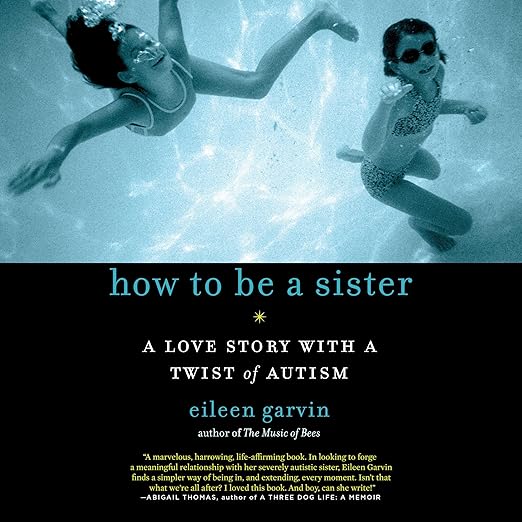
Quick Take
- Narration: Eileen Garvin narrates her own memoir with the unguarded honesty that only a sibling could bring, her voice carries both the exhaustion and the stubborn love that defines the book.
- Themes: Sibling bonds under pressure, autism and family identity, the question of obligation vs. connection
- Mood: Tender, funny, and quietly devastating, the emotional range mirrors the relationship itself
- Verdict: A memoir that earns its place in the autism-family canon through specificity and earned humor rather than easy uplift.
I started listening to this one on a long drive home through the rain, somewhere in the middle of the night, and I ended up sitting in my parked car for twenty extra minutes because I wasn’t ready to stop. Eileen Garvin reads her own memoir about her older sister Margaret, who was diagnosed with severe autism at age three, and there is something in her voice when she describes losing a blue plastic hairbrush, the way it could derail an entire day, the way the family learned to treat a hairbrush as a structural element of domestic peace, that landed differently than I expected. It wasn’t tragic. It was just deeply, specifically true.
How to Be a Sister is structured around Garvin’s return to the Pacific Northwest after several years in New Mexico, where distance had let her sidestep a question she describes as having followed her since birth: what is she going to do about Margaret? That framing turns out to be smarter than it first appears. This isn’t a memoir about Margaret so much as a memoir about what it does to a person to grow up alongside someone they love but cannot fully reach.
The Blue Hairbrush Problem
What distinguishes this book from the broader shelf of autism memoirs is its insistence on specificity rather than generality. Garvin doesn’t describe living with Margaret in abstract terms, she gives you the hairbrush, the Sunday Mass outburst that turned into swearing and dancing, the way a quiet moment could become a scene that scattered the neighborhood kids like startled birds. These are not illustrative anecdotes deployed to make a clinical point. They are what the book is made of. Reviewer Sheila Skinner, who knows this world from the inside, wrote that the book captures autism family life as a series of agonizingly painful events mixed with moments of unexpected joy and humor. That is the exact balance Garvin maintains across six hours.
The humor throughout is never at Margaret’s expense. It arises from situation, from the gap between expectation and reality, from Garvin’s own bewilderment at a life she didn’t choose and couldn’t entirely leave. That’s a difficult tonal line to walk. She walks it with the ease of someone who has been living with the material for decades.
What Distance Costs and What It Preserves
The memoir’s emotional core is not, as the synopsis might suggest, a redemption arc where Garvin figures out how to be a sister. It’s more honest than that. She returns from New Mexico, she tries to reconnect, and she finds that the question of connection with Margaret is not one that resolves cleanly. You can love someone and still not know how to be close to them. You can be present and still feel the distance. Garvin doesn’t pretend otherwise, and that refusal to tidy up the ending is what gives the book its real weight.
There’s also a structural argument running beneath the personal one: as their parents age, Garvin must figure out what role she plays in Margaret’s life going forward. This is the unspoken question that haunts every family with a severely disabled member, and most memoirs gesture toward it without quite sitting with it. Garvin sits with it.
Why the Author-Narrator Changes the Experience
Self-narrated memoirs live or die on the question of whether the author’s voice serves the material. In this case, Garvin’s narration is not a convenience, it’s a requirement. The book depends on tone as much as content, and that tone is hers: wry, slightly raw, occasionally incredulous at her own life. A professional narrator could read the words. Only Garvin can read the weight behind them. The slight hesitations before certain passages, the places where the voice thins out just a little, are not performance. They are the actual texture of a person talking about something they have not quite finished processing.
At six hours and four minutes, the runtime is appropriately concise. This is not a book padded with research or clinical scaffolding. It’s a memoir about a relationship, told at the pace a relationship can bear.
Who Should Listen / Who Should Skip
This will be essential listening for anyone who has a sibling, parent, or close family member with severe autism, particularly for the adult siblings who tend to be invisible in the medical and support literature. Garvin speaks directly to that experience in a way that most resources do not. Parents of children with autism will also find it valuable, for the reminder of what the sibling experience looks like from the inside. Readers who come for a clinical overview of autism will want to look elsewhere, this is not that book, and it doesn’t pretend to be.
Frequently Asked Questions
Is this memoir written from the sibling’s perspective or the caregiver’s?
Strictly the sibling’s. Garvin is not Margaret’s primary caregiver, and the book is explicitly about what it means to be a sister rather than a parent or guardian. That distinction is central to the book’s honesty.
Does the book offer practical guidance for families dealing with autism?
Not directly. This is a literary memoir, not a guide. The value for families dealing with autism is primarily in recognition and validation rather than strategy or technique.
Is the tone mostly heavy, or is there real humor in it?
There is genuine humor throughout, and Garvin earns it. Several passages are laugh-out-loud funny before they become something else. The tonal range is what distinguishes this from a straightforwardly difficult read.
Do you need to know Margaret’s full story before the book begins, or does Garvin provide enough context?
Garvin provides all the context you need. The book opens with her returning to the Pacific Northwest, and the backstory of Margaret’s diagnosis and childhood is woven in naturally as the narrative progresses.