Quick Take
- Narration: Kirby Heyborne brings his characteristic warmth and clarity to a book that benefits enormously from feeling like advice from a trusted older friend rather than a rulebook.
- Themes: Social etiquette, masculine identity, professional and personal conduct
- Mood: Warm and encouraging, like a mentorship conversation you did not know you needed
- Verdict: A genuinely useful social primer that holds up better in audio than in print, thanks to Heyborne’s delivery and the book’s practical, direct tone.
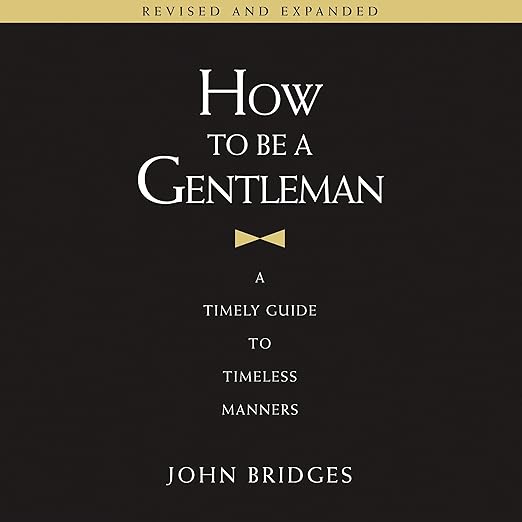
There is a particular kind of book that sounds slightly embarrassing to admit you found useful, and How to Be a Gentleman is firmly in that category. I listened to a good portion of it during a long Saturday errand run, feeling mildly self-conscious at first, and then surprisingly absorbed. John Bridges has been writing about masculine etiquette since the 1990s, and this revised and expanded edition brings his foundational text into the era of smartphones, social media, and the specific social vertigo that seems to affect men who grew up without clear models for navigating adult life with grace. That last part is not my framing, it comes directly from the listener reviews, where one reader describes re-purchasing the book for a 23-year-old grandson who grew up without a father figure. That detail says more about the book’s real audience and real value than any marketing copy could.
Kirby Heyborne is the right narrator for this material. His voice manages to be authoritative without being preachy, a distinction that matters enormously for a book that is, at its core, telling men how to behave. In less capable hands, this kind of content risks tipping into lecturing. Heyborne keeps it conversational, as if he is in the room with you rather than reading from a manual. At nearly four hours, the runtime gives the material room to breathe without overstaying its welcome.
The Etiquette Gap Nobody Discusses
What Bridges understands, and what makes this book more interesting than its cover might suggest, is that etiquette is not primarily about rules. It is about legibility. When you know how to respond to someone with whom you disagree without causing a scene, when you understand how to dress for a formal event you have never attended before, when you can write a sympathy note that does not come across as hollow, you are communicating something about your inner life as much as your social conditioning. Bridges frames this explicitly and returns to it throughout: etiquette is the external expression of consideration for other people.
The revised edition adds chapters on phone use, email etiquette, and social media conduct that were not in earlier versions, and these additions are handled with admirable restraint. The advice is not trend-chasing. It is principled. The guidance on when and where to use your phone, for instance, is not about what is currently fashionable but about the underlying social contract you implicitly sign every time you pull out a device in someone’s company.
What the Reviewers Are Actually Saying
The listener base for this audiobook skews toward people buying it as a gift, for college graduates, for young men entering the workforce, for grandsons at inflection points in their lives. That is telling. This is a book people reach for when they want to give someone the benefit of accumulated social wisdom without making it an awkward conversation. One reviewer notes that the book repeats certain suggestions, which is a fair criticism, and reflects the original structure of the text: it was designed as a handbook to consult rather than a narrative to consume in one sitting. In audio form, that structure requires some navigation, but Heyborne’s pacing helps.
Part of the GentleManners series, this is the core text, the foundational volume rather than a topical expansion. New listeners should start here. The series framework suggests that Bridges has organized his thinking into related but discrete areas of focus, and this book provides the philosophical grounding that makes the rest of the series meaningful.
Mentorship You Can Carry in Your Earphones
The case that reviewers make for this book, and that Bridges makes implicitly throughout, is that the absence of reliable mentorship in many men’s lives creates a specific kind of social uncertainty that no amount of intelligence or ambition can fully compensate for. Knowing how to engage respectfully with different cultural and religious contexts, how to throw a party and set up a bar, how to conduct yourself at the gym, these are not trivial concerns. They are the daily texture of a life lived in relationship with other people. And many men arrive at adulthood without having had these things modeled for them in any deliberate way.
How to Be a Gentleman fills part of that gap without being preachy or rigid about it. The advice is practical, the tone is warm, and the audiobook format actually improves the experience of the material by making it feel less like a compliance document and more like a conversation.
Who should listen: Men at any life stage who want a clear, principles-based framework for social conduct; parents, grandparents, or mentors looking for something to share with a young man entering adulthood; anyone who finds the social rules of contemporary life genuinely confusing. Who should skip: Anyone who already has a strong intuitive grasp of social etiquette and is looking for something more philosophically ambitious or culturally specific.
Frequently Asked Questions
Is this book too basic for men who already have some social confidence?
Possibly. The book is designed as a comprehensive primer, so experienced readers will recognize much of the content. That said, the revised edition’s chapters on digital conduct offer genuinely useful framing even for men who consider themselves socially fluent.
Does Kirby Heyborne’s narration make this more or less awkward to listen to than reading it?
Less awkward. Heyborne’s warm, conversational delivery removes the prescriptive edge that etiquette content can carry in print. It genuinely sounds like advice from someone who likes you, not a rulebook you are being tested on.
Is this book specifically religious or culturally conservative in its framing?
No. Bridges explicitly includes guidance on engaging respectfully with different cultural and religious contexts, which suggests a deliberately inclusive approach. The values are traditional in the sense of valuing consideration and thoughtfulness, not in any ideological sense.
Does the revised and expanded edition significantly differ from the original How to Be a Gentleman?
Yes, primarily in the addition of chapters on smartphone use, email etiquette, and social media conduct that post-date the original publication. The core structure and philosophy remain consistent, but the digital sections bring the advice into the current decade.