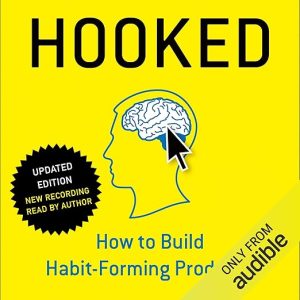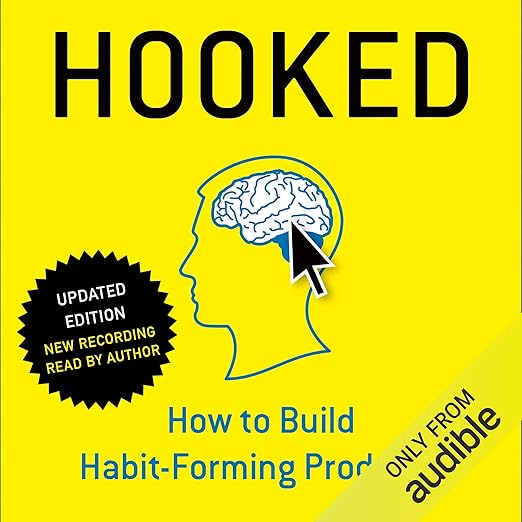
Very few business audiobooks open with a warning about their own sound quality, and this one does exactly that. Before the description says a word about habits or triggers, it tells you the recording was revised and re-cut in December 2019, and asks you to disregard anything earlier buyers said about how it sounded. That is an unusual amount of candor to place above the sales copy, and it sets the terms for everything under it: the page you are buying from is not describing the same file people were grading a decade ago.
A Genuinely Good Product Nobody Opens
Four steps carry the whole argument. Trigger, action, variable reward, investment: the description calls this the Hook Model and presents it as a cycle products run users through until coming back stops being a decision. Each turn of the wheel is supposed to tighten the next one, which is why the copy talks about consecutive cycles rather than single conversions, and why the promise attached to it is repeat use without advertising spend. John Chancellor's five-star account works through the same stages one at a time, starting from the observation that a genuinely good product nobody opens is still a failed product. That premise is the reason the book behaves like engineering rather than persuasion. Four hours and forty minutes is short for a business title, and the compression looks deliberate rather than thin. Nothing in the running time is spent establishing that habits matter.
What I appreciate is how little of the running time goes to justification. Nir Eyal names Twitter, Instagram and Pinterest as worked examples and then gets straight back to the mechanism. Asim Ghaffar's four-star response measures the whole thing at around two hundred pages and calls it essential for product managers, which is a print measurement landing on an audio page, though the point survives the format change: this is a short book that behaves like a manual. A five-star response from January 2026 needs one line to say the same, crediting the book with sharpening skills for product management.
Author, Narrator and Imprint Are One Person
Self-narration is the right call here, and the credit line goes further than usual. Eyal reads his own book, and the publisher credit carries his name too, so author, narrator and imprint are one person on this listing. The material rewards that arrangement. A framework assembled out of behavioral vocabulary needs its terms landed correctly the first time through, and the person who chose the words is the person saying them.
That re-cut notice deserves to be taken seriously, because the visible response pool straddles it. Dan O'Brien's five-star account, filed in February 2016, reads the book as applied behaviorism and never touches the audio at all; a September 2018 response does the same. Both were written while the older recording was the only one on sale. Anyone scanning stars is therefore reading a page whose oldest opinions describe a file the publisher has since replaced, and the notice says so in plain language, which is more than most listings manage.
Skepticism belongs on the score too. Nine ratings sit behind a displayed 4.5, and nine whole-star votes cannot produce that figure: the sums on either side of it round to 4.4 and 4.6, with nothing available in between. Whatever the counter is doing, averaging those nine votes is not it. Five written responses sit on the same page. Read them and let the decimal go, because on a tally of nine the written comments are the larger sample.
Indistractable Is a Separate Purchase
Editions are stacked here. The description advertises a case study on building health habits as new for the second edition, without saying which edition the recording follows or when the second one arrived. Since the same page separately announces a December 2019 re-cut, a buyer ends up with two revision events and one file to map them onto, and no way to line them up.
Another thing to watch is the argument the book declines to have. A method for making products hard to put down is morally live in a way this description never engages: it names the technique, names the companies, and moves on. Eyal has written elsewhere about attention, and the description points to Indistractable by name, but that is a separate purchase. If you want the case against the Hook Model, this recording is not where you will find it, and the description does not pretend otherwise.
Provenance is the harder problem sitting under the edition question. A page carrying a January 2014 date, advertising a second edition, and announcing a December 2019 remake is asking a buyer to trust that all three descriptions point at one file. Most listings never have to make that argument, because most of them only have one version to describe. This one handles the problem by naming the reviews to ignore rather than by naming what you are getting, and candor about a defect is not the same thing as repairing it.
Age shows in the examples rather than in the mechanism. Twitter, Instagram and Pinterest were the obvious case studies when this was written, and anyone listening now will supply replacements without effort. Shelley Greiver's September 2025 response calls the combination of psychology and real examples a simple framework anyone can apply, and that still holds. It is the examples, not the frame, that carry a date stamp.
Telling You Which of Its Reviews to Distrust
Its audience gets named directly in the description: product managers, designers, marketers, startup founders, and anyone curious about what steers their own behavior. I would add anyone who has shipped something good that nobody opened. Four hours and forty minutes fits inside a working week of short sessions, and the framework is portable enough to work when it is only heard rather than annotated, which is not true of every business title at this length.
Novelty is the wrong expectation to bring. Anyone who already absorbed the Hook Model secondhand will find the recording confirms it rather than extends it, and researchers wanting the underlying studies will want notes a linear file cannot show them. Everyone else gets a compact, well-organized argument read by the person who built it, on a page candid enough to tell you which of its own reviews to distrust. That last quality is rarer than the framework, and it is the reason I would still send somebody here.
Questions Listeners Ask
Why does the Hooked audiobook description open with a note about audio quality?
The publisher states that the recording was revised and re-cut in December 2019 and asks buyers to disregard earlier complaints about how it sounded. The listing's own release date is January 2014, so two of the five accounts here were written before the replacement existed. Treat those older comments as evidence about a file you cannot buy.
Which edition of Hooked does this audiobook actually follow?
Nothing says. A case study on health habits is advertised as new for the second edition, and a December 2019 re-cut is announced separately, which leaves two revision events, one file, and no stated relationship between them. Anyone who needs that particular chapter should confirm before buying.