Quick Take
- Narration: Kristin Berry, co-author and adoptive mother, brings an intimacy to this material that no professional narrator could replicate.
- Themes: Foster care realities, open adoption, cross-cultural identity
- Mood: Frank, warm, and grounded in lived experience
- Verdict: For anyone at any stage of the adoption or foster care process, this is the honest conversation you wish you could have with someone who had already been through it.
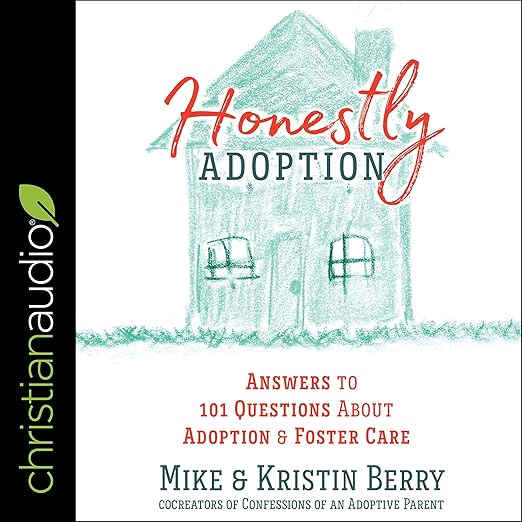
There’s a particular kind of book that gets written about parenting from the inside, where the authors aren’t summarizing research or synthesizing other people’s stories but reporting directly from the life they are living. Honestly Adoption is that kind of book, and it gains something specific from being narrated by Kristin Berry, who adopted eight children alongside her husband Mike and fostered twenty-three more over nine years. When she reads the sections about the hardest nights and the moments where things went sideways, it doesn’t sound like narration. It sounds like testimony.
I listened to the first hour of this one late on a weeknight, expecting something that would feel instructional, maybe useful in a dry reference-guide way. What I got instead was something closer to a long conversation with someone who has genuinely lived the thing they’re describing, and who is willing to say the complicated parts out loud.
Answering Questions Nobody Else Is Answering Honestly
The structural premise of this book is straightforward: the Berrys address the real questions people in the adoption and foster care process are actually asking, including the ones that feel too difficult or too loaded to raise with a social worker. Should you foster or adopt, and how do you know which? What does an open adoption actually mean in practice, not in theory? How and when do you tell a child they are adopted? How do you help a child embrace a cultural or racial identity that differs from your own family’s background?
That last question is handled with particular care. The Berrys have navigated transracial adoption, and they don’t reduce the cultural identity challenge to a reassuring platitude. They talk about the ongoing effort it requires and the specific mistakes they made. This kind of honesty is what distinguishes the book from more polished guides that focus on process over reality. A CASA reviewer noted appreciating the book specifically because it was written by actual parents rather than professionals, and that distinction runs through every chapter.
Where Faith Sits in the Framing
The Berrys approach foster care and adoption from a Christian worldview, and this shapes the book’s tone and some of its framing, particularly around calling and purpose. This is explicit and consistent, not incidental. One reviewer specifically valued the Christian perspective, and readers who share it will find additional resonance in how the Berrys describe their motivation and the sustaining of their family’s commitment through difficulty. Readers who don’t share that framework will still find the practical content valuable, but should know the worldview is integrated into the text rather than kept separate from it.
Kristin Berry’s narration of her own family’s story carries a particular moral authority that’s unusual in audiobooks on this subject. The experience of hearing her read about the emotional terrain of foster care parenting, the attachment challenges, the grief that comes with reunification, and the particular complexity of large-family adoption, is different from reading the same content on a page. Her voice holds all of it without either dramatizing or deflating, and that steadiness is part of what makes the audio version the better format for this material.
The Scope of the Guide and Its Limitations
At just over six hours, this is not a comprehensive legal or procedural guide to the adoption process. It doesn’t walk through the home study, the matching process, or the specific paperwork of foster-to-adopt in any systematic way. What it offers instead is perspective and orientation, the kind of human context that prepares you emotionally and relationally for what the procedural guides don’t cover. Reviewers have used it as a resource to share with family members and friends who want to understand what foster and adoptive families actually experience, and it serves that function well.
For educators, pediatricians, and social workers who work with foster and adopted children, the book offers a window into the family experience from the parent’s side. The reviewer who came to it as a CASA volunteer found it shifted how they approached conversations with foster families, which is a practical outcome for a six-and-a-half-hour listen.
Frequently Asked Questions
Is this book useful if we’re still just considering adoption and haven’t started the process?
Yes, and arguably it’s most valuable at that stage. The Berrys address the fundamental decision-making questions, including whether to foster or adopt and how to choose, before getting into the experience of parenting. Starting here before diving into procedural guides gives you realistic expectations.
Does Kristin Berry narrate the entire book, or does Mike Berry also read sections?
Kristin Berry is the listed narrator and handles the full recording. The book is written jointly by both Berrys, but the audio is narrated in a single voice. Her closeness to the material gives the narration a tone that feels more like direct testimony than performance.
Does the book cover both foster care and adoption, or does it focus on one more than the other?
It covers both, drawing on the Berrys’ experience with both fostering and adoption. Several chapters specifically address the question of which path is right for a given family, and others address issues that apply across both, such as trauma, attachment, and cultural identity.
How does the Christian perspective affect the book for readers who don’t share that faith?
The faith framework is woven throughout and isn’t separable from how the Berrys describe their motivation and sustain their commitment. Readers outside that tradition will still find the practical and experiential content useful, but the worldview is present and consistent, not bracketed into separate sections.