Quick Take
- Narration: Carrington MacDuffie brings a measured, warm delivery that suits the book’s aspirational but grounded register without tipping into parody.
- Themes: Domesticity as personal expression, ritual and tradition in everyday life, the aesthetics of the lived-in home
- Mood: Sophisticated and inviting, like a long Sunday afternoon in a well-appointed kitchen
- Verdict: A thoughtful cultural lifestyle guide that works better in audio than you might expect from an illustrated book, provided you can accept losing the visual references.
I came across this one during a stretch when I was reading a lot about European domestic culture, largely because I’d just returned from a week in Lyon and found myself obscurely dissatisfied with my own apartment in ways I couldn’t quite articulate. I was halfway through Home Sweet Maison before I started to understand what Danielle Postel-Vinay was actually arguing. She’s not writing a decorating manual. She’s writing about why the French relationship to home is fundamentally different from the American one, and what that difference does to how people live.
Carrington MacDuffie narrates, and she’s a good match for this material. MacDuffie has a slightly formal warmth, the kind of voice that reads cultural criticism without making it feel academic, and Postel-Vinay’s prose has a rhythm that rewards that kind of delivery. The book has been compared by its publisher to French Women Don’t Get Fat and The Little Book of Hygge, which is fair positioning but slightly misleading. Those books are about specific practices. This one is about a philosophical orientation toward home that the practices emerge from.
The Philosophy Beneath the Aesthetics
What Postel-Vinay discovered through years of immersive research including a chance encounter with a French expat in La Crosse, Wisconsin, is that French domestic culture is organized around the idea that your home should be a reflection of your life, not a performance for other people. The distinction sounds simple but has significant implications. An American home might be curated for what guests will think; a French home is curated for the pleasure of the people who live there. The formal table setting that sounds stiff in an American context is, in the French context, a ritual of self-respect. You set the table well because you deserve that, not because someone is coming over.
This argument runs through every chapter and gives the book its coherence. One reviewer describes being surprised that the book isn’t about photo-ready rooms with sparse text, but instead offers the reasoning behind the aesthetics. That’s exactly right, and it’s what separates Home Sweet Maison from lifestyle guides that are essentially coffee table books with more words.
What the Audio Format Costs and Gains
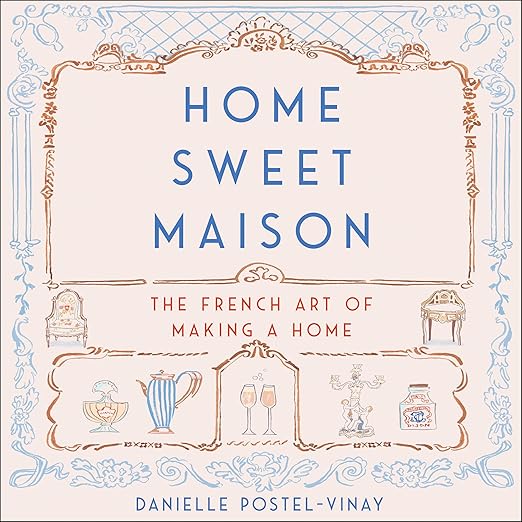
This is an illustrated book. The audiobook loses those illustrations, which matters in certain passages where Postel-Vinay is describing specific visual qualities of French interiors. MacDuffie reads the text fully and the writing is descriptive enough that the absence of images is manageable, but it’s worth knowing. One reviewer noted that the print version’s pleasures include the visual dimension, and for listeners who engage strongly with design imagery, the audio version is a partial experience.
What the audio gains is the pace of reflection. Lifestyle books often work better when consumed slowly, and an audiobook at under five hours enforces a certain thoughtfulness that flipping through a physical book doesn’t require. The chapter on ritual, which covers everything from how French families structure mealtimes to how homes are organized around gathering rather than display, lands more quietly and firmly when heard than when read.
The American Lens That Makes This Useful
One feature of this book that several reviewers specifically appreciated: Postel-Vinay is American, not French. She came to French domestic culture as an outsider who fell in love with it, and her perspective is filtered through that outsider’s awareness of what Americans might find strange or difficult to adopt. She names the places where American habits collide with French domestic philosophy rather than pretending the transition is seamless. A reviewer appreciated this directly, noting that having an American author who understands the cultural translation makes the guidance more actionable.
This is genuine structural value. Books written by French authors about French living often assume the starting position rather than explaining it. Postel-Vinay has to explain it, and the explanation is the most useful part of what she offers.
Ritual Over Renovation
The book’s central claim is that the French home creates a particular quality of life through ritual and intentionality rather than through expense or square footage. The famous formulation near the end, about setting the table formally and then taking pleasure in indulgence, captures something about the French domestic sensibility that rings true. The suggestion that you should host yourself as you would a guest, use the good dishes on an ordinary Tuesday, treat domestic life as worthy of ceremony, is neither new nor uniquely French. But Postel-Vinay earns the argument by grounding it in specific observed behaviors rather than abstract philosophy.
For listeners who came to this expecting interior design tips and find instead a cultural argument about how domestic spaces shape the quality of a life, the experience might land as unexpected. For those who are genuinely curious about why French homes feel the way they do, and whether any of that feeling can be translated without a renovation, this book offers something considered and real. MacDuffie’s narration doesn’t oversell any of it, which is exactly the right call.
Frequently Asked Questions
Does losing the illustrations significantly hurt the audiobook version?
Somewhat. Postel-Vinay’s writing is descriptive enough to carry most of the content, but certain passages about specific visual qualities of French interiors work better with the images present. Listeners with strong visual sensibilities may find the audio version incomplete.
How does this compare to French Women Don’t Get Fat in terms of practical usefulness?
Quite different. Home Sweet Maison is more interested in the philosophy behind French domestic aesthetics than in specific habits or rules. It offers principles and reasoning rather than a prescriptive list, which makes it less immediately actionable but more durable.
Does being an American author who studied French culture give Postel-Vinay a useful perspective?
Yes, and several reviewers cite this explicitly as a strength. She names what’s strange or difficult about French domestic practices for American readers rather than assuming a French starting point, which makes the cultural translation more accessible.
Is this book primarily about interior design or something broader?
Broader. Design is present throughout, but the book is fundamentally about domestic culture: how ritual, family tradition, and intentional living shape the quality of a home. The decorating guidance emerges from that philosophical framework rather than being the primary subject.