Quick Take
- Narration: Annette Amelia Oliveira delivers the debunking energy the History Smashers series demands, brisk, slightly conspiratorial, and pitched right for the middle-grade audience it targets.
- Themes: Myth versus documented history, Indigenous perspective on colonization, the gap between school curriculum and primary sources
- Mood: Lively and irreverent, with the pacing of a history podcast made for kids
- Verdict: Kate Messner’s Mayflower entry does exactly what the series promises: it replaces comfortable myths with messier, more interesting truths, and at under three hours it moves fast enough to hold even reluctant listeners.
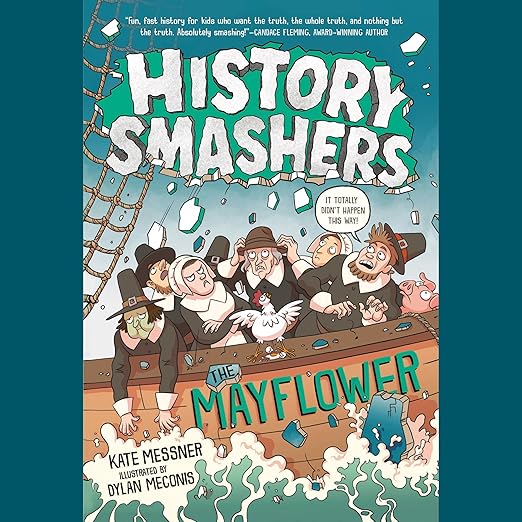
I was halfway through a conversation with a group of fifth graders at a school visit a few years ago when one of them raised his hand and asked, in complete seriousness, whether the Pilgrims and the Wampanoag people had Thanksgiving dinner together on the first day they met. He had absorbed this from somewhere, a picture book, a classroom decoration, the cultural osmosis of November in American elementary schools. History Smashers: The Mayflower is the audiobook that child needed, and it is also, frankly, the audiobook that a lot of adults could use.
Kate Messner has built the History Smashers series around a specific and worthwhile premise: take a famous moment in American history, find the myths that have calcified around it, and replace them with documented evidence. The Mayflower volume is a strong entry in the series because the subject is so thoroughly mythologized. The Pilgrims, Plymouth Rock, the first Thanksgiving, the Wampanoag relationship, almost all of it has been simplified, romanticized, or quietly edited in the telling that most children receive.
The Leaky Second Ship Nobody Taught You About
What makes this audiobook particularly effective is Messner’s instinct for the specific detail that reveals the larger distortion. The Speedwell, a second ship that was supposed to accompany the Mayflower but proved too leaky to make the crossing, is a perfect example. It is a fact most American adults have never heard. Its omission from the standard Pilgrim story is not necessarily malicious; it just gets cut in the simplification. But the cutting also removes context that matters. The Mayflower passengers were already delayed, already depleted, already dealing with a failed plan before they arrived anywhere.
Similarly, Messner’s treatment of the Wampanoag relationship refuses the Hallmark version. The months-long gap before the Pilgrims met any Wampanoag people at all, the political complexity of Massasoit’s decision to engage with the newcomers, the devastating context of the epidemic that had already swept through Wampanoag communities: these details do not appear in most elementary-level treatments, and Messner presents them without sensationalizing or over-simplifying in the other direction.
The Truth About Plymouth Rock
One of the most entertaining sections deals with Plymouth Rock itself. Messner’s handling of this particular myth is representative of the series at its best. She traces not just what Plymouth Rock is and what it isn’t, but how it became what it became in American mythology, who decided it mattered, when, and why. This kind of historiography, explaining not just the fact but the process by which misinformation spreads and gets institutionalized, is rare in children’s nonfiction and valuable at any age.
A homeschooling parent who reviewed this noted that her son appreciated that the subject was not white-washed and that he encountered real history rather than the sanitized version. This is the precise demographic this book serves best: curious children who are ready for the more complicated version, and adults who are willing to revisit what they thought they knew.
Pacing, Narration, and the Under-Three-Hour Promise
At two hours and fifty-five minutes, History Smashers: The Mayflower commits to a pace that does not overstay its welcome. Annette Amelia Oliveira’s narration matches the series’ voice, accessible and slightly conspiratorial, as if she is letting the listener in on secrets. The rhythm suits the material, which is structured in short, punchy revelations rather than long analytical passages.
For families doing Thanksgiving-adjacent curriculum, this is an obvious choice. But it also works outside that seasonal context for any listener interested in how historical myths form and why they persist. The series has other entries, and the Mayflower volume is a solid introduction to the format if this is your first encounter with History Smashers.
Who Should Listen, Who Should Skip
Middle-grade listeners in grades three through six are the core audience, though the content works for adults approaching the subject with genuine curiosity rather than defensiveness. It pairs well with classroom study of Colonial America or the Thanksgiving holiday and does its best work when it has a chance to spark conversation rather than just being consumed passively. Listeners seeking a comprehensive narrative history of the Pilgrims or a deep dive into Wampanoag culture will find this too brief. For that depth, additional resources are needed. But as an entry point that replaces comfortable myths with documented complexity, this delivers the premise its title promises.
Frequently Asked Questions
Is History Smashers: The Mayflower appropriate for a third-grade classroom unit on Colonial America?
Yes, with some facilitation. The content is accurate and age-appropriate, but it will challenge narratives that some students may have already absorbed. Teachers and parents should be prepared to discuss why the simplified version exists and what it leaves out. That conversation is precisely what the book is designed to prompt.
Does this audiobook cover Indigenous perspectives on the arrival of the Mayflower Pilgrims in any depth?
It does more than most children’s books on this subject. Messner addresses the Wampanoag context, the epidemic that preceded the Pilgrims’ arrival, and the political dynamics of the early relationship between the groups. It is not a Wampanoag-centered history by design, but it is meaningfully more balanced than the traditional Pilgrim narrative.
Can this be listened to as a standalone audiobook, or does it pair better with the print version?
It works well as a standalone audiobook. The format is conversational and the revelations land clearly through audio. Unlike some nonfiction titles that rely on charts or illustrations, the Mayflower volume’s primary content is narrative-driven and translates fully to the listening format.
Are the other books in the History Smashers series comparable in quality and approach?
The series uses the same debunking structure across all volumes, and the quality is consistent. The Women’s Right to Vote entry is recommended in the synopsis as a next read. Families who enjoy the Mayflower volume will find the format works equally well for other subjects in the series.