Quick Take
- Performance: Teddy Hamilton takes the only credit on a story told from two men's viewpoints, and the page never says whether a second performer joins the recording.
- What it covers: Friends to strangers to lovers, a bet at eighteen, coming out late and publicly, sport as setting rather than subject.
- Feel: Warm, funny and physically frank, with the ache running underneath.
- Our call: A sharply structured queer sports romance let down by a listing that hides half its authorship.
Nobody died. That is how the description shrugs off the night at hockey camp which ended a friendship, and four years of silence follow the shrug. This audiobook spends its whole eight hours and four minutes conducting, in effect, the argument those two men never had. Jamie Canning and Ryan Wesley get put on opposing college teams at a national championship, handed exactly one apology to survive, and then stranded together coaching at the same camp for a summer. Structure does most of the work here, and it is very good structure.
Three Reviews Credit a Second, Uncredited Author
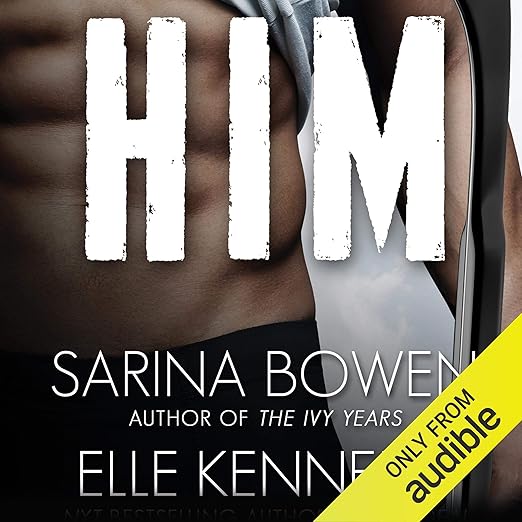
Two names show up in the column and only one on the byline. Three separate written responses treat this as a collaboration: one calls the book Him by Sarina Bowen and Elle Kennedy, one describes arriving at their joint work after reading a couple of titles by each writer, and one signs off with kudos to the two writers who gave us this journey. Three independent people, filing from three different countries, all describing a partnership, while the record credits a single author. Somebody searching under the second name will never arrive at this page, and a listener who finishes the book has no way to learn from the listing who wrote half of it.
Friends to strangers to lovers, not enemies to lovers, is the shape being used, and the distinction matters because the wound is already there when the book opens. Wesley's regret is specific and stated on the record: coaxing a very straight friend into a bet that pushed their relationship past where it could go. Jamie's confusion is equally specific, four years of not knowing why the phone stopped ringing. Putting the apology before the romance rather than after it is the smartest thing the book does, because it means the attraction has to survive an honest conversation instead of substituting for one.
Teddy Hamilton Splits Wesley From Jamie Solo
Moony's July 2018 four-star does more for a prospective buyer than the copy manages. Not a hockey person, the entry says, not even a sports person, and that is emphatically not a prerequisite: the rink is only the setting, and while both leads are athletic and career-focused they are not written as stock jocks. It goes on to call the connection strong, the chemistry tangible, the pace exactly right, and explicitly not a slow burn. That final detail is the one worth acting on, because slow-burn expectations are the commonest way listeners end up disappointed by a book they would otherwise have enjoyed.
Teddy Hamilton holds the sole credit across eight hours and four minutes, on a story that alternates between two heads with genuinely different furniture in them. Wesley arrives tattooed, wisecracking and rule-breaking; Jamie arrives as the person who spent four years failing to work out what happened. Whether the recording splits those voices between two performers is not something this page answers. One name sits in the credit field and nothing else on the record addresses the question, so anybody who buys dual-narrator romance specifically will want the sample before the purchase.
Content warnings usually have to be reverse-engineered from reviews, and here the record supplies its own, in unusually plain language: sexual situations, hotties on hockey skates, skinnydipping, shenanigans in an SUV, and proof that coming out to your family on social media is a dicey proposition. That last clause is doing real work. It signals to a buyer that the coming-out plot is present and treated as consequential rather than as decoration, which is exactly the thing most listings in this category leave you guessing about.
One Player's Homophobic Father Shocks a Reviewer
January 2026 supplies a content note the official warning skips. A five-star filed in Canada praises the central struggle as carefully drawn, then flags what it calls shocking material: a homophobic father belonging to a talented young player the two leads are coaching, plus distant parents on Wesley's side. Yep, these people do exist, the entry adds. Anybody who reads queer romance specifically to spend a few hours away from that particular subject should know it is on the page here rather than gestured at from a distance.
Series numbering promises a companion this record never produces. The field reads Him with the number one beside it, which commits to at least one more volume, and nothing on the page names, links or dates whatever follows. Worth noticing too how the column is put together: nineteen ratings, five written responses, filed from the United States, Brazil, Australia and Canada. That is an unusually scattered set for so small a count, and it means the 4.5 rests on a sample that is both tiny and drawn from four different markets.
Authentic Feelings, Declared Heat, One Real Question
SandyK's March 2024 five-star, filed in Australia, identifies the audience with real precision. New to both writers, having read a couple of titles by each before reaching the collaboration, the entry credits the emotional push and pull between the leads with feeling authentic, praises the dialogue, and notes with visible relief that the plot develops at a good pace without over-the-top melodrama. Readers who want feelings earned rather than manufactured, and who have been burned by romance that mistakes volume for depth, are the constituency.
Slow-burn readers should adjust or look elsewhere, because the four-star in the column says outright this is not one. Somebody needing the sport to be a genuine subject rather than a backdrop will also come away short: the championship exists mainly to put two teams in the same building. And the heat level is declared rather than implied, so nobody averse to explicit content need get as far as the sample to find out.
Check the credit field before you buy if a two-voice production matters to you, since that is the single question this page refuses to answer and the one most likely to change how the book lands. Everything else has been settled in advance: heat level declared, coming-out plot declared, sport reduced to scenery, and eight hours and four minutes is one unhurried weekend. Take the warning at the foot of the description completely literally.
Why does the audiobook listing name only Sarina Bowen?
The record never explains it, and the practical consequences are worth spelling out. This page is unsearchable under the second writer's name, any citation taken from it is incomplete, and a listener who wants more of the same partnership has no thread to pull from here. The column knows about the collaboration; the metadata does not.
Is the audiobook read by one narrator or two?
One name appears in the credit field: Teddy Hamilton, across eight hours and four minutes. The story alternates between Jamie's viewpoint and Wesley's, which would make a second performer a natural choice, and nothing on this page either confirms or rules that out. Check the sample if a duet matters to you.
Do I need to care about hockey to follow this?
Not at all. The rink supplies the setting, the camp and the reason two men keep colliding, but the plot turns on a four-year silence and a long-overdue apology rather than on a season. Nothing in the description assumes you can follow a game, and the championship mainly serves to put both teams in one building.