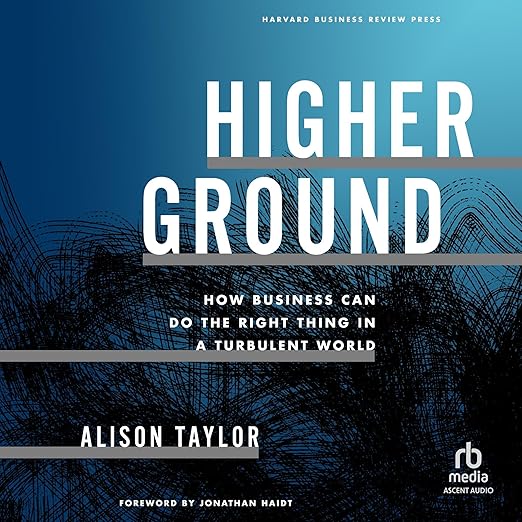
Racial-injustice protests inside company walls, neighborhoods furious over corporate pollution, employees anxious about being surveilled at their own desks: this audiobook opens by cataloguing exactly the kind of headlines that make old-fashioned business ethics training look almost quaint. Alison Taylor, an NYU ethics professor, argues across nine and a half hours that the old black-and-white compliance rulebook stopped being adequate once stakeholders started demanding companies take positions on everything from climate change to labor conditions an ocean away. Higher Ground doesn't pretend a tidy formula sits waiting at the end of the argument.
What Davos Calls For Remains an Open Question
The synopsis is specific about what changed: simply 'maximizing shareholder value while not breaking the law is no longer an option,' yet Taylor argues nobody has replaced that old standard with a clear consensus about what doing right actually requires now. She grounds the argument in real institutional pressure, citing how 'leaders at Davos and the Business Roundtable have called for a new corporate responsibility paradigm,' while noting that translating those calls into practice remains 'an open question' for organizations navigating 'heightened expectations and intense suspicion' simultaneously.
Taylor builds her case through 'vivid stories and examples' rather than pure abstraction, per the synopsis, which matters for a subject this easy to render as dry policy language. williamtheliar's review captures the emotional register underneath the analysis, describing 'heightened anxiety, division, and uncertainty' as the backdrop the book is written against, tied to a broader 'unraveling of institutions and social structures' that gives the corporate-ethics argument real contemporary urgency rather than abstract theorizing.
Surveillance Anxiety Is the Newest Ethical Territory
The specific examples named in the synopsis aren't abstract placeholders; child labor discovered in supply chains, staff anxiety over being surveilled at work, and communities furious over corporate environmental damage are each live, ongoing categories of real corporate scandal rather than hypothetical case studies invented to illustrate a point. Taylor's choice to name these categories directly rather than speak in euphemism gives the book's diagnostic sections real teeth, and it's part of why williamtheliar's review responds to the book with genuine urgency rather than polite professional interest.
Surveillance anxiety specifically stands out among the synopsis's examples as a newer category of workplace ethics concern than the others; bribery and fraud have governed corporate compliance thinking for decades, but staff worry over being monitored at their own desks is a comparatively recent addition to the ethical territory business leaders now have to navigate, and Taylor's inclusion of it signals a book genuinely tracking current concerns rather than recycling an older ethics-training template.
Julia Anthony's Professorial Voice Avoids Dryness
Julia Anthony narrates, and business and leadership nonfiction like this needs a voice that carries professorial authority without ever tipping into lecture-hall dryness, especially across a runtime built on case studies rather than pure argument. TracyKayeLVK's review praises the result directly, calling Higher Ground 'a deeply grounded book about finding a moderate path during polarized times' and crediting Taylor for how she 'adeptly unpicks the difference between a business reacting to' pressure versus genuinely leading on it.
The book's ambition shows in its willingness to name real, live tensions rather than safe generalities, exactly the quality williamtheliar's review responds to when framing the book as essential reading for understanding 'where to next' amid institutional uncertainty. A 4.7 rating across 130 reviews suggests that willingness to engage directly with contentious material, rather than retreat into safe corporate-speak, is landing with listeners rather than alienating them.
TracyKayeLVK's review singles out the book's moderate path during polarized times as its defining achievement, crediting Taylor for resisting the pull toward either a cynical dismissal of corporate ethics entirely or an uncritical embrace of whatever a company's PR department calls responsibility. That middle position is harder to argue persuasively than either extreme, and sustaining that position for the length of the full book without the argument going soft or vague is a real rhetorical achievement the narration has to carry convincingly from chapter to chapter.
Taylor's NYU ethics-professor position gives the book's argument real institutional weight beyond one consultant's opinion or one company's internal task force, credentialing the analysis in a way a purely practitioner-authored book often lacks. That academic grounding pairs with genuinely current, real-world case studies rather than staying purely theoretical, a combination that's harder to pull off convincingly than either approach alone.
Trying Hardest Only Seems to Invite Scrutiny
An Amazon Customer review is honest about the genre's real difficulty: corporate responsibility is 'contentious and fraught with pitfalls,' and companies 'who try the hardest only seem to invite the most scrutiny' when their efforts fall short of perfect. That's an important expectation-setter: this is a diagnostic, strategy-and-nuance book rather than a simple checklist promising an easy formula, and readers hoping for a tactical playbook with clear right answers should recalibrate toward a more analytical, case-study-driven reading experience.
Worth knowing before purchasing: the listing notes a companion PDF is included alongside the audio, standard for business nonfiction that likely references frameworks, case studies, or figures better absorbed visually. The audio carries the argument and storytelling fine on its own, but readers who want to reference specific frameworks repeatedly should know the supplementary PDF exists.
Business nonfiction built around named frameworks and structured case studies sometimes loses something in pure audio, without a page to flip back to for a diagram or a bulleted summary, and Higher Ground likely leans on exactly that kind of structured argument given its academic origins. The included companion PDF exists precisely to cover that gap, and listeners who want to actually apply Taylor's frameworks at work, not just absorb the argument passively, should plan to have that PDF open rather than relying on audio alone for the reference material.
The 4.7 rating across 130 reviews for a business ethics book, a genre not typically associated with enthusiastic five-star responses, suggests Taylor's case studies and direct engagement with genuinely difficult, live controversies are resonating with readers who might otherwise find corporate responsibility literature either too soft or too academic to hold their attention.
No Tactical Checklist, Just Genuine Tension
Business leaders, HR and sustainability professionals, and MBA-adjacent readers looking for a rigorous, credentialed take on corporate responsibility beyond simple compliance are the clear audience, and Taylor's NYU ethics-professor credibility gives the argument real academic backing alongside the practical case studies.
One caution worth naming directly: readers hunting for a tactical checklist with clear right answers, rather than a nuanced argument that names genuine political and ethical tension without resolving it neatly, should adjust expectations before starting, since the book's whole value rests on sitting with that difficulty rather than smoothing it over.
A Few Questions About Higher Ground
Is this audiobook aimed at executives, or is it useful for general business readers too?
Both. While written with leaders and decision-makers in mind, the case studies and institutional analysis are accessible to HR, sustainability, and general business audiences interested in corporate ethics.
Does this audiobook provide a clear framework, or is it more analytical and open-ended?
It leans analytical. One reviewer notes the topic is genuinely fraught with pitfalls, and the book resists offering a tidy formula, focusing instead on nuanced case studies and institutional tension.
Do I need the companion PDF to fully understand this audiobook?
No, though it's included with purchase. The audio carries the argument and stories on its own, but the PDF may help readers who want to reference specific frameworks repeatedly.