Quick Take
- Narration: Tia Rider delivers the book’s irreverent tone without leaning into comedy at the expense of the science, a balance that serves the ACT framework well.
- Themes: Acceptance and commitment therapy applied to health, why motivation fails, self-compassion as a functional tool
- Mood: Frank and gently humorous, with enough clinical rigor beneath the title to actually deliver on its promise
- Verdict: The ACT-based approach gives this considerably more staying power than the provocative title suggests, and the honesty about why health habits are genuinely unpleasant to form is refreshing.
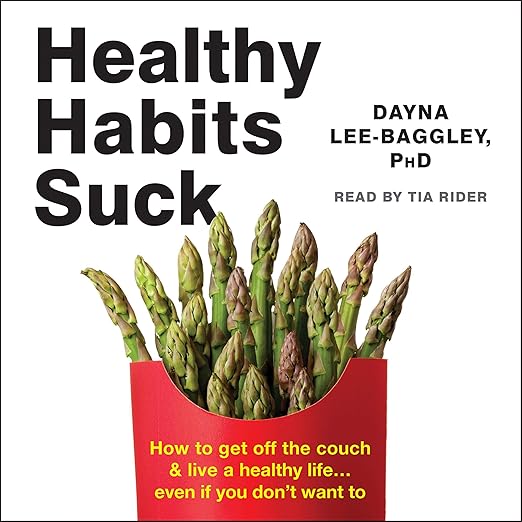
I came to this one specifically because a registered dietitian in a review had started recommending it to her patients, which is not something that happens with wellness books that are merely motivational. Dayna Lee-Baggley is a health psychologist whose work applies acceptance and commitment therapy to behavior change, and the title is not a marketing conceit. The book genuinely begins from the premise that many healthy habits are unpleasant, and that pretending otherwise has been part of the problem all along.
The wellness industry has spent decades telling people that if they just find the right angle on exercise, or discover the right way to prepare vegetables, they will stop wanting the things they actually want. Lee-Baggley is a scientist who knows this is both empirically untested and observably false, and she builds her entire approach on acknowledging that gap rather than trying to close it with enthusiasm.
The Motivation Problem and the ACT Solution
The central insight Lee-Baggley draws from ACT is that waiting for motivation to change behavior is waiting for a bus that runs on an unreliable schedule. Motivation is an internal state that follows behavior at least as often as it precedes it, and the neuroscience she cites on why humans crave sugar and dislike vigorous exercise is not news to anyone who has tried and failed at a health regime. What she adds is a framework for acting in accordance with values even when internal states are opposed to those actions.
This is different from willpower rhetoric, which asks you to suppress impulses through force. ACT asks you instead to acknowledge the impulse, notice your relationship to it, and choose behavior based on what matters to you rather than what feels immediately rewarding. The self-compassion component is not soft. It is strategic: self-criticism activates threat responses that make behavior change harder, and Lee-Baggley explains the mechanism clearly enough that the instruction to be kinder to yourself starts to feel less like an affirmation and more like advice from a clinician who has watched self-criticism fail in real time.
Where the Science and the Tone Find Their Balance
Reviewer S. Harvey’s description of the book as containing peer-reviewed techniques including cognitive review, mindfulness, planning, and identifying values is an accurate summary of what makes this work. Lee-Baggley draws on a substantial research base without making the book feel like a literature review. The humor in the writing, the frank acknowledgment that broccoli does not taste as good as a donut and probably never will, is what makes the science accessible rather than defensive.
Tia Rider’s narration suits the material. She reads the irreverent sections with lightness and the clinical sections with appropriate gravity, and the calibration is steady throughout the nearly four-hour runtime. The book does not overextend itself. It makes a specific argument about a specific set of tools, demonstrates the tools with examples, and then lets the listener decide what to do with them.
The Audience This Book Actually Serves
Reviewer kristina’s perspective as a registered dietitian recommending this to patients is worth taking seriously. The book sits at an unusual intersection: rigorous enough to earn clinical endorsement, readable enough to reach a general audience, and honest enough about the difficulty of behavior change to avoid alienating people who have already tried and failed at standard wellness advice. It is not for people who already love exercise and want to optimize. It is for people who do not, who know they should do certain things, and who need a framework for doing them that does not require liking them first.
The three-hour-and-fifty-five-minute runtime is appropriate for the scope. Lee-Baggley is not trying to cover all of health behavior; she is presenting ACT-based tools for the specific problem of doing things you do not want to do. The focus is a virtue, and the book earns its place alongside the more comprehensive behavior-change literature by doing one thing very well rather than doing many things adequately.
Frequently Asked Questions
Do I need any background in ACT or cognitive behavioral therapy to get value from this book?
No. Lee-Baggley explains acceptance and commitment therapy from first principles in terms that require no prior knowledge. The framework is presented as a set of practical tools rather than a theoretical system.
Is this book for people who have already tried and failed at forming healthy habits, or for those just starting?
Both, but it is particularly designed for people who have tried and failed. The book explicitly addresses why conventional motivation-based approaches do not stick and offers a different mechanism for change that does not depend on sustained enthusiasm.
How does Healthy Habits Suck compare to James Clear’s Atomic Habits?
Clear’s book focuses primarily on environmental design and habit architecture. Lee-Baggley’s approach goes deeper into the psychological relationship with habits, specifically addressing the role of values, self-compassion, and the management of internal resistance. They are complementary rather than competitive.
Are the online resources mentioned in reviews accessible from the audiobook?
The book references online companion resources. In audiobook format you will need to note the URLs or chapter references as they are mentioned and access the materials separately, as they are not embedded in the audio itself.