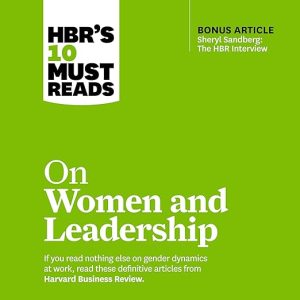
Ten Harvard Business Review articles, curated from decades of archive material, get compressed into this seven-hour, twenty-minute audiobook, and the format choice matters as much as the content curation. Callie Beaulieu narrates in a clear, academic register built for legibility rather than dramatization, which is exactly the right call for a collection assembling multiple authors' distinct arguments into a single continuous listen.
A Century of Institutional Credibility Behind the Articles
The ten selected pieces build toward a specific set of practical goals rather than a single unified thesis: understanding the path women must take to reach leadership, identifying root causes behind persistent barriers, checking personal bias and distinguishing confidence from competence in colleagues, running a more effective diversity program, recognizing what women face when they speak up about bias or harassment, and helping women re-enter the workforce after time away.
That range is the collection's real strength and its structural challenge at once: each article argues its own case independently, drawing on its own research base, case studies, or interview material, which means listeners get triangulated understanding built from several distinct angles rather than the single sustained narrative momentum a traditional single-author business book would offer.
This entry belongs to Harvard Business Review's much broader 10 Must Reads series, which applies the same curated-anthology format to dozens of other business topics, so listeners who find this specific selection useful have a large adjacent catalog to explore built on the identical structural logic.
Triangulated Understanding Instead of One Sustained Narrative
Harvard Business Review itself carries over a century of institutional credibility behind the individual articles collected here, which matters for how this specific compilation reads compared to a newer, less established business-book imprint. The editorial process behind an HBR piece, peer review, senior editorial oversight, research vetting, is different in kind from a single author's independently published take on the same subject.
Because the ten articles were each written and published independently across HBR's archive, the collection reads less like a single coherent argument and more like a curated reading list assembled by an editor with a clear thesis about what matters most in this specific conversation, even though no single contributor wrote with that unifying thesis directly in mind.
A 4.6 rating from 235 ratings signals strong, consistent satisfaction for a research-driven anthology, a format that can be a harder sell for average scores than a single gripping narrative nonfiction title, since anthology listeners are implicitly grading ten separate arguments rather than one sustained story.
Re-Entry Gets Real Attention Beyond the Climbing
Callie Beaulieu's clear, consistent delivery across ten distinct articles is the right narrator choice for a compilation like this one: she prioritizes making each author's argument legible rather than performing or dramatizing material that was written to be read analytically, not narrated for suspense or emotional peaks.
Reviewer Denise Dziwak's framing is useful: understanding both the societal and internal, intrinsic forces that push women out of the workforce, or trap them in worse conditions once they stay, requires exactly the multi-angle approach this collection takes, since no single article could carry that full explanatory weight alone.
Reviewer Dan's response, praising the volume of data and information about workplace marginalization specifically, points at a real differentiator from more anecdote-driven leadership books in this crowded category: these are HBR-vetted, research-grounded pieces rather than a single author's personal theory of the case.
The Right Narrator Choice for Ten Articles
The confidence-versus-competence distinction that one of the ten articles centers on is worth flagging as a genuinely useful, specific analytical tool rather than another vague leadership platitude: the research this article draws on argues that observers routinely mistake confident delivery for competent judgment, particularly across gender lines, which has direct, practical implications for how promotion and hiring decisions actually get made inside real organizations.
The workforce re-entry material addresses a genuinely underserved angle compared to most leadership content in this category: most books in the women-and-leadership space focus on climbing, negotiating, and advocating for yourself while already employed, while this collection devotes real attention to the specific, different challenge of returning to a career after a deliberate pause, a gap most competing titles skip entirely.
Reviewer MCH987's brief but enthusiastic response, calling it highly recommended and absolutely worth the listen, is a useful reminder that even a research-dense anthology like this one can land as a satisfying, complete listening experience rather than merely a reference tool to be consulted piecemeal.
Each article most likely runs as its own marked chapter in the audio file, which matters practically: listeners can jump directly to the specific piece most relevant to their current situation rather than navigating by elapsed time through an undifferentiated single track.
Ten Separate Sessions Instead of One Long Sitting
Because each article was originally written and published independently, some material inevitably reflects the organizational thinking of whatever year it was researched rather than a fully current snapshot; listeners should expect a range of vintages within the collection rather than a uniformly fresh survey.
The listening experience genuinely rewards treating this as ten separate twenty-to-thirty-minute sessions rather than one continuous seven-hour sitting; article-format nonfiction loses very little by being consumed in pieces, and trying to absorb all ten back to back risks flattening the distinct arguments into an undifferentiated blur.
A companion PDF is available in your Audible library alongside the audio, and it matters more here than in a typical single-author book, since some original HBR pieces include charts, frameworks, or summary boxes that do not translate fully into narration alone.
Listeners drawn to a single, sustained argument developed and complicated across an entire book-length narrative, the kind of experience a dedicated single-author leadership book provides, should recalibrate expectations here; the anthology format trades that sustained development for breadth across ten independently argued positions, which serves a different, more reference-oriented listening goal.
Assigned Listening Serves This Better Than Solo Leisure
HR professionals, DEI practitioners, and managers actively building or auditing a diversity program will get direct, applicable value here, since several of the ten articles are explicitly structured around actionable organizational steps rather than pure analysis.
Women navigating early or mid-career leadership questions, along with managers of any gender who want research-backed grounding rather than anecdote, are the collection's clear core audience.
Readers who have already encountered the confidence-versus-competence research or the workforce re-entry material elsewhere, in a business school course or a prior HBR subscription, may find this specific compilation less essential than a listener encountering that research for the first time in curated audio form.
This collection also works well as assigned or shared listening rather than purely individual leisure content: HR teams building a diversity-and-inclusion training curriculum, a company's women's employee resource group running a book discussion, or a manager wanting a common reference point before a team conversation will all find the article-by-article structure genuinely easy to assign in pieces.
Skip it if you want one author's fully unified argument and voice sustained across the entire runtime; this format is built for breadth across ten distinct perspectives, not depth on a single throughline, and readers who've already worked through the individual source articles elsewhere may find limited new material here.
In Brief
- Narration: Callie Beaulieu keeps ten distinct articles legible with a clear, academic register rather than dramatizing the material.
- Themes: gender bias in the workplace, leadership barriers, workforce re-entry
- Mood: Practical and research-driven
- Verdict: A genuinely useful primer for HR and management audiences, less suited to readers wanting one unified authorial voice.
Before You Listen
Does this audiobook work as a continuous listen, or is it better in pieces?
Better in pieces. Each of the ten articles argues its own case independently, so treating it as ten separate twenty-to-thirty-minute listens will land better than expecting one continuous narrative arc.
Is this audiobook part of a larger HBR series?
Yes, it's one entry in Harvard Business Review's broader 10 Must Reads series, which covers many other business topics using the same curated-article format.
Do I need the companion PDF for this audiobook?
It's available in your Audible library and worth having on hand, since some of the original articles include charts, frameworks, or summary boxes that translate imperfectly to audio alone.