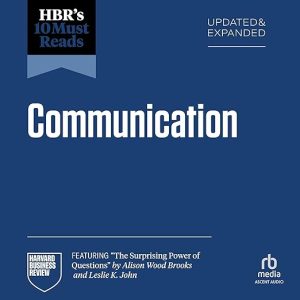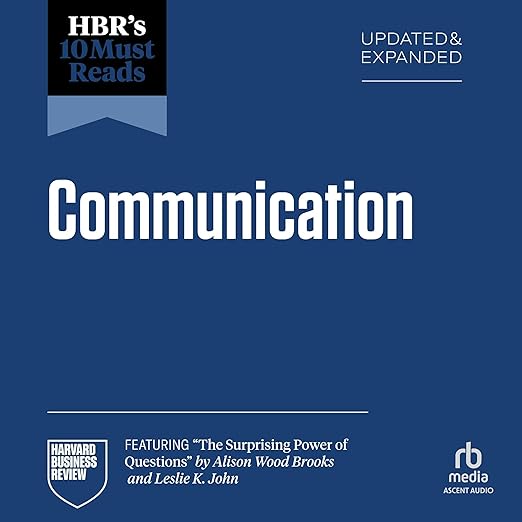
Ten articles, no ratings, no reviews, no names. Harvard Business Review's communication anthology arrived in March 2026 and the page has stayed blank ever since: no stars, no written verdicts, nothing at all. What the listing does carry is a title promising ten pieces, an audiobook running four hours and fifty-nine minutes, Stephen Bowlby credited as the reader, and a description that never names a single one of the ten.
Ten Promised Articles, Zero Named Authors
Ten Must Reads is a promise with no manifest attached. The description lists six things the collection will help you do, ask better questions, listen for emotion and cues rather than only facts, use visuals persuasively, sharpen your business writing so a message sticks, manage negative emotion during stressful conversations, and cultivate enough psychological safety for constructive debate, then names none of the articles doing that work. Harvard Business Review sits on the byline as an institution. The writers of these pieces, each a credited author in the magazine, appear nowhere.
Arithmetic makes the omission concrete. The running time divided across ten articles leaves roughly half an hour each, or about two pieces per hour, and the copy then adds further short-form items on top of the ten, which the title does not count and the description does not enumerate. So the real number of things inside this collection is unknown, and the figure in the title works as a floor rather than a total. The series line compounds it: HBR's 10 Must Reads is named, and the volume number sits empty.
Six Capabilities, from Better Questions to Safety
Anthologies suit audio better than most nonfiction, and this one is built the way the format likes: discrete pieces, each self-contained, each finishing before attention gives out. Nothing carries between articles, so a missed sentence costs a paragraph rather than a chapter. Updated and expanded means new pieces have joined or replaced older ones, which matters practically: the version on sale now is not the version somebody recommended to you three years ago, and the page will not tell you what changed.
Six capabilities are promised, and they are unusually concrete for the genre: better questions to get more out of a discussion, listening for emotion and cues rather than facts alone, persuasive use of visuals, business writing that makes a message stick, managing negative emotion in a stressful conversation, and building enough safety for people to argue productively. The last of those is the most current idea in the list. The first is the oldest. A collection spanning both is doing its job as a survey.
Bowlby's Single Voice Smooths Ten Different Styles
Stephen Bowlby reads it for Ascent Audio, and a single voice across a multi-author anthology is an editorial decision rather than a default. Ten writers with ten prose styles arrive in one register, which smooths the seams and costs you the ability to hear where one argument stops and the next begins. For a collection meant to be worked through rather than absorbed in one pass, that smoothing cuts both ways, and it is worth knowing before you start.
Visuals on the Syllabus, No Recording Fixes That
Visuals are on the syllabus, which is a problem no recording can solve. The copy promises to teach persuasive and effective use of visuals, and it promises to sharpen your business writing, and both of those are disciplines practiced with eyes and hands. Listening to advice about slide design is entirely possible; applying it while listening is not. Anybody buying the recording for those two capabilities in particular should plan on taking notes or on owning the text as well.
Five months after release the page carries no rating, no ratings count and not one written response. That is unusual for a series with this much recognition behind it, and it leaves no independent signal of any kind: nothing on the selection, nothing on the production, nothing on whether the updated edition improves on the one it replaced. You are buying on the strength of an imprint and a table of contents you are not allowed to see.
Small carelessness runs through the record. The description drops a space and welds two words into one, which is a modest thing to find in copy from a publisher whose subject is making a message stick. The tag reads Writing and Publishing, though writing is one of six topics here and arguably not the largest. The opening line has been rewritten for the format, urging you to listen to nothing else on communication and then to listen to this.
Managers and Team Leads Are the Real Target
Managers who have to speak in front of people and would rather not are the target, and the promises are pitched directly at that discomfort: authenticity, clarity, winning over an audience. Team leads get more from it than solo readers do, since the copy frames the material explicitly as tools for you and your team. Anyone who has read scattered pieces from this magazine and wished somebody would gather the useful ones will find the gathering already done.
Learners who study in short sessions are well served by the shape rather than the substance. Half-hour pieces fit a journey, finish cleanly and require no continuity, so this functions as a set of sessions rather than a book you must hold in your head. People working in a second language in corporate settings may find the register useful too, since the whole collection concerns being understood rather than being impressive.
Walk away if you want depth on one topic, because ten pieces at half an hour apiece is a survey by construction and nothing gets developed at length. Walk away as well if you need to know what you are buying, since the articles are unnamed, their authors uncredited, and the count in the title excludes the extra pieces the copy mentions. Five hours is a small commitment, and on a page this empty, small is the only sensible size of bet.
In Brief
- Performance: Stephen Bowlby reads a multi-author anthology for Ascent Audio, giving ten separately written articles a single register they never had on the page.
- What it covers: speaking with clarity under pressure, listening for emotion rather than fact, psychological safety as a precondition for debate
- Feel: Brisk and practical, closer to a workshop than to a book
- Our call: A clean survey of business communication, sold on a completely blank page with its contributors unnamed.