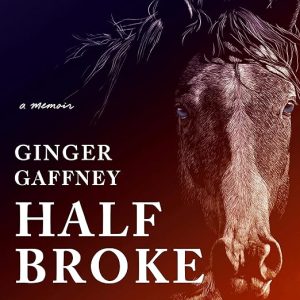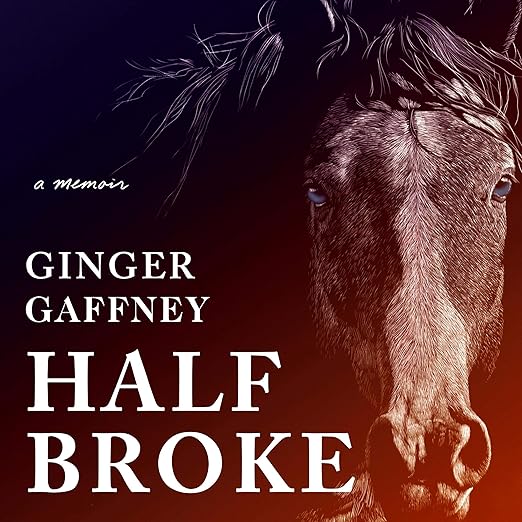
Ginger Gaffney answers a phone call at the start of Half Broke that will take her into one of the more unusual rehabilitation programs in American corrections: a prison ranch in New Mexico run entirely by its residents, where the horses have begun scavenging through dumpsters and injuring the people who feed them. That premise alone would sustain a book, but the audiobook - narrated by Christa Lewis over eight hours and eleven minutes - does something more structurally interesting. It runs two rehabilitation narratives simultaneously, one for the horses and one for the residents, and Gaffney's central argument is that these are not parallel stories. They are the same story told in two registers.
The horses arrive at the ranch broken in the specific ways that trauma breaks animals: defensive, terrified, reading every human movement as potential threat. The residents arrive broken in ways that trauma breaks people: addictions that have hollowed out the physical body, emotional walls built high enough to keep everything dangerous out and everything necessary out as well. Gaffney's skill is in showing how the work of rehabilitating the horses requires exactly the kind of honesty and body-present attention that the residents have been avoiding for years. You cannot lie to a horse about your emotional state. Your posture tells them before your face does.
Gaffney's Own Story With Horses Is Load-Bearing
What distinguishes Gaffney's writing from other horse-and-human rehabilitation narratives is the autobiographical layer she weaves through the ranch year. Her own story - a solitary childhood, painful introversion, and the transformative relationship with her first horse Belle - is not inserted for texture. It is load-bearing. Gaffney is not a neutral observer at this ranch. She is a person who learned to trust animals before she learned to trust people, and the year at the prison ranch is, for her, also a year of learning to trust people as much as she trusts horses. Lewis's narration carries that self-implication without making it sentimental.
Reviewer Eleni describes the character development as 'so visual and visceral at times,' which is the precise response the writing earns. Gaffney writes the horses as specific individuals with specific histories, not as symbols of wildness or innocence. The severely injured horse mentioned in the opening is not a metaphor. It is an animal in pain with a particular history of mistreatment, and working with it requires the same level of individual attention that the residents require. That specificity is what makes the parallel structure work rather than feel imposed.
Christa Lewis Translates Non-Verbal Trust Into Words
Christa Lewis's narration is a significant factor in making the eight-hour audiobook work as a unified experience. Gaffney's prose has a quality of careful attention - she watches things closely before she writes them - and Lewis matches that pace without making it feel slow. The passages where Gaffney describes the non-verbal communication between a handler and a frightened horse are among the most technically interesting in the book to listen to, because Gaffney is translating into language something that is specifically not linguistic, and Lewis delivers that translation with appropriate deliberateness.
Reviewer HMK, who calls it 'a book for everyone, regardless of your affinity for horses,' is identifying something real. The book is about horses the way that The Old Man and the Sea is about fishing - the subject is the vehicle, not the destination. What Gaffney is actually writing about is the basic condition of being a living creature with a history that has made trust difficult, and the specific practices that can begin to repair that. Those practices turn out to work for horses and for people through the same mechanism: consistency, honesty of body and spirit, and the willingness to start over after a failure without adding the failure to the score being kept.
Real Relapses Instead of a Thriller's Clean Arc
The book builds toward a conclusion that Gaffney describes as dramatic, and that description is accurate but requires calibration. This is not a thriller. The drama here is of the human and animal variety - the specific kind where someone who has not trusted anyone in years makes a choice to try again, and the outcome is not guaranteed. There are relapses in the recovery narratives, betrayals that complicate the trust being built, and moments where the progress that seemed real turns out to be provisional. Gaffney does not soften these passages, and Lewis does not deliver them with the cadence of a recovery success story. They land as what they are.
The reviewer who notes wishing they had read this while they still had horses identifies something the book generates reliably: a desire to apply Gaffney's observational framework retroactively to relationships you did not have the tools to read at the time. That retroactive recognition is one of the book's most consistent effects, and it has nothing to do with whether you have ever owned a horse.
Complexity Over Clean Resolution, Horses Included
This audiobook belongs to readers interested in recovery narratives told with genuine complexity, animal communication as a serious subject rather than a sentimental one, and memoir that integrates the author's own history into the larger story without centering it disproportionately. Readers with specific experience of addiction recovery - their own or someone close to them - will find the ranch narratives particularly precise. Those who came looking for equestrian content and stayed for the human story are the majority of the reviews, and that crossover describes the audiobook accurately. Skip it if you need clean narrative resolution or a recovery arc that arrives at a tidy conclusion. Gaffney is honest about the ones that do not.
- Voice: Christa Lewis brings a grounded warmth to Ginger Gaffney's prose that suits the material perfectly - the New Mexico ranch setting, the circling-toward-trust dynamic between horses and residents, and Gaffney's own introverted voice all benefit from a narrator who does not over-dramatize what is already powerful.
- Big ideas: Mutual rehabilitation between animals and humans, addiction and the body in recovery, the communication that happens without language
- Atmosphere: Raw and attentive, moving between difficulty and something that might be called grace
- Worth it?: Half Broke earns the word 'remarkable' that opens its synopsis, and Christa Lewis's narration delivers Gaffney's dual-layer story of horses and humans without softening either.
Good to Know
Do you need to know anything about horses to appreciate the Half Broke audiobook?
No prior equestrian knowledge is necessary. Gaffney writes the horses as individuals with specific behaviors and histories, but she explains the communication dynamics she is working with in terms that any attentive reader can follow. Multiple reviewers with no horse background report finding the book fully accessible and specifically resonant.
Is Half Broke primarily a recovery memoir or a book about horsemanship?
It is genuinely both, and the synthesis is the book's central achievement. Gaffney argues through the structure that horse rehabilitation and human recovery from addiction and trauma operate through the same underlying principles. Neither strand is primary - they are running parallel tracks that converge throughout.
How does Christa Lewis handle the more difficult emotional passages in the audiobook?
With restraint rather than performance. Lewis does not signal to listeners how to feel about the relapses, betrayals, or moments of breakthrough. She delivers Gaffney's carefully observed prose at the pace the writing requires, which allows the emotional weight to accumulate naturally rather than being announced.
Is the Half Broke audiobook complete at eight hours, or does it feel like it ends prematurely?
The eight hours cover Gaffney's full year at the ranch, including the dramatic conclusion she references in the synopsis. It feels proportionate to the material - neither rushed in the difficult passages nor padded in the easier ones. The memoir's scope is one year, and that year is complete.