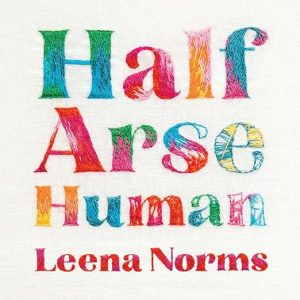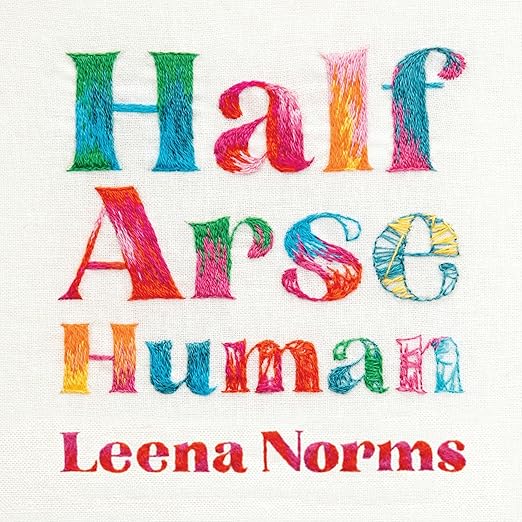
The title Half-Arse Human does most of the marketing work on its own, but Leena Norms's audiobook is considerably more interesting than the joke suggests. Norms, a British YouTuber and writer with a devoted following, is not here to validate sloth. She is here to make a serious argument about the finite nature of human energy and the absurdity of expecting yourself to operate at maximum capacity across every domain of life simultaneously. That argument unfolds over eight hours and forty-six minutes in a voice that is simultaneously self-deprecating and genuinely rigorous, which is a harder combination to land than it sounds. Sarah Knight, whose blurb describes the book as "so important," registers that rare quality correctly.
Strategic Effort Replaces Nonstop Self-Optimization Here
Norms opens the book by describing herself as "a shave-one-legger" and "a rinse-the-plates-and-tell-herself-any-residual-dirt-will-improve-her-immune-system-er." These are funny lines, and they are delivered with the timing of someone who has refined her comedic sensibility through years of video essays. But the book quickly moves past the setup into something more substantive. The core thesis is that the optimization culture currently dominating self-help leaves most people feeling perpetually inadequate rather than progressively better, because it sets a standard of superhuman performance that requires ignoring the reality of limited time, energy, and motivation. Half-arse humanism, as Norms defines it, is not lowering your standards across the board. It is being strategic about where you invest your full effort and deliberately slapdash about everything else, so that the things that genuinely matter to you actually receive what they need.
The section on imposter syndrome, highlighted in a review by listener Maria Magnificent, is a particular standout. Norms reframes imposter syndrome not as evidence that you do not belong somewhere, but as evidence that you are consistent and functional enough to have fooled people for a sustained period, which is, itself, a form of competence. It is the kind of reframe that sounds too clever until you sit with it and realize it is actually quite solid. This is the pattern throughout the book: comic observations that open into something worth keeping long after the laughter fades.
This Book Reads Better as an Audiobook
One listener review specifically noted that the book is "better in audiobook form," which aligns closely with how Norms communicates. Her delivery has the cadence of someone talking to you rather than reading at you, and the book's more conversational passages, the asides, the self-interruptions, the moments of unguarded honesty about her own failures, land significantly better in audio than they would on the page. At nearly nine hours, this is a substantial commitment for a self-help title, but the pacing rarely drags because Norms has the YouTuber's instinct for keeping material moving and varied enough to retain attention across a long runtime.
The audiobook also benefits from Norms's evident investment in the material. This is not a book narrated by its author out of contractual obligation. You can hear her engaging with the arguments as she delivers them, sometimes with a slight shift in energy that suggests she is still working through a thought while recording it. Whether that quality was cultivated deliberately or is simply a byproduct of her working style, it creates a sense of intimacy and authenticity that a hired narrator reading the same text would struggle to replicate, however technically accomplished.
Essayistic Reflection Replaces Step-by-Step Instructions
Readers who come to Half-Arse Human expecting a traditional self-help structure, problem identification followed by actionable steps followed by measurable outcomes, will need to recalibrate their expectations. Norms's approach is more essayistic than prescriptive. She is building a perspective rather than providing a protocol, and while that perspective is coherent and often sharp, it does not resolve into the kind of concrete toolkit that some self-help audiences prefer. If you want a specific system for managing your wardrobe or building better habits on a fixed schedule, this is not that book.
The book is also written from a fairly specific vantage point: a young British woman with an established online career, a social media presence, and the particular kind of anxiety that comes with modern knowledge-economy work. The material resonates most clearly for readers whose life roughly matches that profile. Listeners whose primary stressors involve very different kinds of work, caregiving, or economic pressure may find some of the examples less immediately applicable, though the underlying philosophy tends to translate across contexts with some active interpretation.
Grounded Permission for Chronic Self-Help Shoppers
Anyone who has purchased three self-help books in the last year and finished none of them will recognize themselves in Norms's descriptions of the gap between aspirational life redesign and actual daily behavior. The book is most valuable for people who have internalized the impossible standards of optimization culture and are looking for philosophical permission, backed by actual argument rather than empty reassurance, to operate more sustainably. Fans of Norms's YouTube work will find the audiobook a natural extension of her established voice and perspective.
Those seeking highly structured advice, or who are skeptical of the memoir-adjacent, personal-essay format of modern self-help, may find the book's looseness frustrating. Norms is honest that she is not an expert in the scientific sense, and the book makes no claim to clinical authority. Your tolerance for the reflective self-help memoir genre will largely determine how much you get from this. For listeners whose relationship with self-improvement has always been aspirational rather than systematic, Half-Arse Human offers something more useful than another set of instructions: a permission structure grounded in an actual argument about how human energy works.
Is the Half-Arse Human audiobook better than the print version?
At least one listener has noted the audiobook is the superior version, and Leena Norms narrating her own work supports that view. Her conversational delivery, comedic timing, and the book's essay-like structure all translate particularly well to audio.
Is this audiobook suitable for listeners who already follow Leena Norms on YouTube?
Yes, and they are likely to find it particularly rewarding. The audiobook extends the conversational, reflective voice of her video essays into longer-form argument, and her delivery has the same warmth and dry wit her YouTube audience will recognize immediately.
How does Half-Arse Human differ from conventional self-help audiobooks?
Norms explicitly argues against the perfectionism that most self-help books implicitly endorse. Rather than proposing a new system for optimizing your life, she makes the case that selective imperfection is a legitimate and sustainable way to operate, grounding that argument in personal experience rather than clinical research.