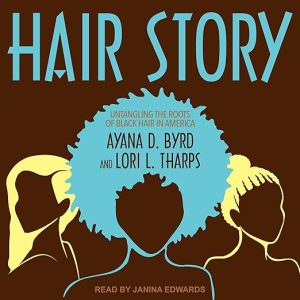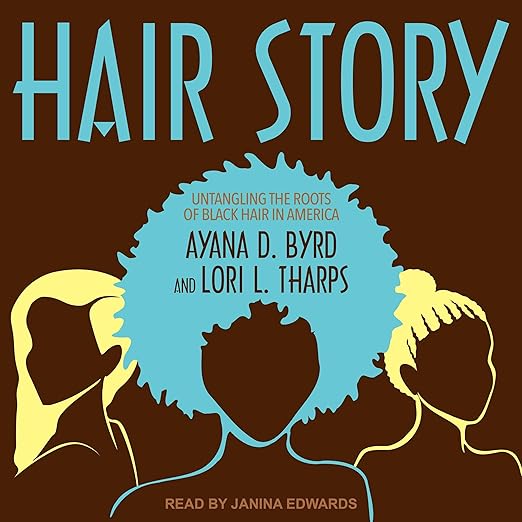
Ayana D. Byrd's Hair Story, narrated by Janina Edwards in this audiobook edition, arrives at the intersection of cultural anthropology, political history, and deeply personal identity in a way that few single volumes manage. The book's argument is straightforward: Black hair in America has never been merely aesthetic. From the antebellum practice of shaving heads to obscure free-person status, to the 2013 controversy over an Ohio school banning Afro puffs, hair has functioned as a continuous site of negotiation between Black Americans and a society that has consistently tried to regulate, diminish, and redefine their self-expression. Byrd traces that arc chronologically, beginning in 15th-century Africa and arriving in the contemporary United States, and the audiobook format allows that long sweep to unfold with genuine narrative rhythm.
Byrd Inhabits Specific Moments, Not Generalities
What distinguishes Hair Story from more polemical treatments of the same subject is Byrd's commitment to specificity. She does not float above history making generalizations. She inhabits particular moments: the Jheri curl boom, the political significance of the Afro during the Civil Rights movement, the economics of the Black hair care industry, the complex internal debates within Black communities about what hair choices mean and to whom. That granularity makes the book's larger arguments more persuasive rather than less, because listeners arrive at the conclusions through evidence rather than assertion.
Nearly Nine Hours Without a Single Padded Era
At 4.7 stars across nearly 400 ratings, listener response has been consistently enthusiastic. One reviewer called it both informational and entertaining, a true piece of hair history, and that double quality is worth emphasizing. Hair Story works as reference material, a chronological guide listeners can return to when context is needed, and as a sustained argument about the ways in which something as apparently personal as a hair texture or styling choice carries political weight that extends far beyond individual self-expression. Byrd ties the personal to the political without forcing the connection or making it feel schematic.
The nearly nine-hour runtime reflects the scope of what Byrd covers. The book does not feel padded; each era gets the space it requires to make its contribution to the argument. The Jheri curl, for instance, is not treated as a punchline or a passing curiosity but as a commercially significant moment with specific implications for Black economic autonomy and cultural self-definition. That seriousness of purpose, applied consistently to the full range of Black hair history, is the book's defining quality. Co-authored with Lori L. Tharps, the book brought two voices to the project, and that collaborative energy is still evident when the text is heard aloud.
Edwards Shifts From Archival Solemnity to Wry Affection
Janina Edwards is an excellent match for this material. She reads with the authority of someone who understands the political stakes of each chapter without editorializing beyond what Byrd has written. The tonal range required across nearly nine hours, from archival solemnity when describing slavery-era practices to something closer to wry affection when chronicling the 1980s, she handles without jarring shifts. Her pacing is measured and clear, which suits a book this dense with historical information. Listeners who engage with the audio rather than the page will find the chronological structure easy to follow because Edwards makes the transitions between eras feel purposeful rather than abrupt.
Audio is a particularly fitting format for Hair Story because Byrd's prose has genuine rhetorical energy. It is written to be heard as argument, not just read as information. The text has a strong conversational undercurrent that emerges naturally when read aloud, and Edwards honors that quality across the full runtime.
Natural Versus Relaxed Fuels an Internal Debate
The book's central thread is the interplay between external pressure and internal community debate. Byrd is attentive to the fact that discussions about Black hair have never been monolithic within Black communities themselves. The tensions between natural and relaxed styles, between political statement and personal preference, between generational norms and individual expression, are all given careful treatment. This prevents the book from becoming a simple narrative of resistance against oppression and instead presents a richer account of ongoing negotiation.
Pay particular attention to the chapters on the mid-20th century, where the political stakes of hair become most legible. The Afro's relationship to the Civil Rights and Black Power movements is analyzed with enough nuance to resist the simplification that tends to flatten this history in popular retellings. Byrd neither romanticizes the Afro as pure political statement nor dismisses it as fashion. She shows how the two registers operated simultaneously, which is the more honest and more interesting account.
Byrd's History Earns a Spot in Research Papers
The book has also found its way into academic contexts, with one reviewer noting they used it for a class research paper. That utility speaks to how completely Byrd built an argument rather than a polemic. The text operates at the level of history rather than advocacy, which makes it durable in ways that explicitly political books rarely are. Two decades after its original publication, it remains the reference point for understanding Black hair as historical phenomenon rather than personal style choice.
Sociology Readers and Casual Listeners Both Benefit
This audiobook is well-suited for listeners interested in Black American history who want a framework for understanding how cultural practices carry political meaning, and for anyone curious about the specific history of beauty politics in the United States. Sociology and cultural studies readers will find the analytical framework rigorous; general readers will find the narrative accessible without being simplified. It functions as both entry-level and advanced treatment of its subject depending on what you bring to it.
Those expecting a conventional beauty or wellness book will need to recalibrate: Hair Story is primarily a work of cultural history with strong scholarly grounding, not a guide to hair care practices. It is the kind of audiobook that rewards careful listening and earns its place as a genuine benchmark for understanding a unique and underexamined dimension of American history.
Quick Take
- Voice: Janina Edwards brings warmth and scholarly authority to Ayana D. Byrd's sweeping cultural history, navigating the shifts between personal testimony and political analysis with consistent clarity.
- Big ideas: Black identity and self-determination, beauty politics, historical resistance
- Atmosphere: Revelatory and grounded
- Worth it?: Hair Story is the rare cultural history that works as both rigorous scholarship and genuine pleasure to listen to. Byrd's argument accumulates force across five centuries without ever feeling like a lecture.
Does the Hair Story audiobook include visual content from the print edition?
The print version of Hair Story includes photographs and images that are not reproduced in the audio edition. However, Byrd's prose provides detailed historical context and description for each era discussed, so the lack of visuals does not substantially undermine the analytical argument. The audiobook works as a complete experience.
Is Hair Story audiobook accessible to listeners who do not have prior knowledge of Black American history?
Yes. Byrd builds historical context as she goes, making the book accessible to newcomers while still offering enough depth and specificity to engage listeners who already have background knowledge. The chronological structure from 15th-century Africa through the present helps orient those unfamiliar with the full arc.