Quick Take
- Narration: Gundry self-narrates with the warmth and authority familiar from his Plant Paradox work, making even contested claims land with clinical confidence.
- Themes: Microbiome as master system, lectins and antinutrients, disease prevention through gut restoration
- Mood: Authoritative, warm, and occasionally evangelical
- Verdict: A compelling listen for Gundry’s existing audience extending the Plant Paradox framework, though new listeners should approach the broader disease-causation claims with independent scrutiny.
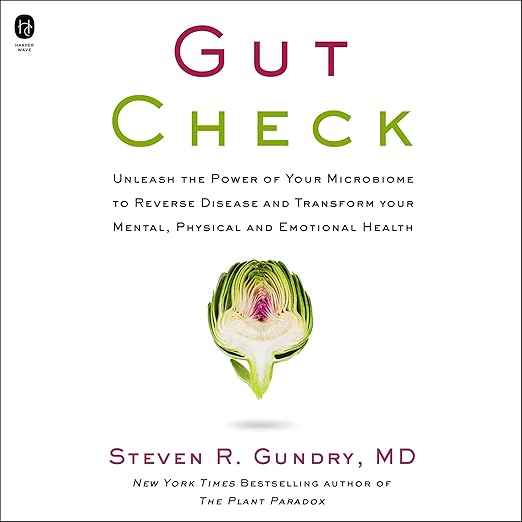
I was already familiar with Steven Gundry’s work when Gut Check came out. I had read The Plant Paradox a few years earlier, tracked the ongoing debate about lectins, and watched the field’s reception of his claims evolve from skepticism to cautious engagement and back again. When his latest appeared in my queue, I listened to the first two hours on a Tuesday evening walk and ended up extending the walk by forty minutes, not because I agreed with everything, but because the book kept raising questions worth sitting with.
Gut Check is presented as the culmination of Gundry’s Plant Paradox series, and in some ways it earns that framing. Where earlier books focused on specific dietary interventions, this one takes a step back to present the microbiome itself as the unifying system behind everything he has argued previously. The organizing claim is that Hippocrates was right: all disease begins in the gut, and consequently all disease can begin to be addressed there.
The Microbiome as Intelligent Ecosystem, Not Passive Population
Gundry’s central move in this book is to reframe the gut microbiome not as a collection of microorganisms we manage but as an intelligent, communicating ecosystem that manages us. He draws on emerging research showing microbial communication through quorum sensing, the microbiome’s production of neurotransmitters including serotonin and dopamine, and the bidirectional signaling between microbial metabolites and the immune system.
This framing is more scientifically grounded than some of his earlier characterizations of dietary villains. The research on microbiome-immune interaction is genuinely robust, and Gundry synthesizes it clearly. Where the book gets more contentious is in the specificity of its disease-causation claims. Gundry connects compromised gut integrity to conditions ranging from autoimmunity to neurodegeneration to cancer risk in ways that are directionally supported by the literature but often presented with a certainty that the evidence does not yet fully sustain.
Reviewer AnnieB’s account is illustrative: they had been gluten-free since 2009 and remained ill, and Gundry’s lectin framework offered a new explanatory model. That experience is real and worth taking seriously. It is also worth noting that the research base for lectin sensitivity as a distinct, widespread condition is narrower than Gundry implies. He is an outlier among gastroenterologists and diet researchers in the scope of harm he attributes to lectins, and that debate is still live.
Self-Narration and the Authority It Carries
Gundry’s decision to narrate this himself was the right call. His voice carries the particular warmth of a clinician who genuinely believes he is telling you something that will help you, and that quality is hard to replicate. When he describes patient cases, the empathy feels authentic. When he moves into the more adversarial passages about the food industry, the conviction is palpable. The narration also allows him to handle the story-form passages that reviewer Mary Frances Garcia noted with natural rhythm; the anecdotal clinical cases are where Gundry is most persuasive, and his own delivery enhances them.
The supplemental PDF accompanies this audiobook and contains the food lists and dietary guidelines central to applying the book’s recommendations. Downloading it before you start listening is strongly advisable; the lists are referenced throughout the narration and are not easy to reconstruct from memory.
Where the Book Asks You to Take Leaps
Gut Check asks the listener to accept a fairly sweeping causal architecture: that a disrupted microbiome is not merely associated with disease but is the primary driver of it across a remarkably wide range of conditions. For listeners who have spent time in integrative medicine circles, this will feel like a familiar and welcome argument. For listeners trained in conventional medicine or evidence-based nutrition, some of the connective tissue between mechanisms and clinical outcomes will feel underbuilt.
What is not in dispute is the quality of the dietary guidance as a practical matter. The plant-diversity recommendations, reduction of ultra-processed foods, inclusion of fermented foods, and emphasis on prebiotic fibers are all well-supported by mainstream microbiome science even when Gundry’s explanatory framework extends beyond what that science currently confirms.
Who Should Listen, Who Should Skip
Existing readers of The Plant Paradox will find Gut Check a genuinely additive extension of that framework, with stronger science undergirding the microbiome sections than earlier volumes contained. New listeners should note that Gundry’s dietary recommendations are more restrictive than mainstream guidelines and that the lectin-as-primary-villain argument remains contested. For anyone curious about the gut-disease connection and willing to evaluate claims independently, this is a well-produced and substantive listen. For anyone seeking mainstream consensus, this is not that book.
Frequently Asked Questions
Is Gut Check accessible without having read The Plant Paradox first?
Gundry writes Gut Check to stand alone, but listeners familiar with his earlier lectin work will get more from it. The core lectin argument is briefly recapped but not explained with the same depth as in The Plant Paradox.
Does the audiobook include the food lists and eating plan?
The dietary guidance is covered in the narration, and a supplemental PDF with food lists is available in your Audible library. Downloading it before you begin is recommended, as the lists are referenced throughout.
How does Gundry’s microbiome framework compare to Emeran Mayer’s in The Mind-Gut Connection?
Mayer stays closer to peer-reviewed research and the bidirectional brain-gut axis, while Gundry extends the microbiome’s causal role further into autoimmunity and disease prevention. They are complementary reads but Mayer’s claims are more conservatively stated.
Is the lectin-restriction approach Gundry recommends mainstream nutritional advice?
No. Gundry is an outlier among diet researchers in the extent of harm he attributes to lectins. The broader microbiome guidance in the book, including plant diversity and fermented foods, is well-supported, but the lectin-specific recommendations are still disputed among gastroenterologists and nutritional scientists.