Quick Take
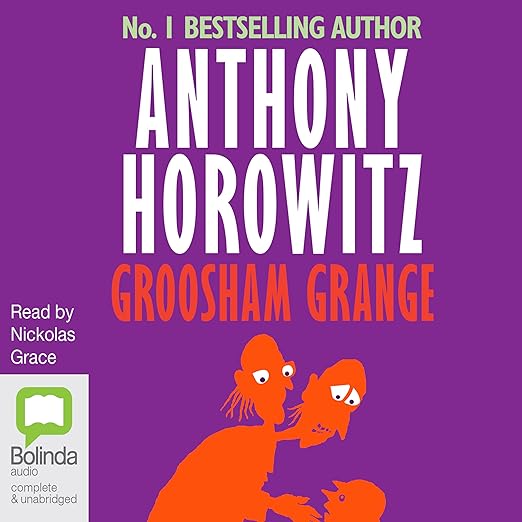
- Narration: Nickolas Grace commands the Gothic atmosphere of Groosham Grange with elegant menace, calibrating the horror-comedy balance with the precision the material demands.
- Themes: belonging and nonconformity, the sinister underside of elite institutions, adolescent identity
- Mood: Darkly funny and creepy in roughly equal measure, Roald Dahl territory, but sharper-edged
- Verdict: A compulsively listenable piece of British Gothic comedy for young readers, and a fascinating artifact given its publication history.
Anthony Horowitz published Groosham Grange in 1988, eleven years before a certain other novel about an unusual school for magically gifted children appeared, and this timing has given it a peculiar afterlife. I’d heard about it for years in literary circles, the comparison to Harry Potter comes up constantly, and not always fairly to either book, before I finally listened to this audiobook on a quiet Tuesday evening. What struck me within the first twenty minutes was that Groosham Grange is doing something meaningfully different from Rowling’s series, and something quite deliberately dark in ways that Potter never fully commits to.
David Eliot, thirteen years old and a thorough disappointment to his rigidly conventional parents, is dispatched to Groosham Grange after being expelled from his previous school. The island school, reached by boat, unknown to the outside world, is immediately, comprehensively wrong. Students sign their names in blood. The English teacher appears to be held together with bandages. The soccer ball is made of something the narrative declines to specify. And students keep disappearing in the middle of the night. David, along with two friends he makes on the journey there, has to figure out what the school actually is before whatever it’s doing to students can be done to him. Horowitz is a skilled thriller writer, his work on Alex Rider and the Magpie Murders series demonstrates this, and he applies that plotting instinct to what is nominally a children’s dark-comedy horror.
Nickolas Grace and the Art of Sinister Delight
Nickolas Grace is exactly the right narrator for this material. His voice has a quality that literary critics might call silkily threatening: warm on the surface and deeply unsettling underneath. He gives the Groosham Grange staff, a collection of figures who are wrong in increasingly specific ways, distinct registers of wrongness. The headmaster is controlled and ominous. The teachers are various flavors of bizarre. David himself gets a slightly bewildered everyman quality that grounds the horror in something recognizable. At just over three hours, this is a tight listen, and Grace’s pacing keeps the tension calibrated throughout. He clearly understands that the humor and the horror need to coexist at the same volume level, which is harder than it sounds.
The Harry Potter Comparison, Honestly Assessed
It’s worth addressing the comparison that comes up in every review of this book. Yes, Groosham Grange and Harry Potter share elements: a child with a suppressed magical gift, an unusual school reached by special transport, the discovery of a secret identity. One reviewer lists specific parallels in detail. But the tonal and thematic differences are substantial. Groosham Grange is darker, sharper, and less interested in making its world comfortable. The school isn’t a refuge from the outside world; it’s a different kind of danger. Horowitz is writing in the tradition of British Gothic comedy, closer to Roald Dahl’s darker registers than to Tolkien-derived secondary world fantasy. The comparison is worth knowing about but shouldn’t drive the reading experience.
What Makes This a Compelling Listen Rather Than Just a Curiosity
Beyond the literary-history interest, Groosham Grange works because Horowitz is genuinely good at plot mechanics. The mystery of what the school is, and what it wants from David, is constructed with the same attention to pacing and misdirection he’d bring to an adult thriller. The revelations land cleanly, and the final chapters move quickly enough that the three-hour runtime ends before it starts to feel short. There’s also something in the novel’s treatment of David’s parents that’s sharper than it appears: their conformist horror at their son’s failure and their willingness to simply send him away registers as a quiet critique of a particular kind of English middle-class aspiration.
Who Should Listen and Who Should Skip
Groosham Grange is for children ten and up who can handle Gothic atmosphere and dark comedy without being derailed by the unsettling elements, there is genuine creepiness here, not just comedy. Fans of Roald Dahl, Eva Ibbotson, or the scarier end of the children’s Gothic tradition will be in comfortable territory. For Potter fans looking for something with a similar boarding school structure but a completely different tonal register, this is an interesting companion piece. Adults curious about the pre-Harry Potter tradition of British magical school fiction will find it rewarding. Those expecting light humor throughout may be surprised by how effectively Horowitz makes things feel actually threatening.
Frequently Asked Questions
How significant are the similarities between Groosham Grange and Harry Potter, and does it matter which came first?
Groosham Grange predates Harry Potter by eleven years, and the parallels are notable: magical children, unusual school reached by transport, discovery of hidden identity, sinister staff. Rowling has never acknowledged the book as an influence, and the tonal differences are significant enough that Horowitz’s novel stands entirely on its own terms. The comparison is interesting context, not a reason to dismiss either work.
Is this book appropriate for younger children, or does the dark content require a minimum age?
The Gothic horror elements, bandaged teachers, blood-signing, students disappearing, are real enough to warrant the ten-and-up range. Younger children who startle easily may find some passages genuinely frightening. The humor balances the darkness, but it doesn’t neutralize it. A parent’s preview listen is worth considering for sensitive kids under ten.
Is there a sequel to Groosham Grange, and does this audiobook work as a standalone?
There is a sequel, Return to Groosham Grange. This first book resolves its central mystery and works fully as a standalone listen. The sequel deepens the world Horowitz established, but there’s no cliffhanger here that leaves this book feeling incomplete.
Why is the runtime only about three hours when this sounds like a substantial story?
Horowitz writes efficiently and the novel itself is not long, it’s a tight, focused Gothic thriller rather than an expansive world-building exercise. The brevity is a feature: the pacing stays tight throughout, and Nickolas Grace’s narration keeps it moving without filler. It’s a complete experience in three hours.