Quick Take
- Narration: Allan Corduner delivers a performance that matches the story’s tonal range, grounded and warm when Arthur is at his most vulnerable, appropriately ominous when the Far Reaches come into play.
- Themes: Debt and obligation, the cost of power, reluctant heroism
- Mood: Inventive and propulsive, with a current of genuine strangeness underneath
- Verdict: A worthy second installment that deepens the Keys to the Kingdom world without losing the momentum Mister Monday built.
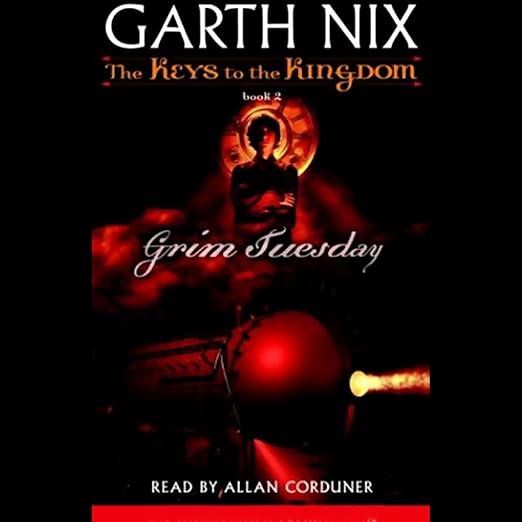
I came to Grim Tuesday already invested, having listened to Mister Monday on a long drive through the Vermont hills the previous autumn. Garth Nix has a specific talent I do not see often in middle-grade fantasy: he builds systems that feel genuinely alien rather than just recolored versions of familiar mythology. The Keys to the Kingdom series operates according to its own internal logic, and what Grim Tuesday does well is expand that logic without simplifying it for the sake of momentum.
I finished this one over two evenings, the second of which stretched well past midnight. The descent into the Far Reaches is the sequence that kept me awake, and I mean that as the highest possible compliment to Nix’s world-building.
Our Take on Grim Tuesday
The second book in the series raises the stakes in exactly the right way. Mister Monday established that the House is vast and strange, that Arthur Penhaligon is an unwilling hero carrying power he barely understands, and that the forces arrayed against him are not simply evil but self-interested in complicated and often darkly funny ways. Grim Tuesday extends all of that. The enemy here is defined by greed rather than malice, which gives the conflict a different texture from what Monday set up, and Nix is smart enough to let that distinction do narrative work.
The synopsis mentions a Sunship, a work camp, a bear-like spirit, and Nithlings, and I want to confirm that each of these elements earns its place rather than just providing set decoration. The work camp sequence in particular carries genuine weight. Nix is writing for children, but he does not talk down to them, and the implied horror of what the work camp represents lands with appropriate force even in audio form.
Why Listen to Grim Tuesday
Allan Corduner is the primary reason to choose the audiobook over the print edition. He has exactly the right instincts for this material: he does not perform the strangeness, he inhabits it, which is a meaningful distinction. A lesser narrator would push the more outlandish characters into caricature. Corduner resists that impulse, and the result is a listening experience where even the most bizarre figures feel three-dimensional. His work on Suzy Turquoise Blue, Arthur’s unconventional ally from the first book, is particularly strong.
The pacing of the audiobook itself works in Nix’s favor. At just over seven hours, Grim Tuesday moves quickly enough to feel propulsive without sacrificing the atmospheric moments that distinguish Nix from his peers. The descent into the Far Reaches, where the void-like Nithlings are at their most threatening and Arthur faces the showdown with Grim Tuesday himself, is the kind of extended sequence that rewards audio listening specifically, because Corduner’s measured performance gives the stakes room to breathe.
What to Watch For in Grim Tuesday
A few reviews note that some of the invented vocabulary and conceptual terminology can be hard to track without a print edition nearby. Nix’s world has a genuine density to it, and terms like Nithlings, the Far Reaches, and the organizational structure of the House are not always explained on first use. Listeners coming straight from Mister Monday will have an easier time, because the core vocabulary carries over. If this is your entry point to the series, starting with the first book is strongly recommended.
The book also ends in a way that clearly points toward the next installment. That is by design and not a flaw, but listeners who prefer self-contained narratives should know that Nix is building a serialized structure with each book functioning more like an episode than a standalone novel.
Who Should Listen to Grim Tuesday
Listen to this if you have already finished Mister Monday and want to continue the series, or if you are looking for middle-grade fantasy that takes its world-building seriously. Fans of Philip Pullman’s His Dark Materials or Susan Cooper’s The Dark Is Rising sequence will find something of that same commitment to internal consistency and genuine consequence here.
Skip it if you are new to the series and starting here rather than at the beginning. The book assumes familiarity with the first installment. Also, listeners who prefer fantasy with more conventional structures may find the conceptual density of Nix’s world demanding rather than rewarding.
Frequently Asked Questions
Do I need to listen to Mister Monday before Grim Tuesday?
Yes, very much so. Grim Tuesday assumes knowledge of the characters, world structure, and events of the first book. Starting here without that context would make significant portions of the story confusing.
How does Allan Corduner’s narration compare to the reading experience of the print book?
Several listeners find his narration enhances the experience, particularly for the stranger characters and more atmospheric sequences. He brings a measured quality that suits Nix’s prose well.
Is Grim Tuesday darker than Mister Monday in tone?
Somewhat, yes. The work camp sequences and the nature of the Far Reaches carry a heavier atmosphere than most of the first book. It remains middle-grade fiction, but Nix does not shy away from implied consequences.
Can children listen to this independently, or is it better as a shared experience?
Capable middle-grade readers and listeners aged around 9 and up can follow it independently. The prose and narration are accessible, though some of the conceptual vocabulary may prompt questions for younger audiences.