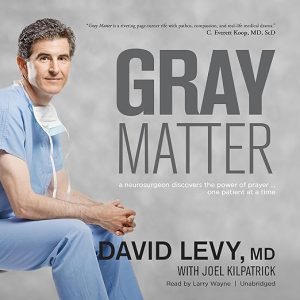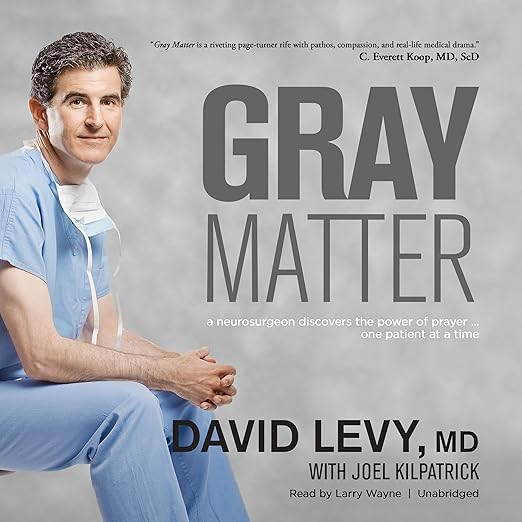
A friend recommended Gray Matter to me the week after I had a minor medical procedure. I was at that particular point of vulnerability where the proximity of mortality had sharpened everything, and the idea of a neurosurgeon writing honestly about what he believes and doubts struck me as exactly the right thing to be listening to. I was right about that. David Levy's book is not a conversion narrative, and it is not a manifesto for prayer in medicine. It is an honest account of one man's struggle to live without compartmentalizing the parts of himself that his profession told him to keep separate.
The structure is elegant in its simplicity. Each chapter presents a patient case: the diagnosis, the procedure required, the complexity of what is at stake. Then Levy describes asking, sometimes haltingly, sometimes not at all, whether he can pray with the patient before surgery. The responses vary enormously. Some patients are moved. Some are politely skeptical. A few are genuinely hostile. One patient, early in the book, essentially throws him out of the room. And then we follow the surgery and wait, alongside Levy, for the outcome. This case-by-case architecture means the book reads with the pace of a medical drama while doing something considerably more philosophically ambitious than most medical dramas attempt.
Where This One Lands
What distinguishes this book from straightforward faith memoir is Levy's insistence on honesty about outcomes. He does not arrange the evidence to confirm his convictions. Patients he prays with die. Surgeries fail. He does not retreat from these facts into easy theodicy. His conclusion, that God is good regardless of surgical outcomes, is not the product of avoiding contradiction but of working through it, case by case, over years of practice. This makes the book trustworthy in a way that more triumphalist spiritual memoirs are not. One reviewer who bought the book after their own neurosurgical emergency wrote that the range from genuinely hilarious (Levy's early attempts to find a private moment to pray with a patient for the first time) to very serious is exactly right, and that reader captured something essential about why the book works. The comedy and the gravity are not in tension, they are the same story.
The Best Parts of Gray Matter
The social environment Levy navigates is given real weight here. His surgical colleagues, by his account, view spiritual concerns as beneath their professional identity, medicine is science, and science is sufficient. The courage Levy demonstrates is not primarily the courage of prayer itself but the courage of being visibly different inside an institution that values conformity and rational authority. Several of his colleagues react with open skepticism, and Levy does not flatten these reactions into antagonism. He understands where they are coming from. The tension this creates, between Levy's growing conviction that prayer is part of his care for patients and his awareness of how his peers will interpret that, drives the book's middle sections and makes it feel like a genuine memoir rather than an extended essay in favor of a predetermined conclusion.
One detail worth noting for listeners considering this book: it was originally published in 2011, and the medical and institutional contexts have changed since then. The conversation about prayer and medicine in clinical settings has evolved, and some of the resistance Levy describes from colleagues reflects a particular moment in medical culture that has shifted, at least in some institutions. This does not diminish the book's personal and spiritual resonance, but listeners who are drawn to it for its professional implications should be aware that the landscape Levy describes is not static. The memoir is a document of a specific time as much as it is a timeless account of faith under pressure.
What Gives Us Pause
The narration challenge with a book like this is avoiding two opposite failures: excessive solemnity that turns honest inquiry into preaching, or insufficient gravity that makes serious material feel thin. Wayne avoids both. His delivery for the medical case presentations is measured and clear; his handling of Levy's more personal reflections adds warmth without saccharine coloring. For a book that repeatedly moves between operating room procedure and interior spiritual wrestling, maintaining tonal consistency across those registers is a genuine achievement across nearly nine hours of listening. Wayne understands that Dr. Levy's voice is simultaneously that of a highly trained technical expert and a person working through something he does not fully understand, and the narration captures that duality.
One more observation worth making: Gray Matter's longevity as a title is telling. It was published in 2011, yet continues to attract readers and listeners across different countries and faith backgrounds, as evidenced by reviews from Spain, Australia, the United Kingdom, and the United States in the same period. Books that speak to faith under professional pressure tend to find their readers whenever that pressure is acute, which means this is a book whose moment is always now for the right person.
The Right Listener for Gray Matter
Listen if you are drawn to the intersection of professional life and personal faith, particularly in high-stakes environments where the two are culturally expected to remain separate. This book will resonate with anyone, religious or not, who has felt the pressure to perform a version of themselves that excludes conviction. Listeners who are open to Christian faith as a serious intellectual and emotional proposition rather than as cultural background noise will find Levy's account genuinely moving. Skip it if your skepticism about prayer in medical contexts is strong enough that a neurosurgeon's honest account of his own practice will simply frustrate you, the book does not debate the existence of God so much as assume a reader willing to sit with the question.
- Read by: Larry Wayne's warm, measured delivery suits the book's tone of honest spiritual inquiry perfectly, he gives Dr. Levy's voice gravity without tipping into sermon mode.
- At its heart: Faith and professional identity, prayer as part of patient care, the limits of scientific certainty
- Vibe: Intimate and quietly moving, with real emotional risk-taking
- Short version: For listeners open to a neurosurgeon's honest account of integrating faith into practice, this is one of the more thoughtful intersections of medicine and belief you will find in audio.
Does Gray Matter require the listener to share Dr. Levy's Christian faith to find it meaningful?
Not entirely. The book's emotional power comes largely from Levy's honesty about doubt and outcome rather than from its theological conclusions. Non-religious readers who are open to engaging with faith as a serious human experience have found it genuinely affecting.
How does the book handle cases where prayer does not seem to produce positive outcomes?
Directly and honestly. Levy does not arrange his case selection to confirm his beliefs. He includes surgical failures and deaths and grapples openly with what those outcomes mean for his faith, which is what distinguishes the book from simpler inspirational memoir.
Is this audiobook appropriate for listeners with a medical background who might evaluate the neurosurgical content critically?
Yes. Levy writes with appropriate clinical precision about diagnosis and procedure, and reviewers with medical backgrounds have generally found the surgical content credible and thoughtfully presented.
How does Larry Wayne's narration handle the book's tonal shifts between clinical case presentation and personal reflection?
With skill. Wayne differentiates clearly between the procedural and the personal without jarring transitions, and his delivery for the more vulnerable moments of spiritual reflection is warm without becoming performative.