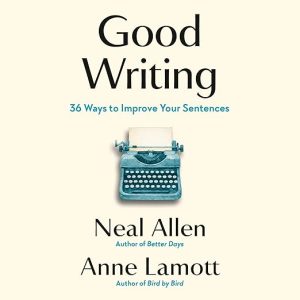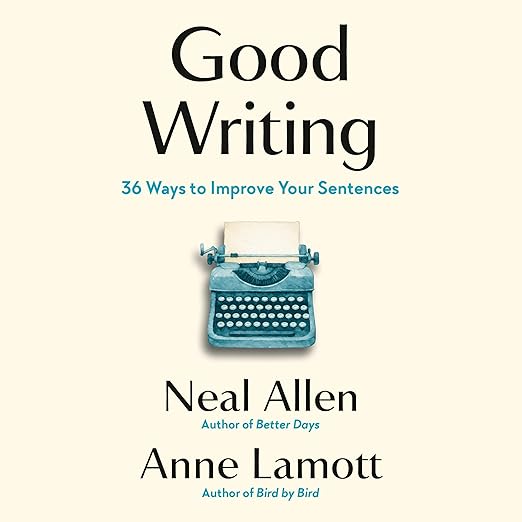
Good Writing positions itself as picking up where The Elements of Style leaves off, and that framing is both accurate and useful. William Strunk and E.B. White gave writers the structural skeleton; Neal Allen and Anne Lamott are interested in what makes a sentence worth reading once the skeleton is upright. This audiobook covers 36 rules for persuasive language, and it delivers them in a format that takes seriously what the audio medium can do: Allen narrates his own material, and for each rule, a lively pair of essays follows. Allen's version, then Lamott's. The authors do not always agree, and their disagreements are the most interesting passages in the book.
Allen developed this list over a journalism and corporate writing career, which means the rules are tested against real-world communication rather than literary theory. Use strong verbs. Remove the boring stuff. Twist clichés. Give your sentence a finale. These sound simple until Allen demonstrates what they actually require, and what writers habitually do instead. At 4 hours and 39 minutes, Good Writing is short enough to finish in a long drive, but the density of the material rewards more than one pass through.
Allen and Lamott Argue Over Every Rule
The dual-essay structure is the book's distinguishing feature and its most interesting craft decision. Lamott is the author of Bird by Bird, the most widely taught creative writing guide of the last three decades, and her presence here is not ceremonial. She and Allen are married, and the collaboration has the quality of a long-running conversation between two people who have argued about sentences for years and arrived at productive disagreement. Where Allen tends toward the technical, Lamott leans toward the intuitive. She trusts the instinct to break a rule more readily than Allen does, and her essays frequently complicate his without invalidating them.
That tension is the book's genuine intellectual content. The 36 rules are useful on their own, but the argument about when rules serve and when they constrain is the more important conversation, and it runs underneath all 36 chapters. Some writers will align with Allen's systematic approach; others will find Lamott's temperamental flexibility more congenial. Most will take something from both, which is presumably the intention behind the format. The disagreements are not staged but real, and they model the kind of thinking about sentences that the book is trying to cultivate in its readers.
Hearing a Weak Sentence Before Its Revision
Allen's narration maintains a steady, conversational authority that suits the instructional material. He is not a dramatic reader, but Good Writing does not need drama. It needs clarity, and he delivers it. The essays are short enough that the dual-perspective structure does not feel repetitive, and the contrast between Allen's and Lamott's approaches to each rule is genuinely informative rather than artificially manufactured. The two voices on the page, even delivered by a single narrator, have distinct tonal signatures that come through in the writing itself.
The audiobook format works particularly well for craft books that emphasize sentence-level awareness, because listening to examples of strong and weak sentences read aloud reveals rhythmic qualities that silent reading can obscure. Allen's instruction to give a sentence a finale, to use strong verbs, to draw on all five senses: these principles are more immediately audible than visible, which makes the audio version a genuinely natural choice for this particular material. Hearing a weak sentence read aloud before its revision is more clarifying than seeing both on a page.
Some Rules Run Thinner Than Others
The book is pitched at writers of any level and any type: novelists, essayists, business communicators, bloggers, speechwriters. The rules are presented as universal, and the examples support that breadth. The 36-rule format means some rules feel more substantial than others. A few of the shorter chapters are more aphoristic than analytical, and listeners who want extended examples and deeper application will occasionally wish for more space. At under five hours, the book is dense rather than exhaustive, which is likely the right call for a craft guide meant to be revisited, but may leave some listeners wanting follow-up material on the principles that land hardest.
Lamott's celebrity and reputation mean some listeners may arrive primarily for her essays and find Allen's contributions genuinely new to them. The reverse is also possible. In either case, the collaboration is genuine and the disagreements are productive, which is a higher standard than most co-authored writing guides achieve. The absence of listener reviews at the time of writing means community response is not yet available, but the book's credentials are solid: Allen's journalism background, Lamott's reputation, and the direct lineage from the Strunk and White tradition give the material real institutional weight.
Sentence-Level Craft for Business Writers Too
Any writer who works at the sentence level and wants to work better there will find value in this audiobook. Business communicators who need to make their writing clearer and more persuasive have as much to gain as fiction writers refining their prose style. The rules are genuinely portable across contexts, which Allen addresses directly in the material and which the mix of journalism and literary examples confirms in practice.
Listeners expecting a deep dive into structure, narrative arc, or story construction should look elsewhere. Good Writing is specifically a sentence-level book. But for the listener who wants 36 concrete principles for making their sentences work harder, delivered in under five hours by the people who developed and live by them, this audiobook earns its slim, efficient form and the re-listen it invites.