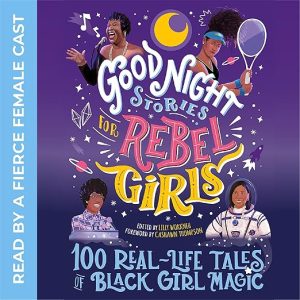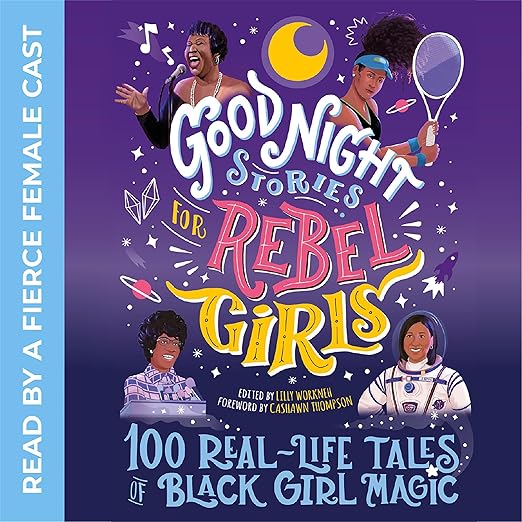
Naomi Osaka, Toni Morrison, and Ida B. Wells share space with dozens of far less famous names across the hundred short portraits that make up this audiobook, the fourth installment in the New York Times bestselling Good Night Stories for Rebel Girls series. Editor Lilly Workneh, an award-winning journalist, built this specific volume around Black women and girls from more than thirty countries, with a foreword by CaShawn Thompson, the writer credited with originating the phrase Black Girl Magic in the first place. That origin story matters to how the book frames itself: not a generic girl-power anthology, but one built directly around a specific cultural phrase and the person who coined it.
Built Around the Woman Who Coined the Phrase
Each entry runs to roughly two minutes, a structural choice that shapes the entire listening experience. A hundred women across three and a half hours means an average biography gets barely more than two minutes of airtime, which sounds thin until you realize that's the entire design: this is a bedtime-story format built for stopping anywhere, not a sequential narrative that demands a start-to-finish sitting. Parents in the reviews describe reading one entry a night, exactly how the book seems built to work.
The range of subjects is the real differentiator against the wider Rebel Girls catalog and against other girl-focused biography collections generally. Tennis player Naomi Osaka sits alongside astronaut Jeanette Epps, aviator Bessie Coleman, filmmaker Ava DuVernay, and Empress Taytu Betul of Ethiopia, a genuinely global spread rather than an American-centric one padded with a few token international names. More than sixty Black female and non-binary writers, illustrators, and editors contributed, which shows in how differently each entry is voiced on the page even before Samira Wiley's narration unifies them in audio.
The book's own material on the phrase's origin, included in the synopsis, is worth knowing before pressing play. CaShawn Thompson, a third-generation Washington, D.C. native, has said the idea came to her as a child watching her mother, grandmother, and aunts, and reaching for the only language she had at the time, fairies, witches, magicians, to describe the brilliance she saw in them. The phrase went properly viral in 2013 when Thompson began using it online, eventually shortening to the now-familiar #BlackGirlMagic hashtag. That backstory reframes the whole anthology: this isn't a publisher slapping a trending phrase on a book cover, it's a collection explicitly built around honoring the phrase's actual originator and the community she was describing.
Committing Fully to One Community Instead of Many
The subjects also span an unusually wide range of eras alongside their wide range of geography. Aviator Bessie Coleman and Ethiopia's Empress Taytu Betul sit within the same hundred-name roster as tennis player Naomi Osaka and astronaut Jeanette Epps, meaning the collection moves fluidly between historical figures many adult listeners won't have encountered in school and contemporary names children may already recognize from television or the news. That mix does real work: it frames current achievement as continuous with a much longer history rather than treating the present moment as the starting point.
The book's full title draws a clear line back to the earlier three Good Night Stories for Rebel Girls volumes while making its own specific focus unmistakable from the cover alone. That specificity is worth naming as a strength rather than a limitation: rather than a broad, generalized girl-power anthology trying to represent everyone equally, this volume commits fully to one clearly defined community and goes deep rather than wide within it.
Wiley Keeps a Hundred Entries From Feeling Disconnected
Samira Wiley narrates the entire hundred-entry collection herself, and that single-narrator consistency across so many distinct short biographies is doing real work. A warm, direct, intimate bedtime-story register carries from the first entry to the hundredth without straining for artificial variety between subjects, which keeps the anthology feeling like one continuous experience rather than a hundred disconnected clips stitched together.
At three hours and thirty-two minutes for a hundred entries, the audiobook is genuinely built for the format parents describe in the reviews: an entry before bed, night after night, rather than one long sitting. That pacing is a real audio-format advantage over the print edition, since a printed anthology this size can feel daunting to open cold, while the audiobook naturally breaks itself into two-minute increments a tired parent can commit to without much planning.
Each print entry in the Rebel Girls series pairs a portrait illustration with its short biography, images from the over sixty credited illustrators that don't carry over into the audio edition at all. That's a real, honest tradeoff worth naming: the audiobook gains portability and hands-free bedtime use, but it loses the visual-art half of what makes the print series distinctive as an object, and families who want both should consider the print edition as a companion rather than a full substitute.
A Smaller Award Than It Might Sound
This is the fourth entry in the Rebel Girls franchise, and the 2022 Tillywig Award it won reflects a series with an already-established formula rather than an experimental new format. Families who already own earlier volumes know exactly what they're getting; this is not a reinvention of the concept, it's the same trusted structure pointed at a specifically Black-women-and-girls focused set of subjects.
At two minutes per entry across a hundred figures, depth is necessarily limited. A listener hoping for a full biographical audiobook about any single one of these hundred women, Toni Morrison or Ava DuVernay especially, should treat this as an introduction and a jumping-off point rather than a substitute for a dedicated biography of any individual subject.
The 2022 Parents' Favorite Products Tillywig Award, noted directly on the listing, recognizes children's media and products for quality and educational value, a reasonably reliable third-party signal for families vetting audio content they haven't previewed themselves. It's a smaller-profile award than a major literary prize, worth knowing so the credential is read for what it actually represents rather than assumed to carry more weight than it does.
The 4.8 rating across 843 ratings is unusually strong even by the high standards children's audio anthologies tend to earn, suggesting the book resonates as much with the adults doing the reading as with the children listening alongside them.
The Audience This Book Was Built for Most
Parents and caregivers raising Black daughters are the audience this book was built for most directly, and the reviews confirm it: multiple listeners describe using it specifically to introduce their girls to figures of accomplishment they wouldn't otherwise encounter. It also works well beyond that core audience, for any family wanting a genuinely global, well-researched bedtime rotation with real substance behind each short entry.
Skip it if you're looking for a single sustained biographical narrative rather than a hundred short portraits, or if your family already owns multiple prior Rebel Girls volumes and wants markedly different content rather than the same trusted format applied to a new set of subjects.
Key Details
- Performance: Samira Wiley holds a warm, intimate bedtime register steady across a hundred short entries.
- What it covers: Black women's achievement, global representation, bedtime biography
- Feel: Warm, celebratory, easy to dip in and out of
- Our call: A genuinely global, well-researched bedtime anthology that earns its place in the Rebel Girls series.