Quick Take
- Narration: Dan Bittner won an AudioFile Earphones Award for this performance, his narration of Paulsen’s voice is pitch-perfect, capturing the memoir’s rough edges without sentimentalizing them.
- Themes: Childhood neglect and resilience, the wilderness as refuge, books and reading as lifeline
- Mood: Raw and elemental, shot through with unexpected warmth
- Verdict: One of the finest middle-grade memoirs in audio form, Bittner’s narration and Paulsen’s unflinching honesty combine to produce something genuinely moving.
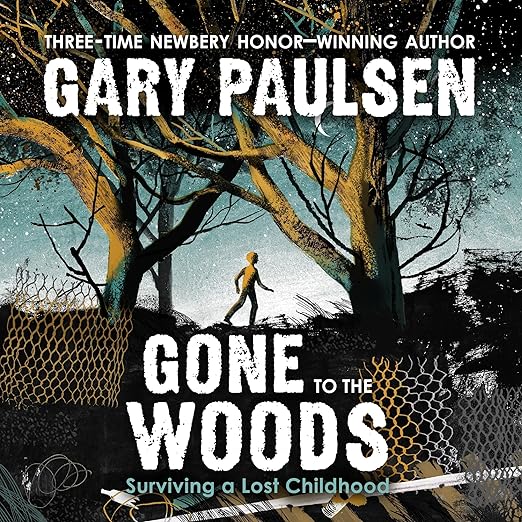
I finished Gone to the Woods on a grey Tuesday evening with the kind of quiet that settles when a book has done something real to you. Gary Paulsen’s memoir had been on my list for a while, but I kept putting it off because I expected something straightforward: the backstory of Hatchet, the origin story of a beloved middle-grade author. What I got was something considerably more difficult and more honest than that.
Paulsen’s childhood was not a foundation for a future career. It was a series of genuine crises: alcoholic parents largely absent from his life, a Chicago upbringing that offered no stability, and then, at five years old, a summer escape to a North Woods homestead with relatives. That summer is the book’s emotional center, and Paulsen renders it with the sensory precision of someone who has been turning those memories over for decades.
Bittner’s Narration and the AudioFile Earphones Award
AudioFile Magazine’s Earphones Award is not given generously, and Dan Bittner’s performance here earns it. Paulsen’s prose is spare, working-class, and precise, it doesn’t reach for lyrical effect, it lands facts with the weight of lived experience. Bittner understands this and resists the temptation to beautify the delivery. When Paulsen describes conditions in his Chicago apartment, or the way his mother and father moved through the world in an alcoholic fog, Bittner keeps his voice level and his pace unhurried. The emotional impact comes from the writing and the listener’s imagination, not from performed feeling.
That restraint is exactly right. Paulsen’s own relationship to his story is not sentimental, he survived it, he processed it, and now he is reporting it clearly. A narration that pushed emotion would have falsified that relationship. Bittner’s clean, honest delivery honors what Paulsen actually wrote.
The Three Turning Points
The synopsis identifies three pivotal moments in Paulsen’s childhood, and they structure the memoir usefully. The first is that North Woods summer at age five, where a compassionate aunt and uncle provided the first stable, nurturing environment Paulsen had known. The second is the librarian who handed him his first book at thirteen, an act of human recognition that Paulsen returned to repeatedly across his writing life. The third is his desperate teenage enlistment in the Army, which removed him from a dead-end trajectory and eventually led to his vocation as a storyteller.
Each turning point works in the memoir because Paulsen doesn’t make it clean. The North Woods summer ends and he goes back to Chicago. The librarian is a brief encounter, not a sustained mentorship. The Army is chosen out of desperation, not ambition. The book is honest about the fact that the people who helped Paulsen mostly didn’t know they were doing it, and that survival was not a narrative of steady progress but a series of narrow escapes. That honesty is what distinguishes memoir from inspirational literature, and Paulsen is squarely in the memoir tradition.
What This Means for Readers of Hatchet
Parents and teachers who have used Hatchet in classrooms will find Gone to the Woods useful as companion material. The connection is direct: without the North Woods summer, Paulsen says, there would have been no Hatchet. The survival skills he learned from his aunt and uncle, the way the natural world functioned as rescue rather than threat, the specific physicality of wilderness experience, all of that is the source material. Understanding Paulsen’s childhood recalibrates Hatchet from adventure fiction to autobiographical projection, which gives the novel an additional layer of weight.
For middle-grade listeners encountering Paulsen for the first time, Gone to the Woods works as a standalone. The memoir is complete in itself, and the audio format makes the rougher passages feel appropriately immediate without being overwhelming. At six hours and forty-five minutes, it asks more of a listener than the short-form science titles in this category, but the investment pays proportionally.
Who Should Listen, Who Should Skip
Ideal for ages ten and up, and for adults who grew up reading Paulsen. Teachers working with Hatchet in the classroom will find this essential contextual material. Younger children and sensitive listeners should note that the memoir addresses parental alcoholism and neglect directly, without softening. That honesty is a strength of the book, not a defect, but parents should be aware of it. Listeners who want a conventional, hopeful origin-story memoir should know this is something more complicated and more interesting than that.
Frequently Asked Questions
How directly does the book address Paulsen’s parents’ alcoholism, and is it suitable for a ten-year-old?
The memoir is direct about his parents’ alcoholism and the neglect that resulted, but Paulsen’s tone is observational rather than harrowing. He reports his childhood clearly without dwelling in trauma for its own sake. Most emotionally mature ten-year-olds can handle it; parents of sensitive younger children should preview first.
Is Gone to the Woods a good starting point for someone who has never read Gary Paulsen, or should you read Hatchet first?
The memoir works either way, but reading or listening to Hatchet first gives the origin-story dimension additional meaning. The connection Paulsen draws between his North Woods childhood and the survival skills in Hatchet lands harder once you know the fictional counterpart. Either order works; Hatchet-first is richer.
Dan Bittner won an AudioFile Earphones Award for this narration, what specifically makes his performance stand out?
Bittner’s performance is distinguished by restraint. Paulsen’s prose is spare and working-class, and Bittner resists any impulse to over-emote or beautify the delivery. The emotional impact comes from the writing, not the narration, which is exactly the correct approach for memoir of this kind.
Is this audiobook part of a series, or is it self-contained?
Gone to the Woods is a standalone memoir. It draws on themes and experiences that appear across Paulsen’s fiction, particularly Hatchet, but the memoir itself requires no prior knowledge of his other work and ends satisfyingly on its own terms.