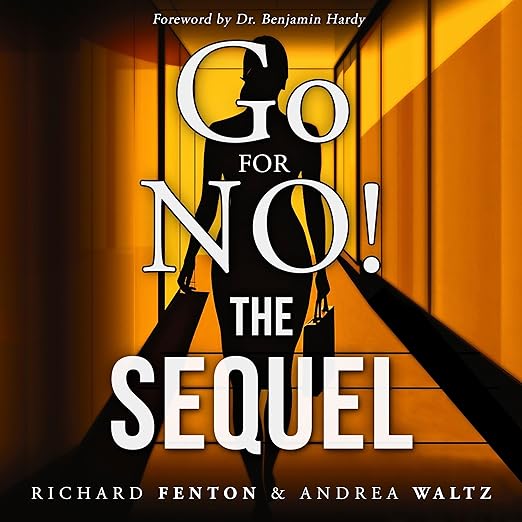
The question at the center of this audiobook is one that sequels rarely articulate as directly as Richard Fenton and Andrea Waltz do: what happens to someone after the philosophy works? The original Go for No! built its audience by following Eric Bratton through a supernatural encounter with a successful future version of himself, learning that the willingness to fail, to deliberately seek rejection rather than avoid it, is the differentiating factor between ordinary and extraordinary professional results. This follow-up, Go for No! The Sequel, picks up twenty-five years later, with Eric at the pinnacle of a career the first book made possible, facing a new fear that the original philosophy did not fully address: what do you do when you have already succeeded and still feel limited?
Our Take on Go for No!
The structural choice Fenton and Waltz make in this audiobook is to split the narrative weight between Eric and his daughter Cassidy. Eric is at a career peak, considering a major investment in a premier golf course that brings back the same fears and doubts the original book resolved decades earlier. Cassidy is graduating from college, driven but struggling with rejection in a way that has quietly eroded her confidence rather than building it. The pairing works because it prevents the sequel from simply being an extended coda to the original. Cassidy's storyline is genuinely new territory: the application of the Go for No philosophy to a young person who never had the original shock of encountering a possible future self.
Reviewer JR calls this an absolute must-read for anyone serious about reshaping their mindset for success. While the banned phrase belongs to the review rather than this write-up, the underlying observation is worth noting: the sequel's strength is in its treatment of the philosophy as something that has to be relearned at each new level rather than something that, once learned, remains permanently installed. That is a more sophisticated argument than many business parables bother to make.
Why Listen to Go for No!
Andrea Waltz narrating this material is the right choice and not simply for authorial authenticity. She is the co-originator of the Go for No philosophy, and she narrates with the particular ease of someone who has spent decades teaching these principles in person. Reviewer DLynnHidy describes being struck immediately by the note from Waltz and Fenton about the willingness to fail as a grounding principle of success, a theme from the original book they are still standing behind twenty-five years later. Hearing Waltz articulate that principle in her own voice gives it a weight that a hired narrator reading the same words could not quite replicate.
The parable format that made the original book work is intact here. This is not a business case study. It is a short novel with a business philosophy embedded in its plot mechanics, and at one hour and forty-one minutes, it is paced to function as a contained story with a clear arc rather than a series of cumulative lessons. That brisk runtime means the book makes no case for itself through accumulation. It either lands in the parable form or it does not, and reviewer Laura A. Templeton's description of a sequel that delivers exactly what she did not know she was waiting for suggests it does.
What to Watch For in Go for No!
Listeners who have not read or heard the original Go for No! will be at a slight disadvantage. The sequel references the core philosophy and its supernatural narrative framework with enough explanation to be coherent, but the emotional payoff in Eric's storyline depends on having a sense of what he went through in the first book. The philosophy itself is explained clearly enough for a new listener to follow, but the resonance of watching Eric face the same fears decades later is proportional to familiarity with where he started.
The runtime of one hour forty-one minutes positions this audiobook firmly in the short business parable category. Some listeners will find that length satisfying, a complete story with a clear philosophy delivered efficiently. Others will want more development in Cassidy's arc, which, while effective, is necessarily compressed within the available space. The book makes its choices about pacing deliberately, prioritizing the philosophical argument over extended character development.
The generational framing is one of the sequel's more interesting structural choices. By making Cassidy the second protagonist rather than a supporting character in Eric's story, Fenton and Waltz resist the temptation to simply replay the original book's dynamics with a slightly different backdrop. Cassidy does not have a supernatural encounter with a future self. She has a living father who has already made the journey, which is both a more realistic scenario and a different kind of emotional weight. The book is quietly making a point about how philosophy transmits across generations, which is a more complex argument than the original's cleaner parable, and it earns that complexity within its compact runtime.
Who Should Listen to Go for No!
This audiobook is for listeners who have engaged with the original Go for No! and want to see the philosophy extended into new territory. It is also valuable for anyone in sales, entrepreneurship, or any context where managing rejection is a practical daily requirement, who wants a parable format for the core principles without having to do the foundational reading first, though the original is short enough that starting there is still recommended.
Listeners who prefer data-driven business books over parable-based frameworks will find the storytelling format unconvincing regardless of how solid the underlying principles are. The book makes no apologies for being a story rather than a case study. For listeners who find narrative an effective vehicle for philosophical concepts, Go for No! delivers a clean, warm, and purposeful sequel that respects both the original and the reader's time.