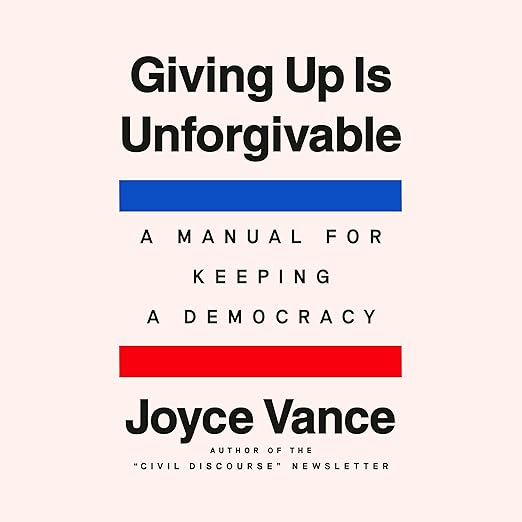
'We're in this together': four words Joyce Vance has closed every single Civil Discourse newsletter post with for years, so what happens when a constitutional law professor stretches that same closing line into a full-length audiobook argument? Vance narrates her own material, and the delivery carries the same clarity she's known for from years of televised legal commentary, measured, unhurried, never rushing past a legal or historical point before it's fully landed. This audiobook is explicit about its politics from the opening minutes: it positions itself directly as a countermovement to Project 2025 and a response to what Vance describes as the constitutionally calamitous start of the second Trump administration, so listeners should know exactly what they're getting before pressing play.
Fighting Exhaustion, Not Apathy, With a Plan
Whatever your position on the specific political claims, the book's structural ambition is worth taking seriously on its own terms. Vance splits her time between historical context, explaining prior moments of democratic erosion and how citizens responded, and direct, practical guidance for readers wanting to stay engaged without burning out. Reviewer Marc C. called it 'a compelling and urgent call to action,' adding that 'it breaks down the responsibilities of citizens in preserving democracy and emphasizes the importance of staying engaged, informed, and proactive.' That combination, history lesson plus actionable framework, is a deliberate structural choice, and it gives the argument more scaffolding than a pure polemic would have.
Vance's day job gives the self-narration real weight here. Reviewer Maluhia specifically mentioned watching her on MSNBC for years, calling her 'very articulate' and someone who 'knows what she's talking about,' and that on-air experience translates directly into an audiobook that never sounds like a first-time narrator reading unfamiliar material aloud. Miriam B. Kahn's review adds that the book stays 'clear' and 'concise,' focused on constitutional history and current legal developments rather than getting lost in abstraction, a fair description of how Vance structures her chapters throughout the relatively compact four-hour-fifty-three-minute runtime.
The book's title itself signals the specific emotional problem Vance is trying to solve, not apathy exactly, but exhaustion, the very real fatigue that comes from staying engaged with distressing news cycle after cycle. That's a narrower, more precise target than a generic call to political action, and it shapes the book's structure: less time spent convincing you the stakes are high, since her existing Substack readers already believe that, and more time spent on the specific mechanics of sustaining engagement without burning out completely. Readers exhausted by pure alarm-raising content, the kind that names every crisis but offers no next step, will notice the difference in emphasis fairly quickly.
The 'instant New York Times bestseller' tag attached to this title is worth reading as a signal of timeliness rather than just a marketing credential. Books responding directly to fast-moving political developments risk feeling dated within months, but the underlying argument here, that sustained civic engagement requires deliberate maintenance against burnout, is built to outlast any single news cycle, even as the specific examples Vance reaches for stay pinned to a very current moment.
From Chart-Topping Substack to Full-Length Argument
The book's endorsement from Mary L. Trump, calling it 'brilliant, galvanizing, and inspirational' and 'a road map to help us find our way out of the darkness,' signals plainly which audience this is written for and which perspective it's written from. Vance isn't attempting a both-sides civics primer; she's writing directly to readers who already share her concern about democratic erosion and want both historical grounding and a concrete plan for what to do next. Within that lane, the book succeeds specifically because Vance's legal training lets her explain constitutional mechanics, why certain norms matter, what specific legal thresholds mean, in plain language without ever condescending to listeners who aren't lawyers themselves.
As a Substack writer with what the synopsis calls a chart-topping following, Vance already has a proven track record of making dense civic and legal material accessible in short, regular doses. This audiobook is the long-form expansion of that same voice and approach, and listeners already familiar with her newsletter will recognize the register immediately: direct, urgent, but grounded in actual legal expertise rather than pure outrage. For anyone who has followed her Substack and wanted a fuller, more structured version of the same argument, this delivers exactly that.
A Partisan Case Compressed Into One Sitting
This is not, and does not pretend to be, a neutral or nonpartisan treatment of current politics. The synopsis itself frames the book as a direct countermovement to a specific political initiative, and listeners hoping for balanced coverage of competing viewpoints, or a sympathetic hearing for the current administration's positions, will not find either here. That's a deliberate authorial choice rather than an oversight, but it's essential to know before committing to nearly five hours of narration built entirely around one side of an intensely contested political moment.
At under five hours, the runtime is also relatively compact for a book covering constitutional history, current events, and practical civic guidance all at once, which means depth on any single thread stays somewhat limited by design. Listeners wanting an exhaustive legal or historical treatise should expect something closer to a galvanizing manifesto instead, built more for motivation and immediate action than for comprehensive scholarly coverage of the material it touches on.
Listeners should also know this audiobook compresses arguments Vance has developed across many individual newsletter posts into a single, denser sitting, which changes the reading rhythm considerably. A Substack post lands with room to breathe between installments; four hours and fifty-three minutes of continuous argument asks for a different, more sustained kind of attention, closer to one long op-ed than dozens of shorter ones stacked together.
For Readers Already Following Vance's Substack
Existing readers of Vance's Civil Discourse Substack wanting the long-form version of her argument are the clearest audience, along with anyone who already follows her legal commentary on television and wants a more structured, book-length treatment of her perspective. Listeners specifically seeking encouragement and a concrete framework for staying civically engaged without burning out, rather than pure historical analysis, will find the practical guidance genuinely useful. Fans of contemporary civics-focused nonfiction generally, in the vein of other current constitutional-law commentary, should also find the pacing and tone familiar and welcome.
Anyone hoping for a nonpartisan civics primer will not find one in this audiobook, since it's explicitly framed as a countermovement to a specific political program from the opening pages. Readers wanting exhaustive scholarly depth over a compact, motivational call to action should also adjust expectations given the relatively short runtime. Neither limits the book's value for its intended audience, but both are worth knowing clearly before you commit.
- Voice: Joyce Vance narrates her own argument with the same clarity and command she brings to her television commentary.
- Big ideas: Civic engagement and democratic norms, constitutional law explained plainly, resisting burnout in anxious political times
- Atmosphere: Urgent, direct, and unapologetically partisan
- Worth it?: A galvanizing listen for readers who already share Vance's politics, not a persuasion project aimed at skeptics.