Quick Take
- Narrator: Charlotte Gosling delivers a conversational, approachable performance that suits the book's explicitly non-intimidating positioning; her register is warm without being condescending, which is the right tone for financial content aimed at listeners who may have had previous anxiety around the subject.
- Subjects: Women and investing, closing the gender wealth gap, demystifying financial markets
- Tone: Encouraging and practical, like a frank conversation with a friend who happens to know about money
- Bottom line: A concise, accessible personal finance audiobook specifically designed for women who have been frozen at the entry point to investing, effective at what it sets out to do even if it covers less ground than more comprehensive texts.
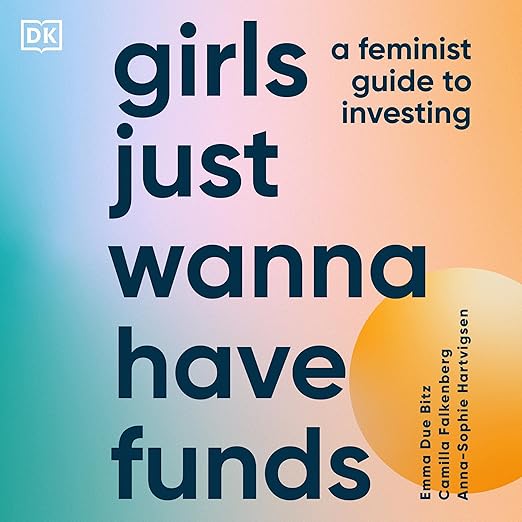
Female Invest, the Copenhagen-based global movement that Camilla Falkenberg co-founded with Emma Bonde and Anna-Sophie Hartvigsen, reached hundreds of thousands of women before it became a book. Girls Just Wanna Have Funds, narrated by Charlotte Gosling over 3 hours and 41 minutes, is the distillation of that movement's core argument into an audiobook bootcamp format: direct, structured, deliberately un-intimidating. The stat that opens the book's premise is the right one to start with. Sixty-eight percent of women worldwide earn less than a man doing exactly the same job. That gap is not closeable through income alone. The argument is that women need their money working in parallel, and that a specific set of structural and psychological barriers has prevented most women from taking that step.
The book does not pretend that those barriers are irrational. Finance has historically been a male-coded domain with deliberately opaque language, an industry that made women feel like outsiders even when they were sitting in the room. Female Invest's founding insight was that demystifying the vocabulary and the entry mechanics was more immediately useful to most women than academic financial theory. Girls Just Wanna Have Funds is the audio version of that insight: plain language, accessible frameworks, and an explicit message that expertise and capital are not prerequisites for beginning.
One Reviewer Found It Common Knowledge Already
Falkenberg's book works at its stated level. One reviewer described finally starting to "actively choose my investments" after reading it - action after years of paralysis is the specific outcome the book is designed to produce. Another found it "jam packed with information and super easy to digest." The third review in the set is worth noting too: a listener who found the information common knowledge and not sufficiently detailed. That range of responses maps directly to the book's intended audience and its limits. For women who are entirely new to investing, the information is not common knowledge; it is the precise set of concepts and permissions they needed to hear stated clearly and accessibly. For women already active in markets, the production will cover familiar ground.
The gender-specific framing is the book's most distinctive feature and the source of both its appeal and its scope limitation. By building the entire text around women's specific relationship to money - the pay gap, the confidence gap, the social messaging that positioned finance as someone else's domain - Female Invest created a book that speaks directly to a listener who has felt excluded from financial culture rather than merely uninformed about it. That directness is real value. The trade-off is that the framework also means the book stays at the level of entry-point empowerment rather than advancing into more sophisticated investment territory.
Gosling's Comfortable, Frank Register Simplifies Finance
Charlotte Gosling's narration is a significant reason this works as an audiobook rather than merely a text condensed into audio. The material needs a voice that normalizes the subject without trivializing it, and Gosling delivers precisely that: comfortable and frank, as though explaining something that is genuinely not as complicated as the finance industry has made it seem. Her pacing is brisk enough to suit the book's practical orientation without rushing past the explanations that need to land. For listeners who have found previous personal finance audiobooks either too intimidating or too aggressive in their confidence-building, Gosling's register is a welcome alternative.
The 3-hour-and-41-minute runtime is well-suited to the book's ambitions. Girls Just Wanna Have Funds is not attempting to replace a comprehensive personal finance education. It is attempting to get a specific kind of listener to the threshold where further education becomes possible. That task does not require 12 hours. It requires clarity and momentum, and the production delivers both. The goal-setting and market demystification sections in particular benefit from the audio format, where Gosling's delivery keeps the concrete frameworks from feeling like coursework.
From Lifestyle Enhancement to Practical Necessity
The sections on financial jargon are worth paying close attention to on the first listen, not because the material is complex but because Falkenberg is deliberate about the specific terms that function as entry barriers for new investors. Stocks, funds, diversification, risk tolerance: the book treats each of these not as knowledge to acquire but as gatekeeping language to demystify. That reframe - from intimidating vocabulary to transparent tool - is the production's central pedagogical move, and it is most effective when you catch it happening in real time.
The passage on the 68 percent gender pay gap and what it means for long-term wealth accumulation is also worth slowing down for. Falkenberg's argument is not simply that women should invest because men do. It is that the structural income disadvantage women face makes investment not a lifestyle enhancement but a practical necessity for building equivalent long-term financial security. That shift from aspiration to necessity is the reframe that the book's most resistant listeners need, and it is made with enough specificity to be persuasive rather than merely declarative.
Women Who've Called Themselves Not a Financial Person
Women who have identified as "not a financial person" and have deferred investment decisions indefinitely will find this audiobook directly relevant. First-time investors who want a low-barrier entry point with clear, jargon-free guidance are the primary audience. Listeners looking for advanced investment strategy, asset allocation frameworks, or tax optimization will not find sufficient depth here and should supplement with more comprehensive texts. The short runtime makes it a productive starting point rather than a complete curriculum, and its most likely path to impact is as the first audiobook in a listener's personal finance journey rather than the only one.
Questions Listeners Ask
Is this audiobook only relevant to women or is it useful for anyone new to investing?
The content is framed specifically for women and engages directly with gender-specific barriers to investing, including the pay gap and cultural messaging around finance as a male domain. The foundational investment concepts are universal, but the framing and the emotional register are designed for women who have felt excluded from financial culture. Male listeners will find the concepts accessible but the positioning explicitly gendered.
How does Charlotte Gosling's narration handle the financial terminology in this audiobook?
Well. Gosling's delivery normalizes financial vocabulary by presenting it with the same conversational confidence she applies to the non-technical sections. She does not slow down or shift register when financial terms appear, which reinforces the book's central message that this language is accessible rather than specialist. The tone remains consistent throughout.
Does this audiobook provide specific investment recommendations or actionable steps?
It provides frameworks and encouragement toward action rather than specific investment picks. The Female Invest approach is to equip listeners with the confidence to engage with their own financial decisions rather than to prescribe specific products or strategies. Listeners wanting detailed asset allocation guidance will need to follow up with more technical resources.