Quick Take
- Narration: Jef Holbrook brings controlled intensity to the moral crisis at the heart of this installment, calibrating the emotional cost of Gameknight’s impossible choice without melodrama.
- Themes: Friendship vs. duty, the corrupting nature of evil, the price of doing what is right
- Mood: Emotionally heavier than prior series entries, with genuine moral stakes that children will feel
- Verdict: The strongest entry in the Herobrine Reborn trilogy for emotional depth, the premise forces Gameknight into a situation where there is no clean answer, and the book doesn’t pretend otherwise.
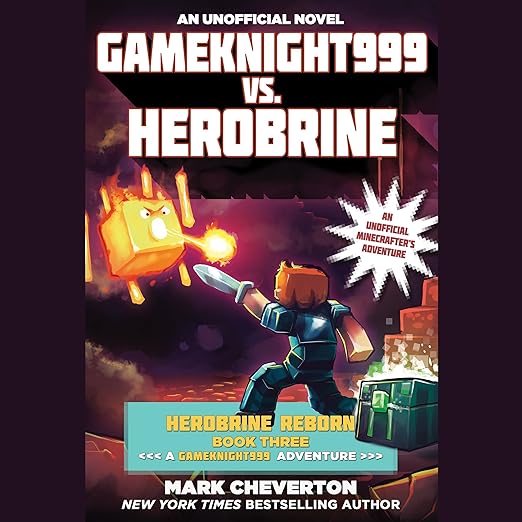
I saved this one for last in the Cheverton batch because the synopsis suggested it carried the most emotional weight of the group. I was right to. Gameknight999 vs. Herobrine is the third book in the Herobrine Reborn trilogy, and it turns what has been an action-adventure series into something that edges toward genuine moral fiction for young readers. The question at its center, how do you defeat an enemy who has possessed someone you love?, is not a question with a comfortable answer, and Cheverton doesn’t provide one.
The setup follows directly from the previous book. With the infected Ender Dragon defeated, Herobrine’s poisonous XP has been captured in an obsidian box. The plan is to destroy the box, but the group needs to take it somewhere it won’t cause harm first. During the voyage, Herobrine takes control of Herder, one of Gameknight’s closest friends, a quiet boy who cares for animals and has no guile in him whatsoever. Herder steals the obsidian box and flees to the Nether. When Gameknight finally catches up to him, the confrontation forces a choice: fight the friend who now carries the virus, or allow Herobrine to survive. The book’s refusal to make this easy is what distinguishes it.
Herder as the Series’ Moral Fulcrum
The choice of Herder as the character possessed by Herobrine is deliberate and meaningful. Herder is the most vulnerable member of Gameknight’s group, the one who doesn’t fight, who cares for animals, who was likely introduced precisely because he represents innocence within a battle-heavy narrative. Making him the vessel forces Gameknight, and the reader, to confront the possibility that protecting the world might require hurting the last person you’d choose to hurt. For children aged nine to twelve, that tension maps onto real social experiences in ways that simpler villain narratives don’t. The reviewers who note that their children devour these books are responding, I think, partly to this emotional honesty.
The Nether as a Landscape of Moral Pressure
Cheverton uses the Nether, Minecraft’s hellish dimension of fire, lava, and aggressive mobs, as the setting for this crisis, and the choice is thematically apt. The Nether is not a place characters go willingly; it is where the dangerous and unresolved things are. Battling blazes, zombie-pigmen, and ghasts while trying to reach and save a possessed friend adds physical pressure to the emotional stakes. The environment mirrors the internal experience: everything is hostile, visibility is limited, and there is no safe ground. Holbrook’s narration leans into this with controlled tension, avoiding the overemphatic delivery that could tip the Nether sequences into parody.
Thirteen Books Read Twice
One reviewer’s account stands out: their ten-year-old daughter has read all thirteen of Cheverton’s published books twice and has the next two pre-ordered. That kind of readerly commitment to a long-running series reflects world consistency, character continuity, and the experience of watching a protagonist grow over time. Gameknight999 vs. Herobrine, as a late series entry, benefits from all three. The emotional stakes of Herder’s possession are only fully felt by a reader who has spent eight or nine books understanding who Herder is, which is precisely why serial investment pays off here in a way a standalone book can’t replicate.
What Cheverton Gets Right About Children’s Fiction
The best children’s fiction does not protect young readers from difficult emotions, it provides a safe context for experiencing them. Cheverton understands this. Gameknight999 has been placed in increasingly difficult situations across the series, and this book brings him to the hardest one: the moment when doing right and protecting someone you love may not both be possible. The resolution exists, and it is satisfying, but the book earns it by genuinely sitting in the difficulty first. That is good storytelling regardless of the target audience.
Who Should Listen: Essential for readers following the Herobrine Reborn trilogy, and one of the stronger entry points for parents wanting to assess the emotional range of these books. Particularly well-suited for the ten-to-twelve end of the children’s age range. Who Should Skip: New listeners should begin with the Gameknight999 series from the start; the weight of Herder’s possession depends entirely on established affection for the character.
Frequently Asked Questions
Does Gameknight999 vs. Herobrine resolve the Herobrine story arc, or does it leave things open for more books?
This is the final book in the Herobrine Reborn trilogy and provides a resolution to that specific arc. Cheverton has written multiple series within the Gameknight999 universe, so while this concludes one thread, the broader world continues.
My child is upset by stories where friends are put in danger. How does Herder’s possession play out?
Herder’s possession is the emotional center of the book and is written with genuine weight rather than as a quick plot device. The situation is resolved within the book, but the confrontation between Gameknight and his possessed friend is genuinely difficult. It is handled with care rather than gratuitously, and is most appropriate for ages nine and up.
How does Jef Holbrook’s narration handle the emotional climax where Gameknight must confront Herder?
Holbrook maintains controlled intensity through the confrontation, avoiding theatrical excess while communicating the emotional stakes clearly. He understands that the scene’s power comes from restraint rather than volume, and his delivery reflects that judgment.
Is the Nether action in this book, the blazes, ghasts, and zombie-pigmen, described in detail that might frighten younger listeners?
The Nether sequences are vivid and kinetic, with multiple mob types described in combat detail. The tone is adventure fiction rather than horror, but the density of threat is higher than in earlier series entries. The nine-to-twelve age range is appropriate; younger children who are sensitive to intensity should wait until they’re more familiar with the series world.