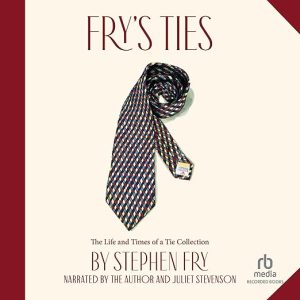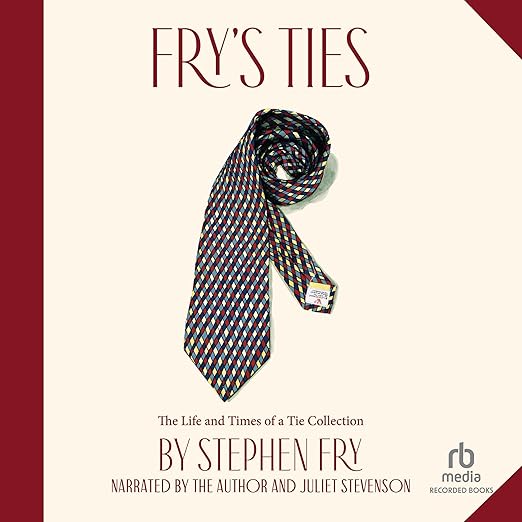
Fry's Ties began as an Instagram series and became a book that is, at its core, a memoir told sideways: not through years and events but through neckwear. Stephen Fry's collection of ties, spanning decades of public life and private obsession, serves as the organizing principle for an audiobook that is genuinely surprising in its range. What sounds like a novelty or a coffee table book compressed into audio turns out to be a vehicle for Fry at his most characteristically digressive and entertaining, moving from the Marylebone Cricket Club's traditional egg-and-bacon colors to the exuberant Dalmatian pattern of a 1980s Nicole Miller design with the ease of a man who has been thinking about this for a very long time.
The choice of Juliet Stevenson as narrator is interesting and, on reflection, correct. Stevenson is one of the great voices in British audio performance, with a capacity for comedy and pathos that few narrators match. Fry's prose here has a particular quality: warm, self-aware, capable of sudden depth underneath the wit. Stevenson handles the tonal shifts with the instincts of a seasoned stage actress, and the result is an audiobook that moves lightly but never superficially. Reviewer coffeetwo describes the book as a witty, illustrated ode to Fry's decades-long obsession, and Stevenson's narration gives that ode the performance it deserves.
The craft here lies in Fry's ability to make a narrow subject open outward. A chapter ostensibly about a tie from the MCC becomes a meditation on English class, cricket, and the particular codes that British institutions use to signal belonging. A piece about an 1980s designer tie becomes a window into that decade's excess and the specific texture of celebrity culture in that era. By the time the book reaches Fry's own essay about his necktie journey, the ties have accumulated the weight of a genuine autobiography. The book expanded its original Instagram content with additional material, and that new essay is reportedly among the most substantive additions, providing the reflective layer that a social media series inherently lacks.
The audio version does carry one meaningful limitation, which is worth being transparent about. The original book is illustrated, and several reviewers of the print edition specifically mention the pictures of Fry's collection as a great bonus. That visual dimension is necessarily absent in the audio version. Stevenson describes ties through Fry's prose with enough specificity that you can form a mental impression of the MCC stripes or the Dalmatian spots, but this is fundamentally a book that was designed with images in mind. Listeners who encounter the audio version and find themselves wanting to see the actual collection will not be disappointed by the print or e-book version; the two formats genuinely complement each other for this title.
Stevenson Restores the Oral Quality of Instagram
The audiobook format suits the essayistic, anecdotal quality of this material particularly well. Fry's original Instagram series was, in essence, a performed version of these pieces, and Stevenson restores something of that oral quality to the text. The diagrammatic content, which includes instructions for tying the Half Windsor, Van Wijk, and Prince Albert knot, is the one area where audio struggles relative to print, but those sections are brief relative to the overall runtime of just over four hours, and the knot-tying guidance is the kind of thing you are likely to look up with a separate resource anyway.
Reviewer M.P. Wilson describes the book as a page turner with a wealth of information on fashion, designers and history, as well as Fry's unique, witty perspective on life, and that assessment holds in audio form. The listening experience is closest to an extended, beautifully assembled anecdote, the kind of material that Fry has delivered in television and radio appearances for decades, now organized around a single subject and sustained across a satisfying runtime. For Fry fans, the audio version is an excellent choice. For listeners who encounter him for the first time through this audiobook, it serves as a particularly appealing introduction to his voice and sensibility.
Windsor Knots Are Better Learned From Print
The knot-tying diagrams deserve a realistic assessment. Stevenson reads the instructions competently, but audio is not the optimal format for learning to tie a Windsor. If that practical content is a draw for you, the print book will serve you better. The rest of the material translates to audio with minimal loss: the historical passages, the cultural observations, the personal essays, and the wit all travel well through Stevenson's performance.
It is also worth noting that the book's humor operates in a specifically British key. The references to the MCC, the specific cultural weight carried by the phrase egg and bacon in cricket contexts, and the class implications of tie culture in twentieth-century Britain all have a particular resonance for British or Anglophone listeners that may require a little more interpretive work for listeners without that cultural background. The humor is accessible regardless, but the densest cultural references land with somewhat more precision if you have the context. Reviewer mehnaz m. afridi's irreverent take on tie culture in the reviews suggests the book is capable of generating fondness even from readers who approach it with gentle skepticism.
Tie Collectors and Anglophiles Will Feel at Home
Stephen Fry fans are the primary audience, and they will not be disappointed. Beyond that core readership, the audiobook is well-suited to anyone with an interest in fashion history, British cultural history, or the specific pleasure of a writer who can make any subject interesting through the quality of their attention and prose. Tie collectors, Anglophiles, and anyone who enjoys the particular genre of the witty cultural essay will find this audiobook a comfortable four-hour investment. Listeners hoping for a practical guide to men's style or a comprehensive history of neckwear should calibrate expectations: this is personal and anecdotal rather than encyclopedic, and all the richer for it.
At a Glance
- Voice: Juliet Stevenson brings a warmth and dry wit to Fry's prose that honors the book's blend of personal memoir and cultural history.
- Big ideas: fashion as autobiography, the social history of men's dress, nostalgia and self-expression
- Atmosphere: Genial and erudite, with the feel of a very good after-dinner conversation
- Worth it?: A witty, companionable audiobook that turns a neckwear collection into a genuine tour of cultural history, personality, and understated British humour.
Good to Know
Does the audiobook version of Fry's Ties work without the illustrated images from the print book?
It works as an audiobook, though with a meaningful trade-off. The print edition is illustrated with photographs of Fry's actual tie collection, which reviewers consistently praise. Stevenson reads Fry's vivid descriptions of each tie, so you form a mental picture, but the visual element is genuinely absent. Some listeners may want to supplement the audio with a look at the print or digital edition for the full experience.
Why does Juliet Stevenson narrate rather than Stephen Fry himself?
The choice is not explained in the available materials. Stevenson is an acclaimed British actress with an extensive audio performance career, and she handles Fry's voice and register with considerable skill. Whether Fry's own schedule or a deliberate creative choice drove the casting is unclear. What is clear is that Stevenson's performance is warmly received and well-matched to the material.
Is this audiobook more of a fashion guide or a personal memoir?
Primarily the latter. While the book includes material on tie history, designers, and knot-tying technique, its core is autobiographical: Fry uses his collection as a way to reflect on his own life, taste, and cultural formation. Reviewer M.P. Wilson describes it as rich in fashion, designers, and history alongside Fry's unique witty perspective, which captures the balance well.
Is Fry's Ties audiobook suitable for listeners unfamiliar with Stephen Fry?
Yes, though Fry fans will get the most from it. The audiobook works as a standalone piece, and Juliet Stevenson's narration is accessible regardless of prior familiarity. For new listeners, it serves as an effective introduction to Fry's sensibility: digressive, humane, erudite, and consistently amusing. Those who enjoy it may want to explore his memoir 'Moab Is My Washpot' or his 'Mythos' audiobooks next.