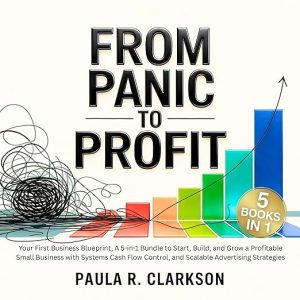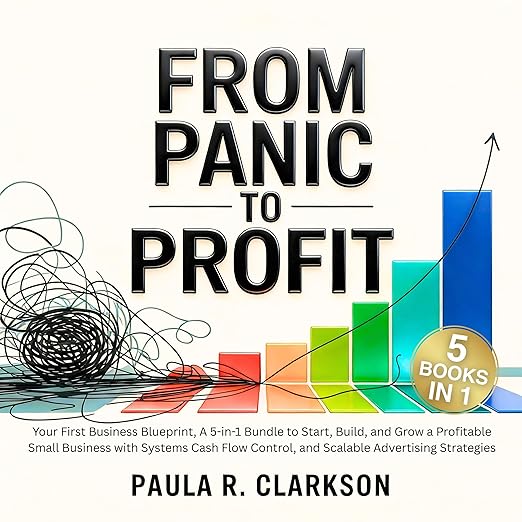
Why does growing revenue so often create more stress instead of more freedom? That question sits at the center of this audiobook, and Paula R. Clarkson spends fifteen chapters answering it with calculations and scripts rather than motivational language. From Panic to Profit positions itself against the typical business book that sells inspiration without arithmetic, structuring its material as a practical roadmap across five parts and fifteen chapters aimed at getting small business owners out of what Clarkson calls the busy but broke cycle. The pitch is blunt from the opening line: most business books sell a dream, and this one is built to show the math instead.
A True Hourly Rate and a Freedom Number
The book's structure leans hard on concrete tools rather than abstract encouragement, including how to calculate a true hourly rate and what Clarkson calls a freedom number, two exercises meant to turn vague financial anxiety into an actual figure a listener can act on. That specificity is the book's real selling point, and it delivers on its own promise of being built for action, not theory, more consistently than most business audio in this space manages.
Clarkson also includes word-for-word scripts for some of the hardest conversations small business owners avoid, raising prices, firing a bad customer, negotiating a better deal, which moves the book past generic advice into something closer to a rehearsal tool. With only twenty-five listener ratings recorded so far, this is clearly a newer, more niche release, but the perfect score among those early responses lines up with how tightly the content sticks to its own stated premise.
Structure Ties Back to the Same Cash Flow Math
The five-part structure signals real intentionality: Clarkson moves from diagnosing why revenue growth creates stress, into pricing and customer decisions, and finally into hiring and scaling without burnout, which mirrors the actual sequence most small business owners hit as their companies grow. Rather than treating growth as an unambiguous good, the book explicitly frames unchecked growth as a common source of the busy but broke cycle it is trying to solve.
Operational structure forms the third pillar alongside cash flow and pricing, and this is where the book moves from financial diagnosis into the practical mechanics of actually running the business day to day. Rather than treating structure as a separate topic from money, Clarkson ties staffing decisions, workflow, and pricing directly back to the same cash flow math established earlier, which keeps the book feeling like one continuous argument rather than five loosely connected sections.
Wayman Won't Rush Past the Arithmetic
KC Wayman's narration favors plain-spoken clarity over performative enthusiasm, which suits a book that explicitly rejects the hype-driven tone of most business audio. Numbers-heavy material like true hourly rate calculations or pricing formulas needs a narrator who will not rush past the arithmetic for the sake of energy, and Wayman's steady pacing gives listeners room to actually follow the math rather than just absorb the vibe of it.
With fifteen chapters packed into three hours and twenty-four minutes, each chapter runs under fourteen minutes on average, which keeps the material digestible in short listening sessions rather than demanding a long uninterrupted sitting. For an audience already described as working harder than ever and still struggling to pay themselves, that bite-sized structure is a practical fit for a genuinely busy schedule.
That anti-hype stance is unusual enough in the business self-help genre to be worth naming directly. Most books in this category sell confidence and momentum first and practical mechanics second, if at all, while Clarkson inverts that order almost entirely, treating emotional reassurance as secondary to giving listeners a number they can act on immediately.
The scripts for firing bad customers and negotiating better terms deserve particular mention, since these are exactly the conversations most small business owners avoid until a crisis forces their hand. Having actual language to work from, rather than just the abstract advice to be more assertive, is the kind of concrete tool that separates this book from the broader shelf of confidence-focused business coaching.
Curiosity-Gap Titles and Numbered Benefit Lists
Listener reviews have not accumulated yet for this newer release, so anyone considering it is working with less outside validation than a more established business title would offer, even with a strong perfect average across its first twenty-five ratings. The book also leans heavily on companion materials, an included PDF and a flashcard-based course meant to reinforce the concepts, and while the spoken content holds up fine on its own, the self-assessment exercises clearly assume a listener willing to pair the audio with those print and digital tools.
The presentation itself leans into direct-response marketing conventions, curiosity-gap chapter descriptions and numbered benefit lists, more than most traditionally published business books do. That is simply a fact about tone rather than a knock on substance, but listeners expecting a more restrained, traditionally edited business book should know the packaging reads closer to a self-published guide built for a very specific, action-oriented reader.
Eliminating Bad Customers Before Adding Staff
The hiring and scaling material toward the back of the book addresses a real gap in a lot of small-business advice, which tends to stop at pricing and cash flow without addressing what happens once an owner needs to bring on help without recreating the same burnout at a larger scale. Clarkson's insistence on eliminating unprofitable customers before adding staff is a sequencing choice worth flagging, since it runs against the instinct to hire first and sort out margins later.
The ninety-day implementation plan mentioned throughout is meant to translate the book's calculations into a concrete sequence of actions rather than leaving listeners with formulas and no clear starting point. Whether ninety days is realistic for any given business depends heavily on how disorganized its finances already are, but the existence of a defined timeline at all sets this apart from business books that stop at diagnosis without offering a path through implementation.
Profitable on Paper, Personally Underpaid
Solo business owners, freelancers, and service providers who are technically profitable but personally underpaid are the clearest audience here, especially anyone who wants concrete calculations rather than mindset coaching and is comfortable doing homework alongside the listening. Owners already tracking their numbers closely but stuck on pricing or customer selection will likely get the most direct value from the scripts and formulas Clarkson provides.
Freelancers and solo service providers who have never formally studied business finance will likely get outsized value here, since the true hourly rate exercise alone can reframe how a listener prices their own time going forward.
Business owners hunting for inspiration or storytelling over spreadsheets should set expectations accordingly, since Clarkson's entire pitch rests on the idea that the math matters more than the pep talk. Anyone allergic to direct-response marketing language in their nonfiction may also find the packaging a little more sales-forward than the genuinely practical content underneath it deserves.
The Short Version
- Voice: KC Wayman delivers a plain-spoken, no-hype read that matches the book's anti-motivational stance.
- Big ideas: Cash flow control, pricing confidence, sustainable small-business profit
- Atmosphere: Brisk, practical, spreadsheet-minded
- Worth it?: A tight, math-first alternative to motivational business books, best paired with its companion materials.
Common Questions
Does the From Panic to Profit audiobook include the companion PDF and flashcard course mentioned alongside it?
Yes, the audiobook purchase comes with an accompanying PDF and a flashcard-based course meant to reinforce the concepts, though the exercises themselves require pairing the audio with those written materials.
Is the From Panic to Profit audiobook useful without doing the accompanying exercises?
The core spoken content, including the calculations and scripts, holds up fine on its own, though listeners who skip the companion self-assessments will miss part of the reinforcement Clarkson builds the book around.
How many chapters does From Panic to Profit cover, and how long is each one?
Fifteen chapters run across three hours and twenty-four minutes, which works out to under fourteen minutes per chapter on average, a structure built for short, repeatable listening sessions.
Is KC Wayman's narration a good match for a numbers-heavy business audiobook?
Yes, the plain, unhurried delivery gives listeners room to follow calculations like the true hourly rate exercise instead of rushing past the arithmetic for the sake of energy.