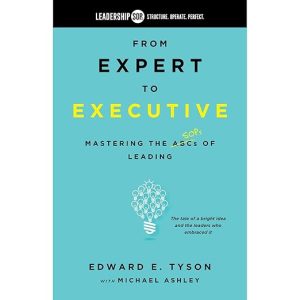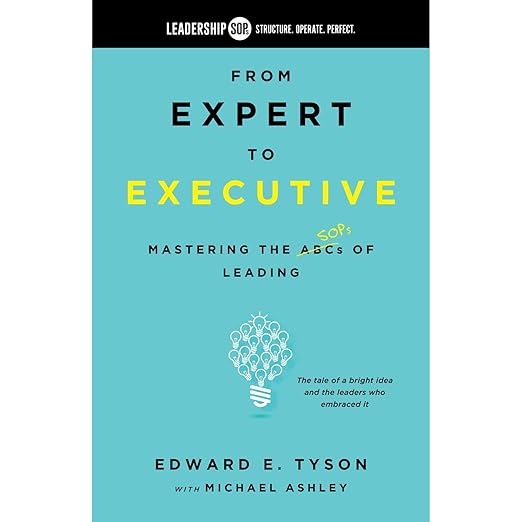
Ed Tyson's core insight lands harder than most leadership books manage: too many people get promoted into leadership because they were excellent at the job underneath it, not because anyone actually taught them how to lead. From Expert to Executive delivers that argument through an unusual structure for a business audiobook, a fictional case study built like a novella, following six invented leaders and one job applicant across more than a decade as they wrestle with Tyson's LeadershipSOPs framework in practice rather than in the abstract.
SOPs Means Two Things at Once Here
Tyson, a former Marine turned executive turned coach, builds his central framework around a mnemonic double meaning: SOPs as standard operating procedures for how to lead, and SOPs as the specific areas, structuring, operating, and perfecting communities of effort, leaders need those procedures for. Reviewer Scott D. summarized the diagnosis at the heart of the book plainly: too many people become supervisors because 'they are the best at the job,' with the false assumption baked in that task mastery automatically produces leadership skill, when in Tyson's telling those are two entirely different competencies.
Reviewer Cris H. brings real weight to the book's credibility: over 40 years in leadership and organization development, more than 200 leaders coached directly, and dozens of leadership programs designed and facilitated. Her verdict, that the book 'puts it all together,' carries more authority than a typical five-star review because it comes from someone with the professional background to actually judge whether Tyson's framework holds up against decades of comparable material in the field.
Not Enough Leaders Are Actually Leading
Tyson's Marine Corps background is worth dwelling on specifically, since military leadership development is built around exactly the transition this book addresses: taking someone skilled at an individual task and deliberately, systematically teaching them to lead others through it, rather than assuming the skill transfers automatically. That formation shows in how structured the LeadershipSOPs framework is; standard operating procedures aren't a business metaphor borrowed loosely, they're a direct import from a world where documented, repeatable process is treated as a matter of consequence, not just efficiency.
The book's opening diagnosis, that 'not enough leaders are actually leading,' taps into a genuinely widespread problem in management literature: promotion systems that reward technical mastery while treating leadership itself as something people should already intuitively know how to do. Tyson isn't the first to name that gap, but the LeadershipSOPs framework's specific contribution is turning a diffuse cultural complaint into a documented, repeatable methodology rather than leaving it as an observation without a fix attached.
This Has Real Precedent in The Goal
The novella structure is the book's most distinctive choice: rather than a dry textbook stacking principle after principle, Tyson dramatizes the LeadershipSOPs framework through six fictional leaders and one applicant navigating real workplace stakes over more than ten years. That narrative approach gives abstract leadership theory somewhere to actually live, case studies with names and consequences attached, rather than bullet points asking a listener to imagine the application themselves.
Reviewer A. Slater, who described following management books 'for decades,' found real personal value in the specific SOPs acronym, crediting it with prompting genuine self-examination about their own team. That kind of response, a seasoned reader of the genre still finding a new framework worth internalizing, suggests Tyson's central model earns its place in a fairly crowded category rather than repackaging familiar advice under a new name.
The business-novella hybrid format has real precedent, going back to books like The Goal, which used a fictional plant-manager crisis to teach operations theory, and From Expert to Executive works in that same tradition: abstract principle demonstrated through invented but plausible workplace consequence rather than asserted as a bullet-pointed rule. The synopsis's own diagnosis of why development programs fail is unusually specific for the genre: most training wrongly assumes leaders already know how to differentiate their own work from their team's, a precise naming of the actual gap rather than a vague call for better leadership training.
Tyson's identity as a coach specifically, rather than a consultant or an academic, shapes the book's register throughout: coaching implies an ongoing, personalized relationship built around a client's actual situation, not a one-size-fits-all lecture, and the novella's six-leader case-study structure mimics that same individualized attention on the page. Each fictional leader gets their own specific struggle rather than serving as a generic stand-in for leadership problems broadly, a coach's instinct: meet the particular person's particular block, not the abstract category.
Seven Characters Test What Virtual Voice Can Do
Virtual Voice narrates this one, which raises a real question for a book built specifically around a dramatized cast: seven distinct characters, each presumably given their own dialogue and workplace conflicts to voice across a novella-length case study. AI narration handles straightforward business exposition reasonably well, but differentiating that many characters across a decade-spanning fictional narrative is a much harder technical demand, and no reviewer commentary confirms how well the performance actually manages that specific challenge.
None of the three attached reviews mention narration quality specifically, which is common for business titles where readers evaluate the framework rather than the audio performance, but it does mean this specific casting choice, Virtual Voice handling dramatized fiction rather than straight nonfiction, is genuinely untested by the available listener feedback. Buyers who've had mixed experiences with AI narration on character-driven material elsewhere should weigh that honestly before committing to six hours.
A matrix of interconnected stories spanning this many characters over such a long timeline is a genuinely ambitious structure for a six-hour audiobook, and listeners should expect real complexity tracking which character's arc is illustrating which specific SOP at any given moment. This isn't a single, linear case study; it's closer to an ensemble piece, which pushes the narration-differentiation question even further, since Virtual Voice has to keep multiple interwoven timelines legible without the vocal shorthand a skilled human narrator would use to help listeners track who's speaking.
This Specific Production Remains a Real Open Question
New and recently promoted managers are the obvious core audience, especially anyone who got the job by being the best individual performer on the team and now feels underprepared for what leading that same team actually requires. Veteran executives looking for a more sophisticated, scalable framework, and mentors who coach other leaders, will also find real use in the LeadershipSOPs model specifically, per Cris H.'s professional endorsement.
Listeners who find AI narration distracting in fiction-adjacent material, or who specifically want a human performer differentiating a multi-character cast, should know that's a real open question with this specific production. Readers who prefer a straightforward, bullet-pointed business book over a novella-style case study should also consider whether the fictionalized format will hold their attention across six hours as effectively as a more conventional structure would.
Before You Press Play
- Performance: Virtual Voice handles a fictionalized business novella with an untested multi-character cast
- What it covers: leadership versus expertise, standard operating procedures for leading, career transition
- Feel: Practical and case-study driven
- Our call: A genuinely useful leadership framework, with narration that's a real open question for the format
Does Virtual Voice narration work for this audiobook's fictional case study?
That's a real open question. The book dramatizes its leadership framework through six fictional leaders and one applicant, and none of the available reviews specifically address how the AI narration handles that dramatized, multi-character format.
How long is the From Expert to Executive audiobook?
It runs 6 hours and 7 minutes.