Quick Take
- Narration: Dan Hillaker delivers Fight the New Drug’s material with a clean, accessible voice suited to the teen and young adult audience, the tone is coaching rather than clinical, which matches the book’s self-help structure.
- Themes: pornography addiction recovery, neuroscience of compulsive behavior, peer community as recovery support
- Mood: Earnest and action-oriented, written for young people who want tools, not judgment
- Verdict: A well-structured recovery guide aimed specifically at teens and young adults, combining neuroscience basics with a practical training program, honest about its limitations if you approach it expecting clinical depth.
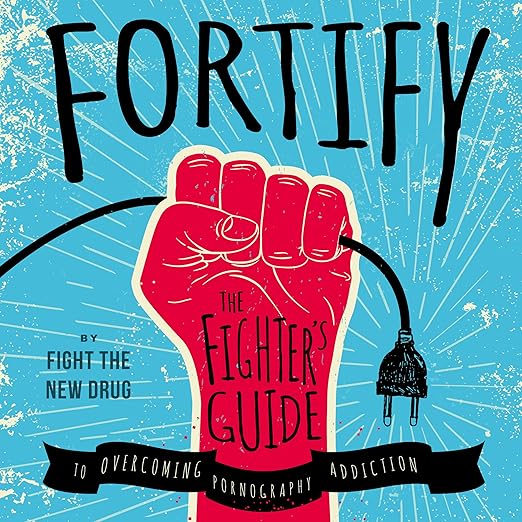
Let me be clear about what Fortify is and isn’t before I say anything else, because this is a book where the framing matters enormously. It is not a clinical resource. It is not a book written by therapists for therapists, or by researchers for researchers. It is a recovery guide designed for teenagers and young adults, written by the nonprofit Fight the New Drug, and its architecture is explicitly that of a training program rather than a treatment protocol. Understanding that scope is essential for evaluating it fairly.
Fight the New Drug was founded in 2009 and has since built a significant presence in schools and online spaces around the argument that pornography functions like an addictive substance, that it rewires neural pathways, escalates in the same way drug addiction escalates, and requires deliberate intervention to overcome. This is a contested position in clinical psychology, where the diagnostic status of pornography addiction remains debated. Fortify does not engage with that debate in any depth. It takes the addiction framework as its operating assumption and builds a recovery program on top of it.
The Training Program Architecture
What Fortify does well is organize its material in a way that gives young listeners something concrete to do. The basic training metaphor runs throughout the book: listeners are positioned as fighters in a battle, equipped with education, tools, and a peer community framework. This framing works better for its target audience than a more clinical approach might. Teenagers do not typically respond well to being told they have a disorder. They respond somewhat better to being told they can get stronger.
The neuroscience sections, which explain the dopamine pathways and reward mechanisms involved in compulsive pornography use, are simplified but not inaccurate. Hillaker reads them with the kind of clarity that makes basic neuroscience accessible without condescending. The book draws on the work of addiction researchers and therapists, and while it doesn’t cite them in the rigorous academic sense, the underlying framework is recognizable to anyone who has read more technical accounts of behavioral addiction.
What the Reviews Tell Us About Who It Reaches
The reviews for Fortify cluster around two types of listeners: parents and spouses who found it for someone else, and young people who came to it themselves and found the language finally matched their experience. One reviewer writes that it was “exactly what I needed” and mentions using the book alongside the companion Fortify app. Another notes the power of having the harm of pornography named plainly rather than minimized. These are signals worth taking seriously. The book is reaching the people it was designed for, and it’s reaching them in the way peer-to-peer recovery resources work: not through clinical authority but through recognition.
The app companion mentioned in reviews is worth noting for audio listeners specifically. The book references a digital platform that extends the training program beyond what the audiobook contains, with accountability features and community components. Listeners who engage with the book as a complete standalone text may feel they’re missing something, because they are. The Fortify app is the delivery mechanism for much of what the book describes as its recovery program. This is worth knowing before you begin.
The Limitations That Matter
The book’s duration, just over seven hours, covers a lot of ground but at a level of depth that will not satisfy listeners looking for clinical nuance. The addiction framework it employs has critics in the research literature, and the book doesn’t acknowledge that complexity. The recovery program it describes, while sensibly structured around community, accountability, and skill-building, does not include guidance on when professional therapeutic support might be necessary. For young people with significant underlying anxiety or depression alongside compulsive pornography use, the self-help framework here may be insufficient on its own.
The book is also explicitly non-religious, which is notable given the subject matter. Fight the New Drug positions itself as a secular, science-based organization, and this distinguishes Fortify from other anti-pornography recovery resources that center faith communities. That secular framing will matter for some listeners and not for others.
Who This Is For
Listen to this if you are a teenager or young adult looking for a framework to address compulsive pornography use, or if you are a parent trying to understand what resources might support a young person in your life. The book is honest about what it is, a training guide, not a therapy manual, and within that scope it is well constructed. Listen also if you want to understand Fight the New Drug’s approach and philosophy, since Fortify is its most comprehensive articulation of that approach in audio form.
Skip it if you are looking for clinical depth, research engagement, or guidance for adults with long-standing compulsive behavior patterns that have resisted other interventions. For those cases, a licensed therapist specializing in behavioral addictions will serve better than any audiobook.
Frequently Asked Questions
Is Fortify appropriate for adults, or is it specifically designed for teenagers?
The book is explicitly aimed at teens and young adults, its language, metaphors, and peer-community framing are calibrated for that age group. Adults dealing with similar issues may find the approach patronizing or insufficiently complex. That said, several reviewers indicate the core framework translates to adult listeners, particularly those who respond to coaching-style self-help rather than clinical treatment models.
Does the audiobook reference a companion app, and is the app necessary to benefit from the book?
Yes, reviews mention the Fortify app as an extension of the program described in the book, with accountability features and community components. The audiobook provides the educational and conceptual foundation, but the full recovery program the book describes is partly delivered through the app. Listeners should be aware that the book and app are designed as a system.
Fight the New Drug takes the position that pornography is addictive. Is this position scientifically mainstream?
It is contested. The addiction framework applied to pornography use is not yet recognized as a formal diagnosis in the DSM-5, and researchers disagree about whether compulsive pornography use meets the criteria for addiction versus other compulsive behavior patterns. Fortify does not engage with this debate, it takes the framework as its operating premise. Listeners should know this going in.
Is this book explicitly religious or faith-based?
No. Fight the New Drug explicitly positions itself as a secular, science-based organization, and Fortify reflects that. The book does not draw on religious frameworks or address faith communities specifically. This distinguishes it from other anti-pornography recovery resources that center church communities and scriptural guidance.