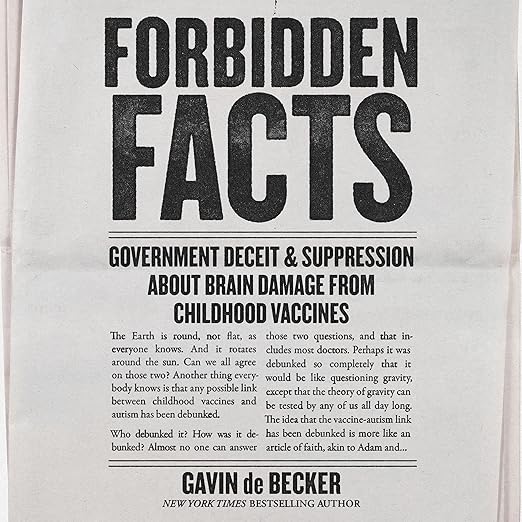
Gavin de Becker built his reputation on The Gift of Fear, a book about trusting instinct in the face of danger, and this audiobook turns that same investigative instinct toward government and pharmaceutical institutions instead of individual threats. Forbidden Facts argues that agencies and corporations have coordinated to bury inconvenient research, a claim de Becker frames as straightforward conspiracy rather than speculation, backed by what the listing describes as real-time access to original source material. At five and a half hours, self-narrated by de Becker himself, this is a focused, single-argument audiobook rather than a sprawling survey of institutional wrongdoing across many unrelated topics.
QR Codes on Every Page, Aimed at Skeptics
De Becker's central method, according to reviewer Bushkin78, is citation-heavy: all pages have 'QR codes to look up his references, citations,' a production choice that signals an author anticipating skepticism and building in a way for listeners to verify claims independently rather than take his word alone. That approach matters for a book making contested claims about vaccine safety and government transparency specifically; whatever a listener's starting position on those questions, de Becker structures the argument to be checkable rather than purely rhetorical in its presentation.
Reviewer KatieInAthens, who read The Gift of Fear previously, describes de Becker's style as economical: he 'doesn't waste a lot of words, gets right down to the point and brings the receipts.' That reputation for directness carries over here, and reviewer Teach1 focuses specifically on a chapter addressing childhood vaccine recommendations, quoting de Becker's own framing that decisions made in the past are 'beyond our reach,' with the real question being what to do with new information now.
The Gift of Fear, de Becker's best-known previous book, built its reputation on a fairly uncontroversial premise: that intuition about danger is often more reliable than people give it credit for, and that premise made it a mainstream bestseller assigned in some safety-training contexts. Forbidden Facts applies a similar trust-the-signal, question-the-official-story instinct to a much more contested domain, government and pharmaceutical accountability, which is worth understanding as a genuine extension of de Becker's established worldview rather than a random pivot into unrelated territory.
A 4.8 average across 501 ratings is a strong reception number, though it is worth remembering that ratings on a book this ideologically charged often reflect an audience that self-selected specifically because they already agreed with de Becker's premise going in, rather than a broad cross-section of listeners encountering the argument with no prior position. That self-selection dynamic is common for advocacy nonfiction generally and does not by itself say much about how the arguments would land with a genuinely undecided or skeptical listener approaching the material cold.
De Becker Narrates in His Own Trusted Cadence
Self-narration matters especially for an author this closely associated with his own written voice: de Becker has built an entire career on being the person readers trust to tell them uncomfortable truths plainly, and that reputation gives the audiobook a direct, unmediated quality a hired narrator could not replicate. Whatever a listener makes of the underlying claims, hearing de Becker deliver his own argument in his own cadence is closer to the experience of reading his prose silently than most narrated nonfiction manages to achieve.
That tight scope also means de Becker never has to pad the argument with tangential grievances just to fill runtime, a discipline not every advocacy nonfiction title manages. The QR-code citation system described by reviewers suggests a book designed to be paused and checked against, which is a genuinely different listening mode than most narrative nonfiction invites from its audience, closer to fact-checking a report than following a story start to finish.
The QR-code-per-page citation system described in reviews is primarily a print and ebook feature, and it is worth asking how, or whether, that verification pathway carries over meaningfully into an audio-only format where a listener cannot glance at a page mid-sentence to scan a code. Audio listeners motivated to actually check de Becker's sources will likely need to cross-reference against a print or digital copy afterward rather than doing so in the moment, a real structural limitation for a book whose core appeal rests partly on its verifiability.
Snarky, Pointed, and Openly Picking a Side
This book takes an explicitly skeptical, adversarial position on government and pharmaceutical institutions, and specifically on vaccine safety claims, subjects where mainstream scientific and public health consensus differs sharply from the argument de Becker makes here. Listeners should go in aware that this is advocacy nonfiction built around a specific, contested thesis, not a neutral survey of competing evidence, and should weigh its claims against other sources rather than treating the QR-coded citations alone as settling the matter conclusively.
Bushkin78's review captures the book's tone honestly: snarky and pointed rather than dispassionate, which will land differently depending on whether a listener already shares de Becker's skepticism toward institutional authority going in. Readers drawn to The Gift of Fear for its calm, practical safety advice should know Forbidden Facts operates in a considerably more combative register, closer to investigative polemic than personal safety guide.
Investigative nonfiction that leans heavily on primary-source citation, QR codes linking to original documents in this case, sits in a specific subgenre alongside other citation-forward books that anticipate reader skepticism and try to preempt it with receipts rather than rhetoric alone. Whether that structural choice actually persuades a skeptical listener depends heavily on how rigorously those underlying sources hold up under independent scrutiny, something a listener has to do their own work to evaluate rather than take entirely on faith from the narration alone.
Assembling Evidence Matters More Than the Verdict
This suits existing fans of de Becker's earlier work curious how his investigative instincts apply outside personal safety, along with listeners already inclined toward skepticism of government and pharmaceutical institutions who want a citation-heavy version of that argument rather than an unsourced rant. Anyone interested in true-crime-adjacent investigative nonfiction with a specific institutional target, rather than a single criminal case, will find de Becker's directness suits the material well.
Listeners who enjoy true-crime and investigative journalism specifically for the process of building a case, assembling evidence, naming sources, testing claims, rather than for a tidy resolution, will likely appreciate de Becker's methodical approach here regardless of where they land on his specific conclusions.
Listeners comfortable sitting with genuine ambiguity, rather than needing a narrator to resolve every contested claim definitively, will get the most out of this specific listening experience. De Becker presents his case with conviction, but the underlying subject matter remains actively debated well beyond the boundaries of this one audiobook.
Skip it if you are looking for de Becker's more universally applicable personal-safety guidance in the vein of The Gift of Fear; this is a considerably more polarizing, narrowly focused argument about institutional trust and vaccine safety specifically. Listeners who prefer nonfiction that presents competing evidence evenhandedly, rather than building a single sustained case, should know this book is built entirely around advocating one specific, contested position throughout.