In Brief
- Performance: A single reader carrying outline, regulation and worked examples, with nothing on a screen to point at.
- What it covers: Food truck launch planning, permits and health compliance, quiz-based business learning
- Feel: Methodical and undramatic, built for repetition
- Our call: The scope and the quiz format are real value, but the numbers need a desk and the page around them is careless.
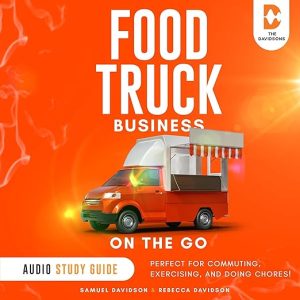
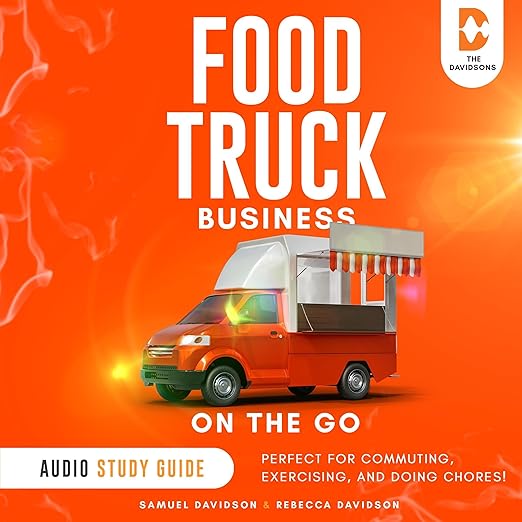
Somebody decided that a food truck business plan could be learned entirely by ear, and this audiobook is the result: nineteen hours and forty-four minutes of concept design, permit talk and practice questions, aimed at people whose days are already full. The description is unusually plain about its own theory of learning. The rhythm of traffic, footsteps on a treadmill, the repetition of daily chores: those are the slots it wants to fill. Whether the theory holds depends almost entirely on which part of the material you happen to be in at the time.
A Study Guide With No Test to Pass
A study guide implies a test. This one names none. No certifying body appears anywhere in the description, no exam, no licensing board with a published syllabus, and the practice questions are described only as "current-style", a phrase borrowed from certification prep and applied to a trade that does not certify. What you actually get, going by the publisher's own outline, is a business course delivered in a quiz-and-explanation format. That is not a fault. It is simply a different product from the one the words on the listing suggest.
Nothing in the outline is unconventional, and nothing is missing: concept, menu, market research, a business plan with financial projections, operations and marketing strategy, then licensing, permits and health inspections. Samuel Davidson claims no originality for any of it. The description says the guide draws on "the same principles found in leading business and hospitality manuals" and "the same core components recommended in professional food truck planning frameworks", without naming a single one of them. Read that as an honest signal of what this is: a competent synthesis rather than a practitioner's account of running a truck.
One more thing is worth knowing before you buy. The publisher line and the byline share a surname, and the series is called Davidsons Audiobooks: On the Go, which tells you this is a self-published operation producing a catalog of ear-first study guides. Nothing is wrong with that model, and the subject suits it. But it does mean the authority behind the material is the synthesis itself rather than a named operator with a truck and a route, and expectations should be priced accordingly.
Commit to an Answer Before the Explanation
Format is the honest argument here. Regulation is the part of the food truck business that people skip, and it is exactly the part that is dull to read and perfectly tolerable to hear. Business licenses, food service permits, health inspections, compliance with local rules: the description gives that material a full passage, and a spoken version has a real advantage over a printed one, because you will actually get through it. Anybody who has abandoned a chapter on permits halfway down the first page knows the problem this format solves.
Breadth is the second gain. This is a long recording for one trade, and the time goes on the whole arc rather than on the glamorous slice. Scenarios ask you to plan menus, calculate costs, choose locations and evaluate operational decisions, which is a wider range of thinking than most single-topic guides attempt. If you want one item that runs from the first idea to an open service window, the scope really is here, and very little of it is padding.
Quiz structure earns its keep as well. Being asked a question and then hearing the reasoning is a better use of listening time than being handed a fact, because it forces you to commit to an answer before the explanation arrives. The description frames this as thinking "like a business owner and problem-solver rather than simply absorbing theory", and that framing is fair. I hear this technique far less often in business audio than I would like, and it is the most interesting decision on the whole listing.
Miano Alone Carries the Boundary by Pause
Question and answer is also the production's hardest problem. Print separates a practice question from its explanation with white space, numbering and often a page turn. Audio has none of those. Anthony J. Miano is the only credited voice, so the boundary between a question and the reasoning that follows has to be carried by pacing and pause alone, and if you want to attempt an answer yourself you have to reach the pause button before the explanation begins. Sample a stretch containing a question and listen for how much air sits around it.
Arithmetic is the other casualty. Financial projections, cost calculations and pricing decisions are the spine of this subject, and numbers are what audio handles worst. You cannot scan a column of figures by ear, you cannot drop back three lines, and a worked cost calculation heard once at road speed leaves very little behind. Plan on a notebook for those sections, or plan on rehearing them at a desk. The promise to learn anywhere holds for the regulatory and conceptual material and holds a great deal less well for the money.
This page itself needs a note. A perfect five across nine ratings with not one written response means you are buying on a number that carries no reasoning, and nine is a sample size rather than a verdict. The listing also shelves this under home and garden alongside its business category, a filing decision nobody hunting for a business plan would predict. The name the description gives the product, Food Truck Business: The Complete Audio Study Guide, is not the title displayed above it, and the series line carries a name with no number, so you cannot tell where this sits among the others.
The Word Cooking Never Once Appears
This suits the person seriously weighing a truck who wants to find out what they do not yet know, before spending money on anything at all. It suits an existing food business owner considering a mobile arm, and it suits anybody who learns by being questioned rather than by reading. Culinary creators are named in the description as part of the audience, though I would put the weight on the business half of that pairing rather than the food half.
Nothing here is about cooking. The word never appears in the description, and no recipe, equipment list or note about the food itself is promised anywhere on the page. An operator already running a truck is the wrong buyer too, since the material aims squarely at the pre-launch stage, and so is anybody who needs the financial sections to stick, because those are the ones a moving vehicle will take from you. Buy it for the permits, the planning and the questions, and accept that the money chapters want a second pass sitting still.
Does this audiobook prepare you for an actual certification exam?
No exam or certifying body is named anywhere on the listing, and the food truck trade does not run one that this material points at. Treat the quizzes as a way of testing yourself on a business course, not as preparation for a formal qualification you could put on a wall or hand to an inspector.
Can you follow the financial projection sections while driving?
Not well. Cost calculations, pricing and projections are the parts audio handles worst, because you cannot scan figures or drop back three lines to check one. Save those passages for a session at a desk with something to write on, and give the driving time to the regulatory and concept material, which survives the transfer intact.
Does this audiobook cover cooking or recipes?
No. The description talks about designing a concept and creating a menu, and the word cooking never appears in it. Nothing promises recipes, equipment specifications or ingredient sourcing. This is a business course about a food business, and the food itself is treated as a commercial decision rather than as a craft to be taught.
Why does the five-star average here tell you so little?
The whole of it rests on nine votes, and nobody has written a sentence to explain any of them. Nine people clicking a star leaves no reasoning behind, no sense of who they are and no way to know whether a single one of them reached the end. On a recording this long, that gap matters far more than it would on a short one.