Quick Take
- Narration: Julie Eickhoff handles the conversational interview format well, maintaining a natural back-and-forth rhythm that makes the transcribed dialogue feel organic rather than stilted.
- Themes: pharmaceutical overreliance, whole-food nutrition science, food politics and medical misinformation
- Mood: Direct and galvanizing, occasionally alarming but ultimately practical
- Verdict: A pointed, evidence-backed argument for dietary intervention over medication that works best for listeners already questioning conventional medical advice.
I came to this one during a week I had spent reading about the American healthcare system, already a bit ragged from thinking about pharmaceutical spending statistics. I pressed play on a Tuesday morning walk, intending to give it twenty minutes. I stayed with it through the afternoon, and by the time I sat down for dinner, I was rethinking what was on my plate.
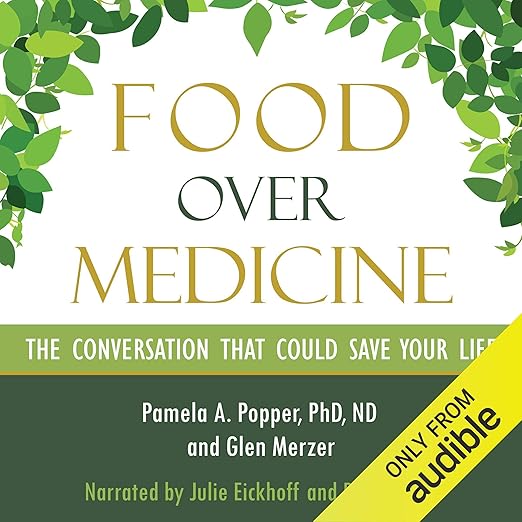
Food over Medicine is unusual in its format: what you are essentially listening to is a transcribed conversation between Pamela Popper, a naturopathic doctor who runs the Wellness Forum, and her co-author Glen Merzer. That structure, which could easily have felt like a podcast someone forgot to edit, actually becomes the audiobook’s greatest asset. The exchange of questions and answers creates a natural pace, and Popper’s responses have the candor of someone who has made this argument so many times she no longer needs to soften its edges. She names the problem plainly: Americans are overmedicated, malnourished, and misinformed by decades of dietary guidance that served industry interests more than patient outcomes.
The Argument That Carries Everything
The central thesis is blunt: most chronic diseases are not inevitable, and the drugs prescribed to manage them address symptoms rather than causes. Popper’s position, backed by references to scientific literature throughout the conversation, is that dietary intervention outperforms pharmaceutical treatment across a range of conditions including diabetes, hypertension, heart disease, and obesity. This is not fringe territory she is covering, though it will feel confrontational to anyone heavily invested in the conventional model. She cites studies, names researchers, and distinguishes between observational data and clinical trials with the precision of someone who anticipates being challenged.
What separates this from the more evangelical corners of the plant-based nutrition world is the attention paid to misinformation itself. Popper and Merzer spend real time examining why common beliefs, like the idea that everything in moderation is sound nutritional advice, persist despite evidence to the contrary. The food industry’s influence on nutritional research, medical school curricula, and public health guidelines gets examined here with specificity rather than vague gesturing.
When the Conversation Gets Uncomfortable
There are moments where the tone tips from authoritative into absolute, and a more skeptical listener may bristle. Popper’s confidence in the whole-food, plant-based framework is essentially total, and she handles dissenting studies with less generosity than she handles supporting ones. For someone already aligned with this approach, that will feel like strength. For someone coming in genuinely undecided, a few passages may read as advocacy dressed in the language of science. That tension is worth acknowledging.
Still, the specificity here is a virtue. This is not a book that tells you to eat more vegetables and less sugar before moving on. Popper walks through the mechanics of how particular dietary patterns affect disease markers, why popular diets like low-carb produce results that look promising in the short term but are difficult to sustain or interpret over longer periods, and what the peer-reviewed record actually shows versus what has filtered into popular nutrition culture.
The Audio Format as a Feature
Julie Eickhoff’s narration deserves recognition for a challenge specific to this kind of material. A transcribed dialogue, rendered by a single narrator, risks losing the conversational texture entirely. Eickhoff subtly differentiates between Popper’s responses and Merzer’s questions, giving the exchange enough tonal variation that you do not lose track of who is speaking. At five and a half hours, the runtime is efficient without feeling compressed. This is a book that respects the listener’s time, and Eickhoff’s delivery respects the listener’s intelligence. Reviewer Daniel Calvisi called it both enlightening and entertaining, and that combination is genuinely rare in health nonfiction. The subject matter earns that description here.
Who Should Listen and Who Should Not
This audiobook is well suited for listeners who are already questioning the role of prescription medication in managing chronic conditions, who have a family history of diseases linked to lifestyle factors, or who are curious about the evidence behind plant-based dietary approaches. It is also valuable for anyone trying to understand why nutritional advice has been so inconsistent and contradictory over the past several decades.
Listeners looking for a balanced survey that gives equal weight to multiple dietary philosophies will find this one-sided. Listeners who are currently managing serious conditions and considering significant dietary changes should treat this as a starting point for a conversation with their physician, not a prescription in itself. And if your relationship to food and medicine is already settled and you are not open to having it examined, the book will frustrate rather than interest you.
Frequently Asked Questions
Is this book the same as Raymond Francis’s Never Be Sick Again, or are they different titles?
These are two entirely separate books by different authors. Food over Medicine is authored by Pamela A. Popper and Glen Merzer and argues for dietary intervention as an alternative to pharmaceutical management of chronic disease. Raymond Francis’s Never Be Sick Again is a different title with a different theoretical framework.
Does the interview format make this harder to follow as an audiobook?
Actually the opposite. The back-and-forth dialogue between Popper and Merzer gives the material a conversational rhythm that is easier to sustain on audio than a conventional chapter structure might be. Narrator Julie Eickhoff manages the voice differentiation well enough that you rarely lose track of who is speaking.
Does Pamela Popper address the low-carb and ketogenic diet arguments directly?
Yes, with some specificity. Popper examines why short-term results on low-carb diets can look compelling while arguing the longer-term evidence does not support them for disease prevention. This section may be the most contentious for listeners who have had personal success with those approaches.
Is there scientific sourcing throughout, or is the book primarily based on the authors’ clinical experience?
Popper references published research throughout, including clinical trials and population studies, though the conversational format means citations are not delivered the way they would be in a formal academic text. Listeners who want to verify specific claims will benefit from also consulting the print edition, which includes source notes.