Before You Press Play
- Narration: Kirsten Potter's documentary restraint refuses to perform emotion, which lets this morally tangled disaster story make its own case.
- Themes: Disaster medicine, moral ambiguity, institutional failure under Hurricane Katrina
- Mood: Somber and unflinching
- Verdict: A demanding but essential seventeen hours for readers of investigative journalism and healthcare ethics.
Potter Refuses to Perform Grief or Outrage
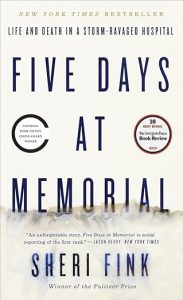
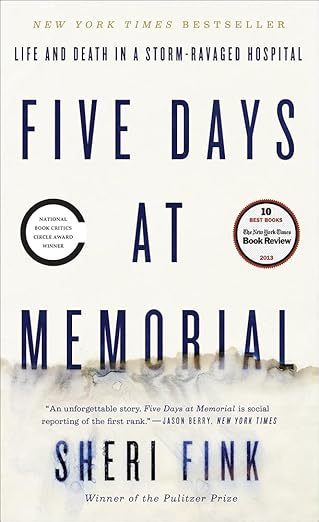
Seventeen hours is a long time to sit with impossible medical choices, which is almost exactly how long this audiobook asks of you, and I'd plan for a genuinely sustained stretch of listening, a long solo drive or several focused evenings, rather than background noise during chores. Sheri Fink spent six years reporting Five Days at Memorial, and the Pulitzer Prize credential the synopsis leads with refers to her original investigative journalism on this same story before it became a book, which is worth knowing because it signals just how deeply reported the material underneath this audiobook actually is.
The core event is almost unbearably specific: after Hurricane Katrina's floodwaters rose and Memorial Medical Center in New Orleans lost power in the summer heat, exhausted caregivers made real-time decisions about which patients to evacuate first and which to designate 'last for rescue.' Months later, several of those same caregivers faced criminal allegations that they had deliberately injected patients with drugs to hasten their deaths rather than let them suffer through a rescue that might never come. Fink reconstructs those five days hour by hour, building toward a genuinely difficult question about health care rationing under total institutional collapse.
Narrator Kirsten Potter's documentary restraint, refusing to perform grief or outrage even when the material would fully justify either, is exactly the right instrument for a story this morally tangled. She narrates the same way Fink apparently reports, without editorializing, which forces you as a listener to sit with the ambiguity rather than have it resolved for you by vocal cues. A 4.4 average across more than 2,600 ratings, plus the synopsis's note that this made the New York Times' Best Ten Books of the Year, suggests that discomfort has been widely recognized as the book's actual strength.
Fink's reporting instincts on display here carried forward directly into her later work; she continued covering healthcare crises and disaster response as a New York Times reporter in the years since, including extensive reporting during the COVID-19 pandemic's own hospital capacity crises. That continuity matters for how you read this book now: the specific dilemma at Memorial, medical staff forced into rationing decisions no training fully prepares anyone for, turned out not to be a one-time disaster-era anomaly but an early, acute preview of questions health systems would face again on a much larger scale.
Sustaining Restraint Across Seventeen Hours Is Harder
What makes this more than a disaster chronicle is Fink's refusal to hand you a verdict. The synopsis itself frames the book as unspooling the mystery of what happened rather than prosecuting a case, and that structural choice, six years of reporting bent toward genuine uncertainty rather than a predetermined conclusion, is rare in true-crime-adjacent nonfiction, where narrative momentum usually demands villains and vindication by the final chapter. Here, the caregivers' impossible position, no clear protocols, failing equipment, rising water, dwindling supplies, gets rendered with enough specificity that easy judgment becomes genuinely difficult to sustain.
The book also functions as a much broader argument about disaster preparedness that extends well past one hospital's crisis. Fink uses Memorial as a specific, deeply reported case study to ask how prepared any health care system actually is for the kind of total infrastructure collapse Katrina caused, and that question has only gained relevance as climate-driven disasters have become more frequent since the book's original publication. Listeners interested in healthcare policy, disaster response planning, or medical ethics will find the Memorial case functioning as a genuinely useful worked example rather than an isolated horror story.
Sustaining that restraint across seventeen hours is its own kind of discipline worth naming. A narrator's instinct over that many hours tends to drift toward more expressive delivery simply to maintain listener engagement, especially through material this emotionally heavy; Potter's ability to hold a steady, unadorned register from the first hour to the last, without the performance ever tipping into either dramatization or detachment, is a harder needle to thread than a shorter, more overtly emotional book would require.
The book's title refers to the specific five-day window between the hurricane's landfall and the hospital's eventual full evacuation, and Fink's reporting makes clear just how much can go wrong within a window that short when every layer of expected support, the power grid, the evacuation chain of command, outside communication, fails simultaneously. New Orleans's levees failed catastrophically in the days after Katrina made landfall in August 2005, and Memorial's crisis unfolded as one specific, deeply human consequence of that much larger infrastructure and governmental failure, which is part of why Fink treats the hospital as a case study rather than an isolated tragedy.
Absent a Verdict, the Reckoning Is Yours
This is graphic, sustained medical and disaster content, patients dying in extreme heat without power, difficult end-of-life decisions made under total duress, and eventual detailed discussion of possible deliberate lethal injections, and listeners sensitive to medical trauma or mortality should know that going in rather than discovering it mid-listen. It's also worth flagging that the health-wellness genre tag attached to this listing undersells what the book actually is; this is investigative journalism bordering on true crime, not a self-care or wellness title, and going in with wellness-genre expectations will misalign badly with the actual content.
Seventeen hours is genuinely substantial, longer than most narrative nonfiction of this kind, and Fink's hour-by-hour reconstruction of the five days themselves means the pacing stays deliberately granular rather than compressed for efficiency. That density is the book's whole method, not a flaw, but listeners wanting a tighter, more summarized true-crime-adjacent listen should recalibrate expectations toward a genuine long-form investigative commitment rather than a brisk single-sitting read.
It's worth knowing the eventual legal outcome going in, since the book builds real tension around it: a grand jury ultimately declined to indict the physician at the center of the criminal allegations, a resolution Fink reports on directly rather than treats as a twist to withhold. Knowing that outcome ahead of time doesn't diminish the listen; if anything, it sharpens the book's real question, since the absence of a courtroom verdict means the moral reckoning has to happen entirely inside the listener rather than getting resolved externally by a jury.
Disaster-Protocol Readers Get a Worked Example
This audiobook is essential listening for readers of investigative journalism, healthcare workers and administrators interested in disaster protocol, and anyone drawn to genuinely difficult ethical questions handled without an easy resolution supplied for you. It also rewards listeners who appreciated the moral complexity of books like this one enough to sit with real discomfort rather than needing a tidy verdict by the final hour.
Skip this one if you need to avoid detailed medical and mortality content, or if you're looking for a shorter, lighter true-crime listen rather than a demanding, six-years-in-the-making investigative deep dive. Readers specifically wanting the health-wellness genre this listing is filed under, practical self-care content rather than institutional catastrophe, should look elsewhere entirely; that tag is a mismatch for what this book actually delivers.
How graphic is the medical content in this audiobook?
Substantial. It covers patients dying under extreme heat and power loss, real-time end-of-life triage decisions, and later criminal allegations of deliberate lethal injections, all in specific, reported detail, so sensitive listeners should be prepared.
Does this audiobook conclude whether the caregivers were guilty, or stay neutral?
It stays deliberately neutral. Sheri Fink structures the book around uncovering what happened rather than delivering a verdict, and narrator Kirsten Potter's restrained delivery reinforces that same refusal to editorialize.
Is seventeen hours a long commitment for this kind of audiobook?
Yes, at seventeen hours it runs considerably longer than most investigative nonfiction, and the pacing stays deliberately granular through an hour-by-hour reconstruction, so it rewards sustained listening over a quick single sitting.
Does the narration stay restrained given the book's difficult subject matter?
Yes. Kirsten Potter avoids performing grief or outrage even in the story's most difficult passages, a documentary approach that keeps the moral ambiguity intact rather than resolving it through vocal cues.